Europe on alert: What the Dutch vote means for Brussels



Moses Becker is a political commentator for News.Az. He holds a PhD in political science and specializes in interethnic and interreligious relations. The views expressed in this article are the author’s own and do not necessarily reflect the position of News.Az.
The Netherlands, a small but economically powerful country at the heart of Europe, is once again at the center of political attention. The early parliamentary elections on October 29 are far more than a domestic affair — they are a litmus test for the European Union’s future. The results will reveal whether European integration still commands confidence among EU citizens or whether the continent is drifting toward a new era of nationalism, cultural identity politics, and migration skepticism.
The stakes could not be higher. The Netherlands is not just another EU member — it is a founding nation of the European project, a country that helped shape the idea of a united Europe after the devastation of World War II. Its economy, among the most innovative and export-oriented in the world, stands as a model of efficiency and liberal values. With a GDP exceeding one trillion dollars and ranking 17th globally, the Netherlands remains an anchor of stability. But politically, that stability is beginning to erode.
At the center of this political storm stands Geert Wilders, leader of the Freedom Party (Partij voor de Vrijheid, PVV) — a man who proudly calls for a “stronger and prouder Netherlands” and who has been dubbed “the Dutch Trump.” His party’s rise is striking: from barely 6% of the vote in 2006 to nearly a quarter in 2023. Wilders’s rhetoric is a potent mix of nationalism, cultural preservation, and frustration with Brussels. His message is simple: Dutch citizens should come first.
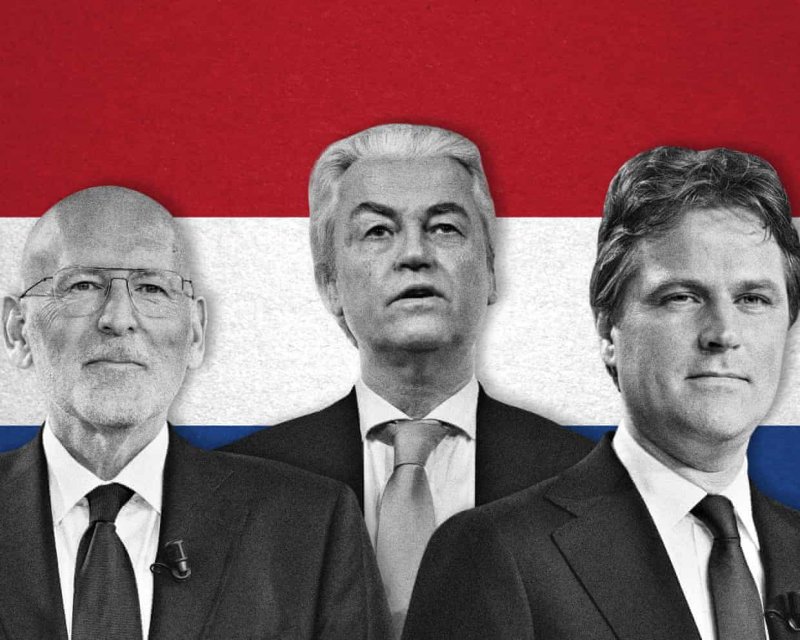
Photo composite: Guardian Design/Shutterstock
Wilders speaks to those who feel left behind by globalization and alienated by the EU’s migration and climate policies. His manifesto calls for closing borders to “fortune seekers,” cutting financial aid to foreign countries, and ending what he describes as “climate madness” and “diversity nonsense.” He openly advocates for a Dutch exit from the EU, insisting that the Netherlands must regain control over its laws, borders, and finances. For many in Brussels, this represents a nightmare scenario — the resurgence of Euroscepticism in a founding EU state.
His popularity surged after the government appeared unwilling to confront supporters of Hamas within the Netherlands. That moment crystallized a sense among many Dutch citizens that their leaders were more concerned with global virtue signaling than with defending national values. The Freedom Party’s cultural platform is unapologetically nationalist: it defends Dutch traditions like Zwarte Piet, Christmas, and Easter, rejecting what it sees as the erosion of national identity in the name of political correctness.
Critics label Wilders’s platform as extremist or even racist, but his appeal cannot be dismissed. He has learned to walk a fine line between radical populism and mainstream conservatism, carefully distancing himself from outright hate speech while still channeling public anger at unchecked immigration and EU bureaucracy. He presents Islam not as a religion, but as a “totalitarian ideology” incompatible with Dutch secularism — a stance that resonates with voters disillusioned by years of political correctness and rising crime rates.
Photo: Martin Bergsma | Credit: Shutterstock
The Freedom Party’s program goes far beyond cultural issues. It proposes cutting taxes, reducing the size of government, abolishing the Senate, lowering the retirement age, and even taxing the royal family. It mixes right-wing cultural nationalism with left-leaning economic populism — a formula that has proven successful across Europe, from Marine Le Pen’s France to Italy’s Brothers of Italy and Germany’s AfD.
But Wilders’s chances of forming a government remain slim. Despite his strong polling numbers, other major parties have declared they will not form a coalition with the PVV. The ruling coalition itself collapsed earlier this year over disputes about migration, underscoring how deeply this issue divides Dutch politics. During televised debates, Wilders called for the “immediate suspension of all asylum applications” — a statement that captured headlines but alienated potential partners.
Still, the symbolism of his rise matters more than his immediate prospects. The Netherlands is a bellwether for Europe — a country that often signals trends before they spread across the continent. The growing resonance of Wilders’s message echoes similar developments elsewhere: the steady advance of right-wing populists in France, Germany, Italy, and Sweden. As the German newspaper Frankfurter Rundschau noted, the idea that right-wing parties will “discredit themselves” in power has not proven true.
Instead, they are learning to govern — and to win.
What makes the Dutch case so revealing is that it reflects not only anger at migration but also fatigue with technocratic governance. For many voters, Brussels has become distant, unaccountable, and obsessed with ideology. Issues like climate regulation, gender policy, and multiculturalism dominate EU debates while everyday economic concerns — inflation, housi
(If you possess specialized knowledge and wish to contribute, please reach out to us at opinions@news.az).


Similar news