Final warning: Trump targets BRICS


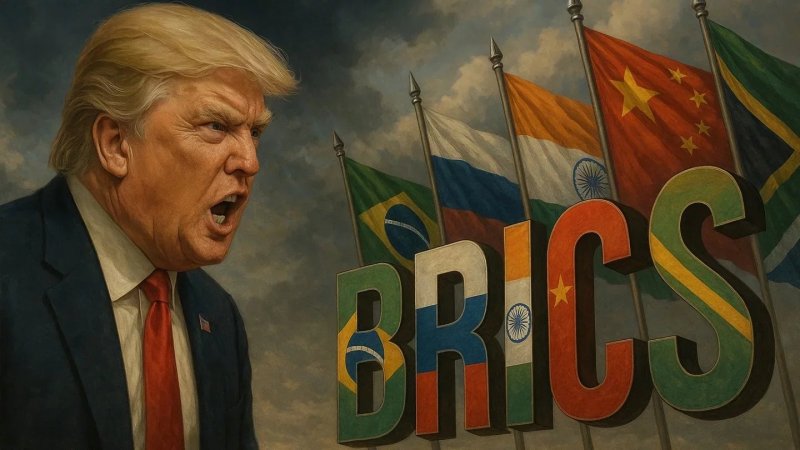
Not a day without controversy. Several days ago, U.S. President Donald Trump warned that countries supporting BRICS policies contrary to American interests would face additional 10% tariffs.
"Any country that follows anti-American BRICS policies will be subject to an additional 10% tariff. There will be no exceptions to this policy," Trump wrote on social media.
The warning came in response to a joint statement by the finance ministers of BRICS countries at the summit in Rio de Janeiro, according to the BBC. The ministers criticized U.S. tariffs as a threat to the global economy, claiming they create “uncertainty in international economic and trade activities.” The bloc also proposed reforms to the International Monetary Fund (IMF) and changes in how global currency values are assessed.
The White House's reaction was swift—and in turn, BRICS members responded with confusion.
“This format has never been and will never be aimed against any third countries,” said Kremlin spokesman Dmitry Peskov, commenting on Trump’s statement. “We are indeed aware of President Trump’s remarks, but BRICS cooperation is not directed against anyone,” he told RBC.

Source: Youtube
Other member states also responded. As reported by China's CGTN, Brazilian President Luiz Inácio Lula da Silva stated: “I don’t think it’s responsible or serious for the president of a country as large as the United States to threaten the world online. BRICS is a new model. It is not a closed group or a club of privileged nations. These are countries striving to build a new form of global economic organization. China is leading the way in transitioning to a low-carbon economy. This should serve as an example to the G7 and many other wealthy countries.”
South African President Cyril Ramaphosa also broke his silence, telling reporters that BRICS is not trying to compete with any other country.
CGTN noted that China’s Ministry of Foreign Affairs has repeatedly spoken out against tariff wars and emphasized that BRICS is an open and inclusive platform that does not target any specific country.
It should be noted that this is not Trump’s first attack on BRICS. Even before returning to office, he was already accusing the bloc of harboring anti-American intentions. In January, he threatened 100% tariffs on member countries if they attempted to “play games with the dollar.”
Source: Watcher Guru
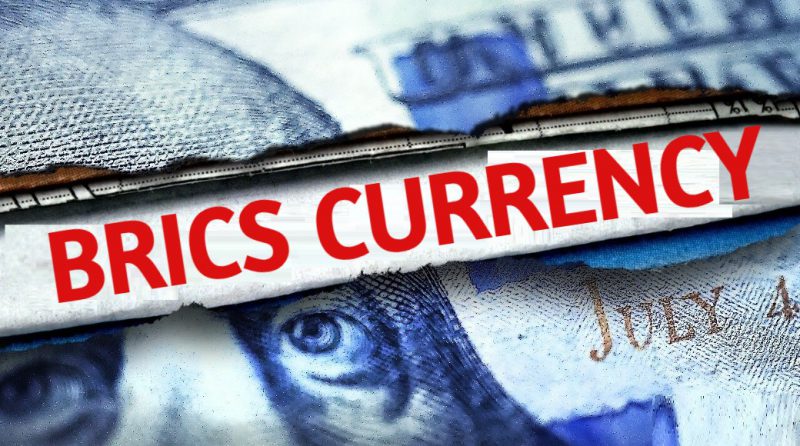
“We will demand that these seemingly hostile nations refrain from creating a BRICS currency or supporting any other currency aimed at replacing the mighty U.S. dollar. Otherwise, they’ll face 100% tariffs and lose access to the magnificent American market,” Trump was quoted as saying by RBC.
In February, according to TASS, Trump raised the threat to 150%.
“BRICS countries tried to destroy our dollar. They wanted to create a new currency,” he said during a dinner with the Republican Governors Association in Washington. He suggested that BRICS might attempt to adopt the Chinese yuan. The lack of a direct response to these threats was interpreted in Washington as a sign of fear—fear of losing access to the U.S. market if any attempt to bypass the dollar were made.
This time, too, BRICS members have largely avoided making strong public statements. There could be two reasons: either the issue of a new currency was never seriously discussed at the Brazil summit, making Trump’s comments little more than a storm in a teacup, or the member states—aware of the U.S. president’s unpredictable nature—prefer not to provoke further hostility.
On April 2, Trump moved from words to action by publishing a list of countries that would be subject to the new tariffs. He declared the day as "America’s Liberation Day." The initial implementation date was set for July 9, but has now been pushed to August 1. When reporters pressed him for clarification, Trump replied vaguely: “There will be tariffs. Tariffs will be tariffs.”
Talks about a unified BRICS currency first emerged on August 22, 2023, during the 15th BRICS Summit in Johannesburg. It was reported that the currency would likely be based on a basket of the member countries’ currencies. The primary goal was to reduce dependence on the U.S. dollar and the euro.
According to analysts at Gazprombank, a potential BRICS currency could undermine the global role of the dollar while simultaneously strengthening the currencies of BRICS member states. If the currency is created, it could lead to several consequences: a negative trend on U.S. stock markets, falling share prices, higher yields on U.S. government bonds, and more expensive imports.

Source: Investing
JPMorgan experts Alexander Wise and Ian Lois believe the biggest threat may not be the devaluation of American assets but the geopolitical fallout. It is geopolitics—not de-dollarization—that could slow economic growth and fuel inflation. In such conditions, Global South countries may shift away from the dollar and euro in favor of a BRICS currency.
Be that as it may, with Trump’s return to the White House, discussions of a BRICS currency have largely moved behind closed doors.
As Russian economist Igor Makarov told MK.ru after the Brazil summit: “No one in BRICS wants revolutionary initiatives right now, and the word ‘dollar’ is being avoided altogether because of Trump’s threats to impose 10% tariffs.”
By Tural Heybatov


Similar news