Lachin triangle: A new center of gravity in global politics


Editor's note: Abulfaz Babazadeh is a scientist and Japanese scholar, political observer, member of the Union of Journalists of Azerbaijan. The article expresses the author's personal opinion and may not coincide with the view of News.Az.
When the world is shaken by global crises and old alliances strain under the pressure of emerging interests, the most consequential moves on the chessboard of global politics often take place in locations once considered peripheral.
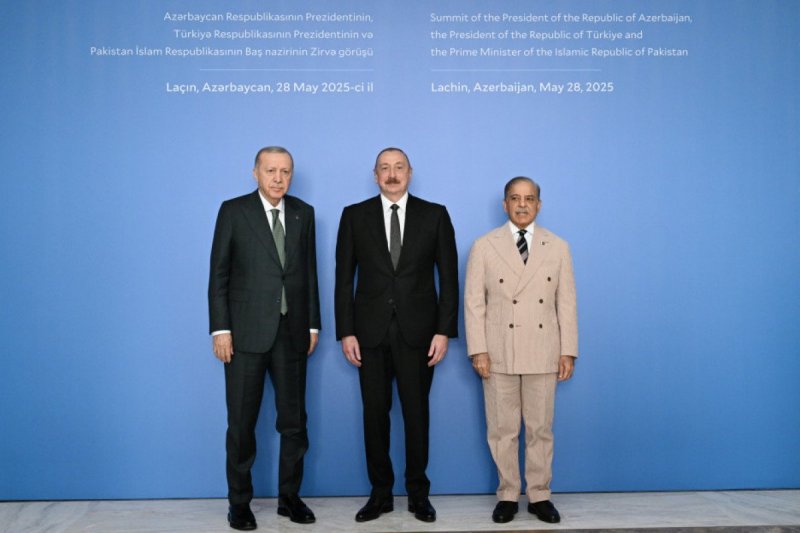
On May 28, 2025—Azerbaijan’s Independence Day—the city of Lachin, which until recently lay in ruins after decades of occupation, became the stage for a significant diplomatic event. It was here that the leaders of Azerbaijan, Türkiye, and Pakistan convened in what is already being hailed as the birth of a new strategic triangle.
This triangle is far more than a conventional alliance. It represents a necessary new geopolitical formula, adapted to the realities of an increasingly unstable world. Against the backdrop of mounting turbulence—from energy and climate crises to the ongoing war in Ukraine and escalating U.S.–China tensions—states with internal resilience and a foreign policy instinct for survival are forming new axes of influence. The Azerbaijan–Türkiye–Pakistan format is emerging as such a tool—not only for the region but well beyond its borders.
The choice of Lachin as the meeting site was a carefully calibrated signal. On lands once occupied, Azerbaijan has not only built roads and residential districts—it is constructing a new concept of space: a space of diplomacy, power, and future orientation. Holding an international meeting on these lands symbolizes both sovereignty and the transformation of post-conflict territories into platforms for new alliances.
Since the end of the Second Karabakh War in 2020, Azerbaijan has proven that restoration is not merely a mechanical return of territory—it is, from top to bottom, a strategic investment. Every road, every energy hub, every administrative structure is a brick in the foundation of a future in which Baku becomes a central node in a new regional matrix.
President Ilham Aliyev is the architect of this emerging regional paradigm. His leadership combines the precision of a strategist with the pragmatism of a statesman. He avoids flamboyant declarations and instead focuses on building unprecedented infrastructure for future decision-making. It is under his leadership that the liberated territories have become a platform for a non-military victory—a victory of diplomacy, modernization, and symbolic and physical return. His foreign policy flexibility—from strategic partnerships with China to reestablishing channels with Iran and the European Union—has turned Azerbaijan into a vital bridge between East and West, North and South.
President Recep Tayyip Erdoğan, for his part, is a statesman who thinks in imperial timeframes. Under his leadership, Türkiye operates simultaneously as a military, diplomatic, and technological power. Ankara’s moral and political support for Azerbaijan during the 2020 conflict marked a moment of truth: behind Türkiye’s words stood real firepower and political will. Turkish drones, Turkish investments, and Turkish soft power formed a comprehensive approach to expanding regional influence. Erdoğan’s participation in the Lachin trilateral meeting provided essential momentum to elevate the Türkiye-Azerbaijan partnership into a sustainable strategic axis.
Prime Minister Shehbaz Sharif of Pakistan adds scale and depth to the triangle. His country, a nuclear power with a population of 240 million, is an active player in the Islamic world and holds significant weight in South Asia. Through this alliance, Pakistan finds an opportunity to move beyond its traditional rivalry with India and enter the Eurasian arena. Prime Minister Sharif appears less focused on diplomatic formality and more interested in technological, transportation, and energy cooperation with regions previously beyond Pakistan’s sphere of influence.
It is encouraging that this new format of strategic cooperation does not duplicate existing alliances—it redefines them. In a region where Russia retains influence through the CSTO and Iran seeks to deepen its reach, the Azerbaijan–Türkiye–Pakistan alliance establishes a new center of gravity. It does not require ideological loyalty from its members, but offers the exchange of resources, strategic logic, and mutual reinforcement.
This format is flexible and scalable. Its framework could easily extend to include Central Asia. Uzbekistan, Kazakhstan, and Kyrgyzstan—nations that are navigating a delicate balance between Moscow, Beijing, and Ankara—are seeking alternative models of engagement. In a time of growing challenges, from transnational crime to cyber threats, the “Lachin Triangle” could serve as a new model for security and development. Kazakhstan, which already has strong ties with both Türkiye and Azerbaijan, may be the next logical participant. Uzbekistan, in turn, could be the missing link for further regional integration.
Notably, no treaty was signed in Lachin on May 28. No grand declarations were made about forming an alliance. Yet this meeting could reshape the region’s geopolitical structure. It demonstrates that in a world where unipolarity is unraveling, real power is no longer forged in forums but in concrete partnerships, pragmatic actions, and enduring cooperation.
Azerbaijan is becoming both a key participant in this cooperation and a kind of super-strategic hub—geographically, politically, and logistically. Its role is fundamentally connective. Türkiye and Pakistan, in turn, represent the vital vectors. Together, they form an axis capable of stabilizing the South Caucasus, proposing a model of cooperation for Central Asia, and even increasing their influence across the Islamic world.
It is important to remember that this is not a return to 20th-century geopolitics. This is an entirely new architecture of power—free from ideological dogmas and rigid bloc discipline, yet driven by the understanding that sovereignty in the 21st century is not only about territorial integrity, but about the ability to rally those who see the future not as chaos, but as a field of opportunity.
The Lachin Triangle may well mark the beginning of a new chapter in regional history. And if this chapter is written with strategy, clarity, and consistency, it could serve as a model for other regions of the world that are also searching for a new anchor in an age of uncertainty.
(If you possess specialized knowledge and wish to contribute, please reach out to us at opinions@news.az).


Similar news