Magbat Spanov: Azerbaijan, Kazakhstan, and Uzbekistan will become key green energy suppliers to Europe – INTERVIEW



By Maria Zhigadlo
News.Az presents an interview with Magbat Spanov, a Kazakh economist, expert at the Institute of Innovative Economy, and professor at Al-Farabi Kazakh National University.
– Azerbaijan, Kazakhstan, and Uzbekistan will cooperate in the development and transmission of green energy. How do you assess the prospects of this collaboration? What benefits does it offer these countries?
- The cooperation between Azerbaijan, Kazakhstan, and Uzbekistan in the field of green energy holds significant potential and aligns with global trends in economic decarbonization. Last year, these three countries signed an agreement on the development and transmission of renewable energy, marking an important step toward a sustainable energy future for the region.
This project has great prospects as it aligns with the comprehensive Sustainable Development Goals (SDGs) set by the UN and corresponds to the international climate agreement recently discussed in Azerbaijan as part of the preparations for COP-29. Furthermore, the project supports the European Union's initiative to diversify energy supplies, making it strategically important not only for the region but also for Europe.
Kazakhstan has already signed separate documents and developed a clear implementation plan for renewable energy projects. The country is actively expanding its solar and wind energy initiatives while seeking integration with other partners to efficiently utilize green capacities.
The advantages of such cooperation are evident. Firstly, it will enable these countries to optimize energy production and distribution, reducing dependence on traditional sources. Secondly, the joint efforts of the three countries within a unified energy corridor will allow for more efficient capacity management and ensure stable energy supplies on both regional and international levels. Thirdly, this project could serve as a foundation for exporting clean energy to Europe, particularly given the EU’s decision to include nuclear power plants in its list of green energy sources. Thus, Azerbaijan, Kazakhstan, and Uzbekistan can expand their influence in the global energy market.
However, it is essential to recognize that this project is still in its early stages. In the near future, Kazakhstan and Uzbekistan plan to bring approximately 700 MW of green energy to the market, marking the first significant step in this direction.
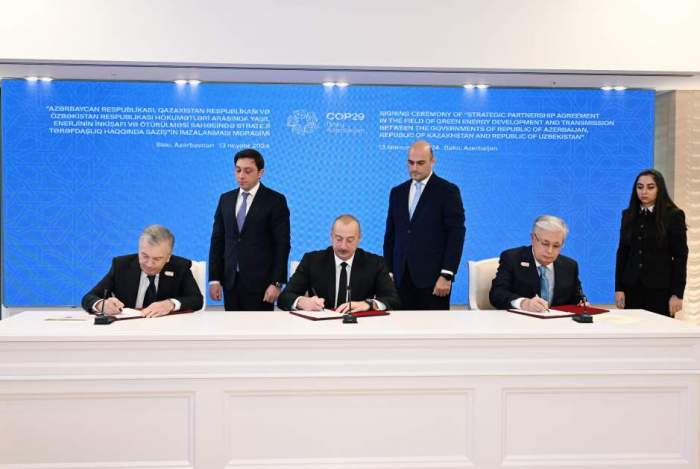 Azerbaijani, Uzbek, Kazakh leaders signed the “Agreement between the governments of the Republic of Azerbaijan, Republic of Kazakhstan and Republic of Uzbekistan on Strategic Partnership in the Development and Transmission of Green Energy” on Nov. 13, 2024. Photo: AZERTAC
– What specific steps is Kazakhstan taking to modernize the infrastructure of the Middle Corridor, including ports, railways, and logistics hubs?
- The Middle Corridor, also known as the Trans-Caspian International Transport Route (TITR), is gaining strategic significance amid global geopolitical shifts. Over the past few years, the role of this route has increased significantly, particularly due to the sanctions pressure on Russia and the necessity to diversify supply chains.
While in 2014, the Middle Corridor was considered an additional route, it is now emerging as one of the key transit corridors between China and Europe. This shift is driven by changes in global logistics as well as the growing interest of Kazakhstan, Azerbaijan, and Uzbekistan in deepening economic cooperation.
Kazakhstan is actively implementing a series of measures to modernize the route’s infrastructure. The country is expanding its railway network by upgrading railway tracks and increasing the throughput capacity of mainlines. In 2023, a project was launched to build a second railway line between Dostyk and Moyynty, significantly reducing cargo delivery times.
Major investments are being made in the expansion of the ports of Aktau and Kuryk, which play a crucial role in ensuring cargo flows through the Caspian Sea. Meanwhile, Azerbaijan is actively developing the Port of Alat, which is becoming an important hub for Trans-Caspian trade.
New logistics hubs are being established along the route to provide comprehensive cargo handling services, significantly reducing processing time. Kazakhstan and Azerbaijan are closely coordinating their efforts with European countries, as interest in the Middle Corridor continues to grow. Disruptions in the Suez Canal, caused by shipping delays, are forcing many countries to seek alternative routes, and the Trans-Caspian Corridor is becoming one of the most attractive options.
– What role does the Middle Corridor play in the geoeconomic strategy of Kazakhstan and Azerbaijan, considering global logistics changes and the sanctions pressure on Russia?
- The Middle Corridor is no longer just an alternative route; it has become a crucial element of the region’s new geoeconomic reality. Amid the ongoing standoff between the West and Russia, Kazakhstan, Azerbaijan, and Uzbekistan are strengthening their positions as key transport hubs in Eurasia.
To maximize the potential of this corridor, regional countries are taking strategic measures. Kazakhstan and Azerbaijan are simplifying customs procedures to accelerate cargo movement through their territories. Administrative restrictions are being reduced, and transport regulations are being harmonized to enhance efficiency. The development of digital infrastructure, including electronic services such as a "single window" system for logistics operators, is helping to minimize delays and improve cargo tracking.
Additionally, integrating the Middle Corridor with the North-South route, which connects Russia, Iran, and India, further enhances its appeal for international partners.
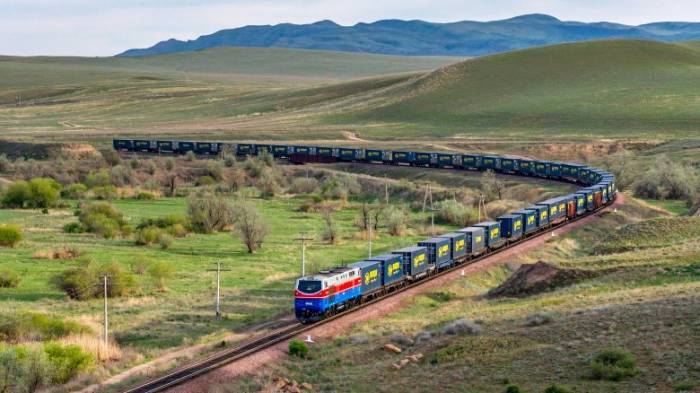 Photo: World Bank
– What infrastructure projects and investments are needed to increase the throughput capacity of the Middle Corridor so that Kazakhstan and Azerbaijan can fully capitalize on its potential?
- For the route’s further development, significant investments are required to modernize ports, railways, logistics centers, and digital services. Key projects that could enhance the efficiency of the Middle Corridor include the expansion of ferry fleets across the Caspian Sea, which will accelerate cargo transportation between the ports of Aktau, Kuryk, and Alat.
The development of railway hubs in Central Asia, including the construction of new routes and modernization of existing railways, will increase freight volumes. The creation of multimodal terminals integrating maritime, rail, and road transport will ensure more efficient logistics. The advancement of digital solutions, including real-time cargo tracking systems, will reduce delivery times and enhance transportation security.
The Middle Corridor is not just a transit route but a key element of global logistics that will play a crucial role in the future economic development of the region.


Similar news