Putin’s strategy: Time gained, sanctions delayed


Editor's note: Alexander Leonov is the Executive Director of the Center for Applied Political Research "Penta" and Ukrainian political analyst. The article expresses the personal opinion of the author and may not coincide with the view of News.Az.
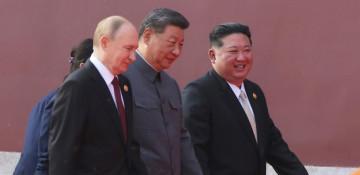
The meeting between Vladimir Putin and U.S. President Donald Trump, held on Ukrainian soil, is widely read as a tactical victory for the Kremlin. For Moscow, the optics alone were priceless: a Russian leader, long treated as a pariah in Western capitals, was effectively ushered back into the top tier of diplomatic choreography. State honors, formal protocol, and the gravitas of a bilateral with the American president signaled not a break with isolation but a deliberate, public puncturing of it. Symbolism matters in geopolitics, and here the symbolism favored Putin.
Beyond the theater, time is the most valuable commodity this summit delivered to the Kremlin. Every week without new punitive measures allows Russia to rewire supply chains, cycle matériel, stabilize currency expectations, and test Western political resolve. The encounter created precisely such a pause. Washington and Brussels may yet tighten sanctions, but the meeting—by its very existence—shifted the tempo. Strategic pauses are not neutral; they are used, and Moscow knows how to use them.
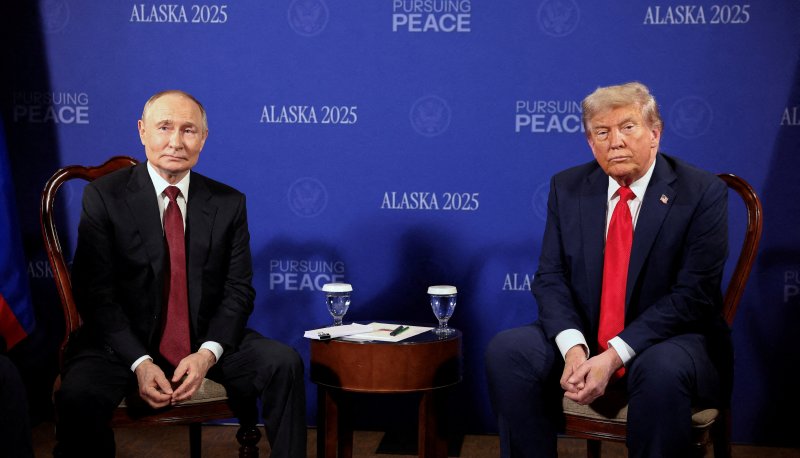 Photo: Reuters
More consequential still was the agenda’s drift toward Russia’s framing. Reports and leaks—some credible, others clearly designed to shape the conversation—suggest that two pillars dominated behind closed doors: no immediate ceasefire and the idea of a “territorial exchange.” Whoever authored the phrase, the logic is plain. A ceasefire without concessions freezes lines roughly where they stand; a “swap” dresses annexation in legalistic clothing. In both scenarios, the language is Moscow’s, the terrain of debate is Moscow’s, and the burden of rebuttal lies with everyone else. Even if the United States never endorses such terms, the mere normalization of the vocabulary recalibrates expectations.
Trump, meanwhile, returned home to a predictable storm. The images that flatter Putin inflame Washington. Critics see appeasement; allies see improvisation; undecideds see ambiguity. The cancellation of a joint luncheon and a compressed format were read as a course correction—tactical moves by a president who sensed the political price and tried to lower the optics without scrapping the engagement. But those adjustments did not change the headline. They only confirmed how combustible the meeting was from the start.
Faced with backlash, the White House is floating the contours of a peace initiative. Yet here, too, the gravitational pull of the Kremlin’s proposals is evident. If the framework begins with a de facto acceptance of battlefield realities and works backward toward legal cover, then the negotiation is already taking place in Russia’s preferred coordinates. The information space is now thick with “details” of Russia’s demands—some accurate, many speculative, and not a few deliberately planted. That fog is not incidental; it is a feature. Confusion creates space for maneuver, trial balloons, and the incremental mainstreaming of previously unthinkable outcomes.
What could shift this balance? Europe and Ukraine acting in unison. Kyiv’s red lines—no reward for aggression, no barter on sovereignty—are, at their core, the European Union’s stated principles. If Brussels and Kyiv stand immovably together, they narrow Washington’s room for improvisation and raise the political cost of any semantic or legal contortions that would launder faits accomplis into “compromise.” This is not simply an argument about borders; it is about the credibility of the post–Cold War European order and the deterrent value of international law. Either territorial integrity means what it says, or it becomes a conditional clause subject to force and fatigue.
For the United States, there is a blunt strategic question beneath the swirl of personalities and protocol: is America prepared to defend a rules-based order when the rules are hardest to defend? If the answer is yes, then the pathway is clarity—on sanctions, on military support to Ukraine, on the rejection of euphemisms that convert seizure into “exchange.” If the answer is no, then the world will quickly internalize a different lesson: revisionism pays if pursued with enough stamina and calibrated risk.
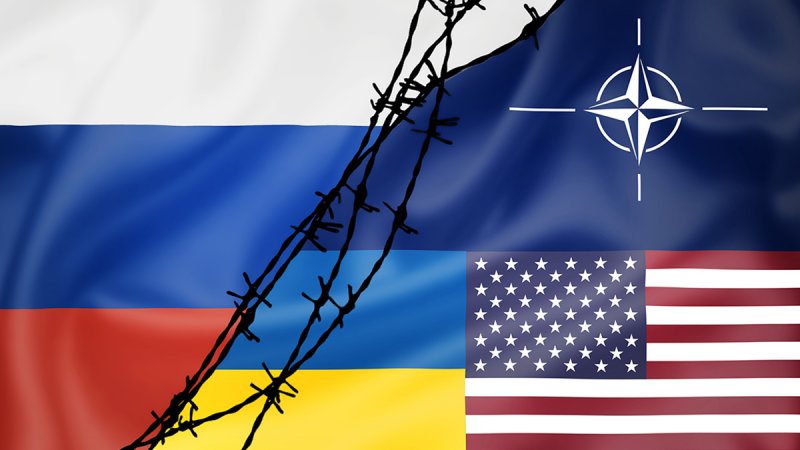 Photo: Shutterstock
The coming days may bring clarifying statements. They need to. Ambiguity may be tactically useful in the short term, but it corrodes leverage in the medium term. A coherent U.S. line would anchor around three elements. First, language discipline: retire the vocabulary that masks aggression as negotiation. Second, policy ballast: pair any diplomatic outreach with automatic escalators on sanctions and sustained military assistance, so diplomacy does not read as drift. Third, alliance unity: make Brussels and Kyiv co-authors, not audiences, of any process; the more aligned the Western position, the narrower the space for unilateral gambits or wedge-driving.
Putin left the meeting with two dividends—time and terms—without paying a visible price. Trump left with domestic turbulence and international skepticism, and is now trying to retrofit a process that does not look like concession. That is not checkmate, but it is advantage Russia for the moment. If there is a corrective available to Washington, it lies less in clever choreography and more in unambiguous choices. Diplomatic stagecraft can signal intent; only policies enforce it.
By Monday, the picture should be sharper. The test is whether clarity emerges—on aims, on terms, on red lines—or whether the fog thickens. In international politics, uncertainty often favors the side that created the crisis. If the United States and Europe want a different outcome, they will have to do the unfashionable thing: say exactly what they mean—and mean exactly what they say.
(If you possess specialized knowledge and wish to contribute, please reach out to us at opinions@news.az).


Similar news