Russia and China launch strategic gas project


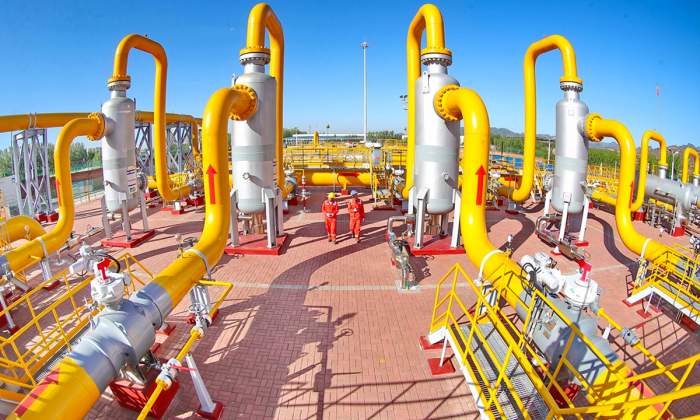
Two Chinese technicians inspect a compressor station of the China-Russia east-route natural gas pipeline in Qinhuangdao city, North China's Hebei Province, on May 1, 2024. Photo: VCG
The completion of the Eastern Line of the China-Russia Gas Pipeline marks a significant milestone, symbolizing the deepening of the strategic partnership between Russia and China. This project plays a pivotal role in China’s energy supply, delivering Russian natural gas through the "Power of Siberia-1" main gas pipeline. The Eastern Line not only strengthens China’s energy security but also opens new avenues for Russian gas exports to Asia, an essential development in the current geopolitical landscape.
On December 2, 2024, China’s PipeChina officially announced the completion and commissioning of the final section of the pipeline, the Nantong-Luzhi segment in Jiangsu Province. This section serves as the concluding link in a massive infrastructure system now spanning nine provinces and regions of China, including the Beijing-Tianjin-Hebei economic zone and the Yangtze River Delta. The early completion, seven months ahead of schedule, underscores the high efficiency of Chinese construction companies. With this achievement, the entire Eastern Line is now fully operational, ensuring uninterrupted natural gas deliveries from Russia. The pipeline has also been integrated into the existing "West-East" gas network, which transports gas from China’s inland regions, such as Xinjiang, Qinghai, Sichuan, and Chongqing, to the country’s eastern coast.The Eastern Line exemplifies the application of cutting-edge technologies in pipeline construction. The project utilizes pipes with a diameter of 1,422 mm, larger than those used in the "Power of Siberia-1." These X80-grade steel pipes withstand pressures of up to 12 MPa, enabling the transport of larger gas volumes with minimal losses. Additionally, the project is a milestone for China, as it is the first to feature fully localized key equipment and control systems. All necessary infrastructure was designed and manufactured by Chinese companies, highlighting their growing technological independence.
Since the commissioning of the initial segments of the Eastern Line, over 80 billion cubic meters of gas have been transported. With the final section now operational, the system has stabilized its annual delivery capacity at 38 billion cubic meters. This figure aligns with the terms of the 30-year contract signed between Gazprom and CNPC in 2014. In 2024, Russia plans to exceed the initially agreed annual volume of 30 billion cubic meters by supplying over 31 billion cubic meters to China, made possible by expanding the capacity of "Power of Siberia-1" and enhancing compressor station capabilities.
Photo: Shutterstock
For China, the Eastern Line plays a strategic role in reducing dependence on coal and transitioning to cleaner energy sources. This aligns with the country’s climate goals, which aim for carbon neutrality by 2060. For Russia, the project represents a strategic pivot in response to shifts in the global gas market. The reduction of gas exports to Europe due to sanctions has prompted Moscow to expand cooperation with Asian countries, particularly China. The Eastern Line bolsters Russia’s presence in the Asia-Pacific energy market and lays the groundwork for further economic collaboration.
The project’s phased development ensured gradual supply increases even before the line's completion. The northern Heihe-Changling section began operations in 2019, followed by the central Changling-Yongqing segment in 2020. In 2022, the Anping-Taixing section was completed. The final Nantong-Luzhi segment, completed in 2024, marked the full realization of the project. This sequential approach allowed both Russia and China to ramp up gas supplies progressively, maximizing the pipeline's utility from the outset.
Beyond the Eastern Line, Russia and China are actively exploring additional gas supply routes. The Far Eastern route, slated for launch in 2027, is expected to add 10 billion cubic meters annually, bringing the total to 48 billion cubic meters. Another promising project, "Power of Siberia-2," which will pass through Mongolia, could deliver up to 50 billion cubic meters annually, though price negotiations are ongoing.
Additionally, the proposed Russia-Kazakhstan-China pipeline could supply up to 35
billion cubic meters annually, while also enhancing gasification in northern Kazakhstan.
The completion of the Eastern Line underscores the importance of energy cooperation between Russia and China. This project stands as a testament to successful collaboration, where the technological and economic interests of both nations converged to create large-scale infrastructure. Amid global energy shifts, the Eastern Line has become a crucial link, strengthening Russia’s position in the Asian market and ensuring stable energy supplies for China. Looking ahead, Russia and China are poised to deepen their partnership, with plans for new routes and increased gas volumes laying a solid foundation for long-term cooperation.
(If you possess specialized knowledge and wish to contribute, please reach out to us at opinions@news.az).


Similar news