Why Georgia suddenly needs Kyrgyzstan


Editor’s note: Zaur Nurmamedov is a journalist and a graduate of the Faculty of Political Science at the Academy of Public Administration under the President of the Republic of Azerbaijan (1993–1999). He previously served as first deputy editor-in-chief of the Vesti.Az news portal (2009–2023). The views expressed in this article are his own and do not necessarily reflect the position of News.Az.
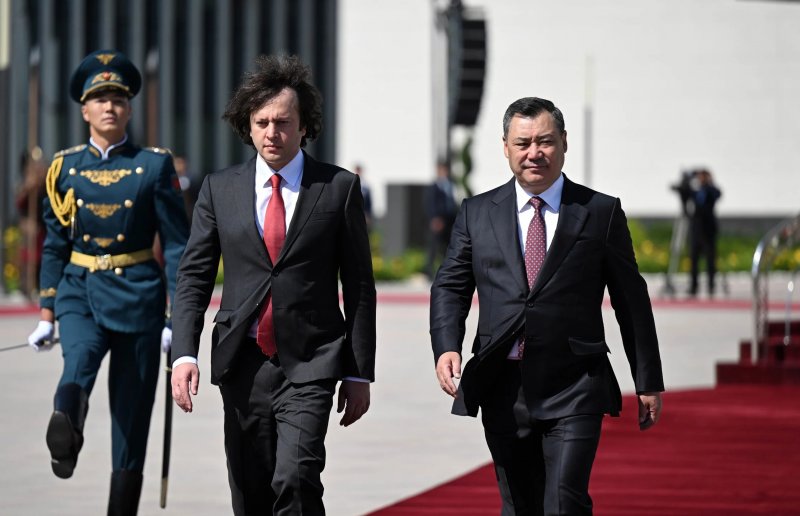
Georgian Prime Minister Irakli Kobakhidze’s official visit to Kyrgyzstan is far more than a protocol-driven trip. The Georgian head of government is in Bishkek from 11 to 13 June, and the very fact of the visit carries historical significance: it is the first official visit by a Georgian prime minister to Kyrgyzstan since the establishment of diplomatic relations between the two countries.
At first glance, the obvious question is why such a visit did not take place earlier — and why it is happening now. Georgia and Kyrgyzstan do not share a border, are located in different parts of the post-Soviet space, and for many years did not occupy a central place in each other’s foreign policy agendas. However, Kobakhidze’s visit demonstrates that the traditional geography of political priorities in Eurasia is changing rapidly. Trade, logistics, re-exports, transport routes and new economic links between the South Caucasus and Central Asia are increasingly moving to the forefront.
RECOMMENDED STORIES
The economy forms the backdrop to this visit. In recent years, Kyrgyzstan has unexpectedly become one of the key destinations for Georgian exports. According to Georgian statistics, in January–April 2026, Kyrgyzstan ranked first among Georgia’s export markets, with exports amounting to $272.8 million. In 2025, Georgian exports to Kyrgyzstan reached approximately $1.5 billion. For two countries that for decades maintained largely formal rather than active economic relations, this represents a remarkable increase.
 Source: AkiPress
It is important, however, to understand the structure of this growth. A considerable share of Georgia’s exports to Kyrgyzstan is linked not so much to domestic production as to re-exports, primarily motor vehicles. Georgia has long served as a regional hub for importing cars and then reselling them to external markets. Kyrgyzstan has become one of the principal destinations for these flows. Consequently, the sharp increase in bilateral trade cannot be explained solely by a sudden political rapprochement. Rather, the opposite appears to be true: trade expanded first, and diplomacy is now catching up with the new economic reality.
This is why Kobakhidze’s visit to Bishkek appears logical. When a country that was not previously among a state's principal partners suddenly becomes one of its largest export destinations, the relationship can no longer be treated as a purely technical matter. Political guarantees, a legal framework, intergovernmental commissions, customs cooperation, transport arrangements and mechanisms for protecting business interests become increasingly necessary. In this sense, the current visit represents an effort to transform rapidly growing trade flows into a more sustainable institutional partnership.
The composition of the Georgian delegation is also telling. Kobakhidze did not travel to Kyrgyzstan alone. The delegation includes Deputy Prime Minister and Foreign Minister Maka Bochorishvili, Economy and Sustainable Development Minister Mariam Kvrivishvili, Environmental Protection and Agriculture Minister David Songulashvili, and Head of the Government Administration Levan Zhorzholiani. This suggests that the agenda extends well beyond political statements. It is focused on practical matters — trade, transport, agriculture, investment, logistics and the expansion of the legal framework for cooperation.
In Bishkek, Kobakhidze was welcomed by Chairman of the Cabinet of Ministers of Kyrgyzstan Adylbek Kasymaliev. This is also symbolic: the visit has not only a presidential dimension but also a distinctly intergovernmental character. Although the key talks were held with Kyrgyz President Sadyr Japarov, the economic rationale behind the trip is primarily linked to cooperation between governments, ministries and relevant agencies.
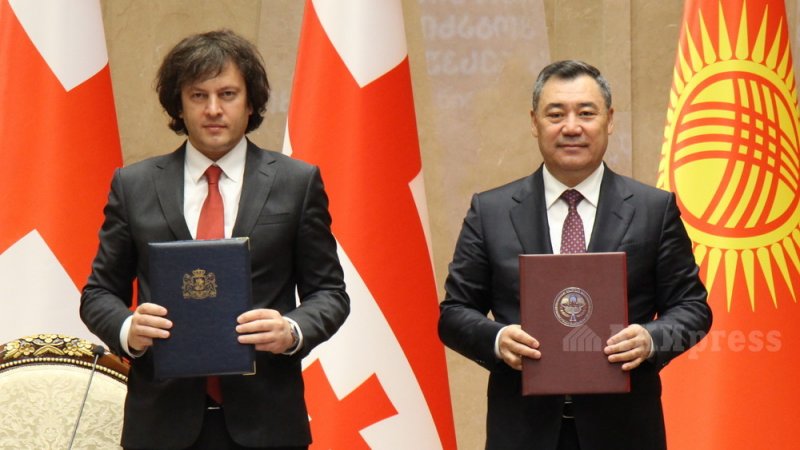
Following the talks, Kyrgyzstan and Georgia signed a package of bilateral documents. These include agreements on cooperation between the two countries’ aviation authorities, interaction in the management of state property, veterinary control and livestock development, as well as a cooperation programme between the foreign ministries of Kyrgyzstan and Georgia for 2027–2028. The sides also agreed to exchange information and cooperate in the field of radiation protection, nuclear safety and the physical protection of nuclear facilities, and signed a memorandum of cooperation in education.
Particular importance should be attached to the agreement on the preliminary exchange of information regarding goods and vehicles transported between Kyrgyzstan and Georgia. This document may prove to be one of the most practical elements of the entire package. For two countries experiencing growing trade volumes and increasing transit flows, the advance exchange of data means more transparent customs procedures, lower risks, faster processing and a better understanding of the movement of goods.
This is especially important given the sensitivity of Eurasian trade to sanctions restrictions, re-export schemes and controls on the movement of goods. The more trade grows between countries that do not share a border, the more important digital data exchange, customs coordination and advance information on cargo and vehicles become. The signed documents are therefore not merely diplomatic formalities. They create the infrastructure necessary for the further development of economic ties.
Another important backdrop to the visit was the second meeting of the Kyrgyz-Georgian Intergovernmental Commission on Trade and Economic Cooperation, held in Bishkek. The Kyrgyz delegation was headed by Minister of Economy and Commerce Bakyt Sydykov, while the Georgian side was led by Economy and Sustainable Development Minister Mariam Kvrivishvili. The parties discussed cooperation in trade, transport and logistics, agriculture, information and communication technologies, environmental protection, education, culture, communications, labour relations and other areas. A protocol formalising the agreements reached was signed following the meeting.
Kobakhidze’s visit therefore does not appear accidental. It represents the political formalisation of a process that is already underway in the economic sphere. Georgia is seeking to strengthen its role as a trade and logistics hub linking the Black Sea, the South Caucasus, Türkiye, Central Asia and wider Eurasian markets.
Kyrgyzstan, for its part, is interested in gaining access to additional routes, strengthening links with the South Caucasus and Black Sea region, and diversifying its foreign economic relations.
Against this backdrop, the Middle Corridor is gaining particular importance. The route linking China and Central Asia with the Caspian Sea, the South Caucasus, Türkiye and Europe is becoming not merely a transport project, but a new economic logic for the region. For Georgia, participation in this process is a matter of strategic positioning. For Kyrgyzstan, it presents an opportunity to expand its foreign trade network and reduce dependence on traditional routes.
There is also a broader political context. In recent years, Georgia has pursued an increasingly pragmatic foreign policy, seeking to preserve room for manoeuvre between the West, Russia, China, Türkiye and the countries of Central Asia. The development of relations with Kyrgyzstan fits within this approach. Tbilisi is signalling its readiness to engage more actively in the eastern direction while maintaining its declared strategic priorities and expanding its circle of practical partners.
 Source: Kabar news agency
For Kyrgyzstan, the Georgian prime minister’s visit is equally significant. Bishkek is demonstrating that its foreign policy is not limited to relations with Russia, China and its Central Asian neighbours. Kyrgyzstan seeks to become part of broader Eurasian connectivity, in which the South Caucasus serves as a natural extension of Central Asian routes towards the west.
This is why the first official visit to Kyrgyzstan by a Georgian prime minister should be viewed not as an isolated event, but as a sign of a deeper restructuring of regional ties. In the past, economic relations between the two countries lacked sufficient weight to justify such a high-level political visit. Today, that weight clearly exists.
So far, there is no public information about major commercial agreements involving significant financial commitments. However, the package of agreements already signed suggests that both sides are focusing not on a one-off deal, but on building a foundation for long-term cooperation. This may be less spectacular than announcing a billion-dollar contract, but in practice it is often customs, transport, sectoral and interagency agreements that determine whether trade becomes sustainable.
The key question now is whether Georgia and Kyrgyzstan can transform the current surge in trade — much of it linked to re-exports — into a more balanced and durable partnership. If cooperation remains dependent on car re-exports and short-term trade flows, it will remain vulnerable to regulatory changes, sanctions pressure and fluctuations in demand. However, if the two sides broaden their agenda through transport, logistics, agriculture, tourism, education and digitalisation, the current visit could mark the beginning of a qualitatively new stage in bilateral relations.
In diplomacy, economic figures often drive political developments. In the case of Georgia and Kyrgyzstan, trade transformed bilateral relations first. Irakli Kobakhidze’s visit to Bishkek is an attempt to bring political engagement into line with a new economic reality.
(If you possess specialized knowledge and wish to contribute, please reach out to us at opinions@news.az).


Similar news