Azerbaijan, Türkiye and Georgia are redrawing the map of the South Caucasus


Editor’s note: Leyla Shirinova is a seasoned media professional with extensive experience in broadcast journalism and political communication. The views expressed in this article are her own and do not necessarily reflect the official position or editorial stance of News.Az.
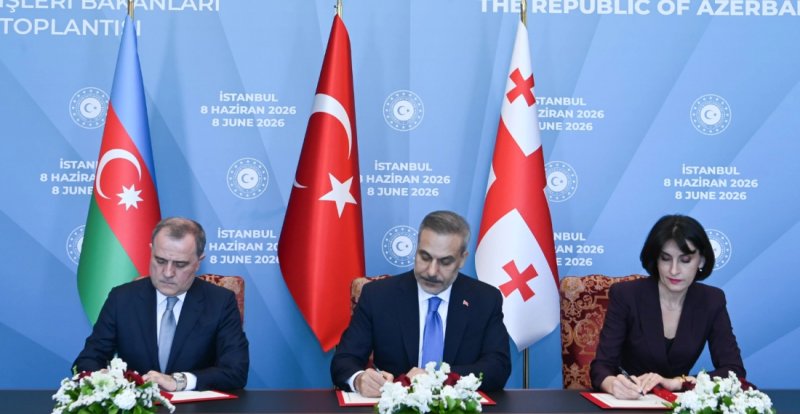
The signing of the Istanbul Declaration on 8 June by the foreign ministers of Türkiye, Azerbaijan and Georgia was not merely another diplomatic event in a trilateral format. Against the backdrop of a shifting geopolitical architecture in the South Caucasus, the document reflects a deeper process: Baku, Ankara and Tbilisi are shaping a practical alternative to conflict-driven geopolitics by focusing on transport corridors, energy security, regional connectivity and sustainable cooperation.
The tenth trilateral meeting of the foreign ministers of the three countries in Istanbul showed that the Türkiye–Azerbaijan–Georgia format has long moved beyond routine political consultations. It has become one of the key mechanisms through which the three states coordinate their approaches to security, trade, logistics, energy and the future of the South Caucasus. In a region still dealing with the consequences of past conflicts, and where external actors continue attempting to preserve or expand their influence, practical cooperation is becoming the main instrument of stabilisation.
The main value of the Istanbul Declaration lies in the fact that it sets out a new regional logic. For many years, the South Caucasus was viewed primarily through the prism of conflict, closed borders and great-power rivalry. Today, Azerbaijan, Türkiye and Georgia are offering a different approach: development through connectivity. This is not only about roads, railways, ports and pipelines. It is about creating a stable system of interdependence in which security is supported not only by political statements, but also by shared economic interests.
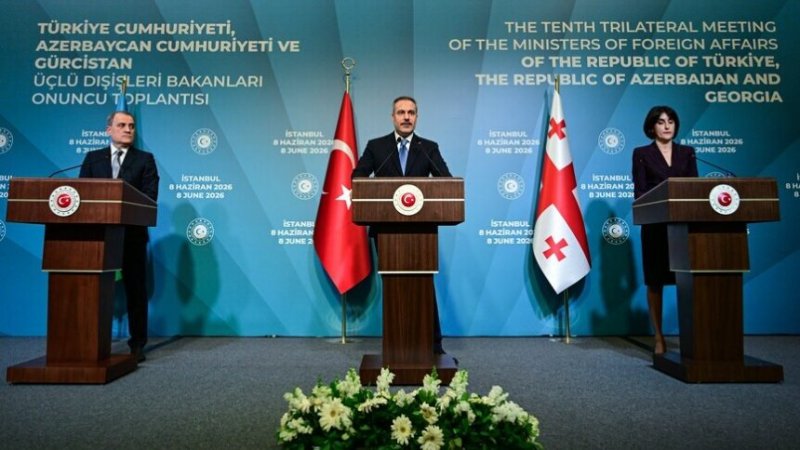
The foreign ministers of Türkiye, Azerbaijan and Georgia attend a press conference after signing the Istanbul Declaration. Photo: Anadolu Agency.
The Middle Corridor, officially known as the Trans-Caspian International Transport Route, occupies a central place in this logic. It connects China and Central Asia with Europe via the Caspian Sea, Azerbaijan, Georgia and Türkiye. Following the war in Ukraine and the disruption of traditional northern routes through Russia, interest in this corridor has grown sharply. In 2022, cargo traffic along the Middle Corridor stood at around 1.5 million tonnes. In 2023, it reached approximately 2.8 million tonnes. In 2024, volumes increased by 62% to 4.5 million tonnes, while the 2025 forecast stands at around 5.2 million tonnes. This is no longer a secondary logistical option, but an expanding Eurasian transport framework.
The Baku–Tbilisi–Kars railway is especially important. Its launch in 2017 marked a major step in connecting the railway systems of Azerbaijan, Georgia and Türkiye. Following the modernisation of the Georgian section, the line’s importance has increased substantially: its annual capacity has risen from 1 million to 5 million tonnes of cargo. This makes BTK one of the key links of the Middle Corridor and allows cargo from Central Asia and China to move towards Türkiye and Europe without passing through Russian territory.
It is also significant that the modernisation of BTK was highlighted just days before the signing of the Istanbul Declaration, on 2 June at the Akhalkalaki station in Georgia. This gives the declaration practical, rather than purely symbolic, weight. The point is not elegant diplomatic language, but concrete infrastructure that is already operational and capable of expanding the region’s opportunities.
For Azerbaijan, the Middle Corridor is not just a transport project. It is a strategic continuation of its foreign policy line. After restoring its territorial integrity, the country has sought to consolidate its role as a central hub between East and West, North and South. Baku already has considerable experience in implementing major infrastructure projects: the Baku–Tbilisi–Ceyhan oil pipeline, the Southern Gas Corridor, the Baku–Tbilisi–Kars railway and the Baku International Sea Trade Port in Alat have all demonstrated how geography can be transformed into a political and economic resource.
The Port of Baku in Alat plays a separate role in this system. It is becoming the Caspian gateway of the Middle Corridor. Through it, cargo from Kazakhstan, Turkmenistan and other Central Asian countries can enter Azerbaijan and then move on to Georgia, Türkiye and Europe. This chain — the Caspian Sea, Alat, BTK, Georgian ports and Türkiye’s railway network — is forming a new logistics map of the region.
Türkiye, in this architecture, is not merely Azerbaijan’s ally, but a key gateway to Europe and the Mediterranean. Ankara has consistently promoted the idea of turning the country into an energy, transport and trade hub. In this context, cooperation with Baku and Tbilisi allows Türkiye to strengthen its position not only in the South Caucasus, but also in the wider Eurasian system. For Ankara, a stable route through Azerbaijan and Georgia means a greater role in global logistics and a stronger strategic partnership with two of its most important regional neighbours.
For Georgia, participation in this format is no less important. The country retains a key geographic position between the Caspian and Black seas. Its territory is an essential link in the transport and energy connection between Azerbaijan and Türkiye. For Tbilisi, trilateral cooperation is also a way to strengthen its regional significance, attract infrastructure investment and maintain balance in a complex geopolitical environment. Georgia gains the opportunity to be not a periphery, but an important transit centre in the region’s new architecture.
The numbers confirm this trend. In the first half of 2025, container transit through Georgia along the Middle Corridor increased by 173% compared with the same period of the previous year. Container traffic on the Baku–Tbilisi–Kars line over the same period grew almost 59-fold. Even if absolute volumes still remain below those of traditional routes, the dynamics underline the key point: the South Caucasus is gradually turning into a space of real transit growth.
Photo: APA
It is also important that the Istanbul Declaration focuses not only on transport, but also on energy. The Baku–Tbilisi–Ceyhan pipeline and the Southern Gas Corridor have already demonstrated that the Azerbaijan–Georgia–Türkiye link can contribute to energy security not only in the region, but also in Europe. BTC remains one of the key routes for transporting Caspian oil to global markets, while the Southern Gas Corridor has become an important element in the diversification of gas supplies to Europe.
A new agenda is now being added to traditional energy: green energy, low-carbon technologies and digital connectivity. Azerbaijan is actively developing projects to export green electricity, including through the Black Sea towards Europe. In cooperation with Georgia and Türkiye, these initiatives may become the next level of regional integration.
Thus, Baku, Ankara and Tbilisi are not building separate projects, but a comprehensive infrastructure and geopolitical platform. Its foundation consists of railways, ports, pipelines, energy lines, digital communications and political coordination. Such a platform is capable of transforming the South Caucasus from a zone of rivalry into a space of transit, trade and development.
This process gains particular importance against the backdrop of the Armenia–Azerbaijan peace process. If peace between Baku and Yerevan is finalised and communications in the region are unblocked, the entire logic of the South Caucasus could change. Armenia could also have the opportunity to become part of regional connectivity instead of remaining outside key projects. But for that to happen, Yerevan must accept the new reality: the sustainable future of the region will be built not on revanchist expectations, but on recognition of borders, normalisation of relations and participation in economic processes.
The Istanbul Declaration effectively shows that the time of waiting is ending. Türkiye, Azerbaijan and Georgia are not waiting until every regional contradiction is resolved. They are already creating a working model of cooperation that may become the basis for a wider regional order. This is a pragmatic approach: not declarations for the sake of declarations, but the consistent construction of links that make conflict less profitable and cooperation more attractive.
Against the backdrop of Russia’s weakening traditional influence, growing Western engagement, China’s rising role and the increasing importance of Central Asia, the South Caucasus is becoming one of the key nodes of new Eurasian competition. But unlike external actors, which often view the region as a field of rivalry, Baku, Ankara and Tbilisi are offering a logic of regional agency. They are not merely reacting to an external agenda; they are shaping it themselves.
The Istanbul Declaration is not just a diplomatic document. It is a signal that a new logic is taking hold in the South Caucasus: from conflict to corridors, from isolation to connectivity, from dependence on external centres of power to regional responsibility. Baku, Ankara and Tbilisi have already demonstrated that they can implement projects of strategic scale. Their next task is to turn this practice into the foundation of a new regional order.
If this course continues, the South Caucasus could cease to be seen as a zone of chronic instability and become one of Eurasia’s most important transport and energy bridges. This is the main meaning of the Istanbul Declaration: it records not only the current cooperation of the three countries, but also the contours of a future region where roads, energy, trade and mutual benefit become stronger than old conflicts.
(If you possess specialized knowledge and wish to contribute, please reach out to us at opinions@news.az).


Similar news