Scholz out: What’s next for Germany’s political future?


REUTERS/Liesa Johannssen dzen
Editor's note: Alexander Rahr, German political scientist, chairman of the Eurasian Society (Berlin). The article expresses the personal opinion of the author and may not coincide with the view of News.Az.
A majority of Bundestag members have voted for a no-confidence motion against Olaf Scholz’s government, following the collapse of the ruling coalition. This decision was initiated by Chancellor Scholz himself, who brought the matter to parliamentary discussion. Snap elections in Germany are now scheduled for February 23, with the fate of the Bundestag resting in the hands of President Frank-Walter Steinmeier. Within the next three weeks, the President must decide whether to dissolve the Bundestag—a scenario that seems increasingly likely given his prior emphasis on the need for “a stable majority and an effective government.”Germany’s political system faces an unprecedented challenge: for the first time in the country’s history, its government comprises three parties with fundamentally different ideological foundations. This experiment has evidently failed. The Social Democrats, Greens, and Free Democrats could not reconcile their core differences, resulting in governmental dysfunction.
The Free Democrats, representing business interests with a liberal-conservative orientation, clashed ideologically with the Social Democrats, who prioritize social welfare projects. Meanwhile, the Greens, once a symbol of leftist ideals, have shifted toward mainstream politics but still hold priorities often detached from pressing economic realities.
This alliance proved incapable of finding common ground to address the nation’s challenges effectively. The Social Democrats sought to support vulnerable groups, including the poor, migrants, and refugees, but did so at the expense of the working population and industrial capital. Consequently, big business, taxpayers, and the industrial sector found themselves unprotected, exacerbating the country’s crisis.
The problems, however, are not limited to the current government. Germany now faces a critical question: what will the next government look like? Post-election negotiations after the Bundestag elections in February 2024 promise to be arduous, as traditional parties are likely to retain influence despite the nation’s deteriorating situation.
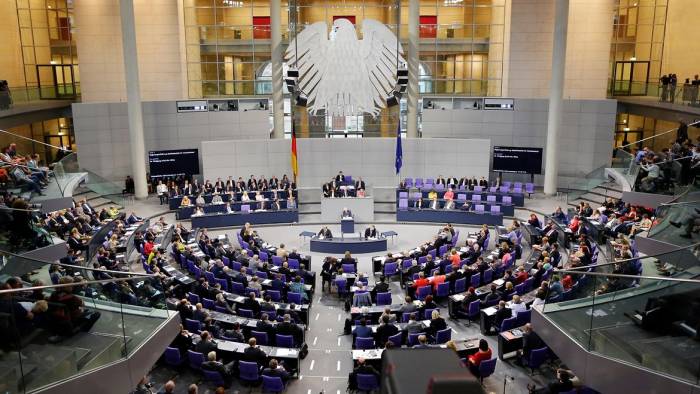
A view of the plenary chamber (© German Bundestag/photothek)
The mainstream parties—Christian Democrats, Social Democrats, Greens, and Free Democrats—are united primarily by their shared opposition to the right-wing Alternative for Germany (AfD). Yet, AfD continues to gain traction as voters grow increasingly disillusioned with traditional politicians.
The worsening economic situation is bolstering support not only for far-right forces like AfD but also for new leftist movements, such as the recently established “Sahra Wagenknecht Alliance.” Germany risks heightened societal polarization, complicating any reform efforts.
To navigate the crisis, Germany must take two critical steps.
While feminist diplomacy, support for minorities, and a focus on human rights reflect commendable moral ideals, they yield little in the face of today’s geopolitically harsh realities
Germany has distanced itself from pragmatic relations with key players like Russia and China. Moralistic pressure only deepens divides, weakening Berlin’s position on the global stage. The U.S. has already made a similar shift; Donald Trump’s “America First” policy discarded liberal values in favor of national interests.
Germany could adapt this approach by prioritizing its economic interests and reclaiming its standing in Europe and the world. Ignoring this course will only deepen the crisis.
Green technologies are essential, but imposing them without accounting for economic realities undermines the country’s competitiveness. Germany’s decision to phase out nuclear energy and transition to renewables has proven premature. Even France, Germany’s key EU partner, continues to rely on nuclear power, while Eastern Europe adopts a more pragmatic approach to energy resources.
Today, Germany risks isolation due to its green ideology. Its economy is weakening, industry is losing competitiveness, and the energy crisis is worsening. Berlin must focus on a long-term strategy that balances ecological and economic interests.
The new government, potentially forming in 2024, will face the same challenges as the current one. Economic difficulties, external pressures, and rising populism will play decisive roles in shaping the country’s future.
Germany is no longer the economic powerhouse of Europe it was 25 years ago. Without radical measures, the country risks being sidelined in global politics and economics.
To regain leadership, Berlin must reassess its position and abandon ideological dogmas. Only a pragmatic approach rooted in the country’s real needs will enable Germany to reclaim its leading role on the world stage.
(If you possess specialized knowledge and wish to contribute, please reach out to us at opinions@news.az).


Similar news