Trump and Harris: Key moments and outcomes of the debate


By Tural Heybatov
The debate between Donald Trump and Kamala Harris , held on September 11, looked more like a carefully staged show than a real discussion of issues concerning voters. It all began with an unexpected gesture: the candidates exchanged handshakes. This symbolic moment could have marked the start of a productive dialogue, but within minutes, any semblance of civility vanished. What followed was a fierce verbal sparring match, with both participants sticking to their usual tactics and talking points.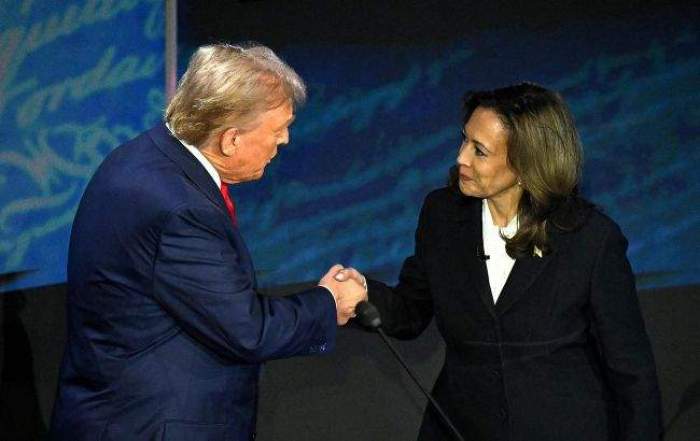
The debate kicked off with a focus on the economy — a topic that predictably led to heated exchanges. Trump, as expected, accused the Democrats of causing the collapse of the American economy. His rhetoric, aimed at portraying the opposition as destroyers incapable of running the country, was nothing new. Harris, on the other hand, employed a more subtle strategy, emphasizing how Republican policies hurt not just the economy, but ordinary Americans. It seemed like both candidates were so engrossed in blaming each other that they forgot debates are supposed to be about solutions, not just finger-pointing.
As the topics shifted, the debate turned to abortion, and the tensions escalated. Trump wasted no time in repeating his well-worn claim that Democrats support "late-term abortions, right up until the ninth month." Harris countered with the standard defense, arguing that women’s reproductive rights should remain their personal choice. The exchange highlighted one clear point: neither candidate was interested in compromise or finding common ground. The issue remained unresolved, but as a spectacle, this back-and-forth was likely perfect for those watching for entertainment.
The most absurd part of the evening came when the discussion shifted to foreign policy. Here, the candidates almost entirely abandoned diplomatic decorum in favor of personal attacks. Trump accused Harris of being anti-Israel, while Harris responded by accusing Trump of being too friendly with Putin. What could have been a meaningful dialogue about international relations turned into a political circus. Each accusation was accompanied by dramatic statements, as if designed solely to ramp up the tension. For instance, Harris suddenly mentioned Russia being a threat to Poland, likely hoping to appeal to Polish-American voters. Trump, on his part, proudly reminded the audience that he had "stopped" the Nord Stream 2 pipeline, as if this issue was at the top of mind for the average American.
As the debate came to a close, viewers were left with the impression that they had watched a performance, not a serious discussion. Predictably, most media outlets, including CNN and Fox News, rushed to declare Harris the winner. Her confidence and preparation made an impression on both voters and journalists, while Trump came across as tired and less assured than in his earlier political engagements. Although Trump had moments where he could have pressed Harris more effectively, he failed to capitalize on them, missing opportunities to assert his dominance.
However, the true essence of a debate often lies in its perception. For those who watch these events more for entertainment than political analysis, the spectacle certainly delivered. Harris skillfully capitalized on the low expectations that most viewers had of her. Many doubted her ability to handle Trump, which in turn worked in her favor. Not only did she deflect his attacks, but she also gave the impression that she was in control. Still, despite her apparent confidence, her performance was not groundbreaking in terms of substance — rather, she won through solid preparation and strategy.
As for Trump, his rhetoric remained unchanged. He continued to attack Biden, criticize the current administration, and focus heavily on immigration policy. Yet in this debate, it was as though he forgot that his opponent was not the president but the vice president. He failed to convincingly tie Harris to Biden’s unpopular decisions. Experts agree that this was a missed opportunity that a more adept politician could have used to greater effect.
Expert opinions on the debate's outcome generally agree that while both participants performed better than expected, Harris appeared more confident and composed compared to Trump, who spent much of the time with a stern expression. Expectations for her were so low that any competent performance was automatically seen as a victory. Moderators, some observers argue, may have also played a role in this, appearing to favor Harris by putting more pressure on Trump’s key talking points.
In the end, these debates once again underscored that modern political shows are more about spectacle than substance. Trump remained true to his core message, while Harris seized the moment to strengthen her position. For many voters, though, this was more of a show than a means of learning anything new about the candidates.


Similar news