Trump turns up the pressure on Europe


By Tural Heybatov
In June, The Hague will host a NATO summit that is already drawing heightened attention.
Much of the anticipation surrounding the upcoming meeting centers on potential surprises from the United States. Though calling them “surprises” might be misleading — for several months now, Washington’s European allies have been facing mounting and persistent pressure from the new U.S. administration.
U.S. President Donald Trump is expected to call on European nations to significantly increase their defense spending at the NATO summit in The Hague. This was confirmed by U.S. Permanent Representative to NATO Matthew Whitaker during his remarks at an Atlantic Council conference. “Trump has made it very clear that our European and Canadian allies now need to match the United States,” he said, referring to the burden-sharing on defense expenditures.
Even before his inauguration, Trump had already hinted at drastic moves. In December last year, he declared that the U.S. might consider withdrawing from NATO unless its partners increased their defense budgets. In January, he became more specific, stating that he would push for NATO member states to raise military spending to 5% of their GDP — well above the current 2% target, which Trump deems insufficient. He warned that if NATO countries do not contribute their fair share to defense, the U.S. would no longer feel obligated to protect them.
Washington’s message to its allies has been not just forceful, but unequivocal — these are not suggestions, they are demands. Ahead of the NATO Foreign Ministers’ meeting in April, U.S. Secretary of State Marco Rubio stated, as quoted by Euronews: “I’d like to leave Brussels with a clear understanding that every NATO country has committed to increasing defense spending to 5% of GDP.”
It is worth noting that NATO countries have recently committed to raising their defense budgets. According to NATO Secretary General Mark Rutte, this will mark the alliance’s largest military spending increase since the end of the Cold War. But even a proposed rise to 3% failed to satisfy Trump.
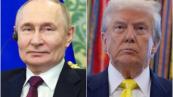
Currently, the United States shoulders the largest share of NATO’s defense spending. In 2024, it accounted for 63.7% of the alliance’s total defense budget — $754.7 billion out of a total of $1.18 trillion. During his first term in office, Trump successfully pressured partners to increase spending to 2% of GDP. Now, he’s raising the bar once again. Justifying the demand with the ongoing war between Russia and Ukraine, Trump has simultaneously begun moving closer to Russian President Vladimir Putin, claiming that Russia no longer poses a threat. This contradictory stance has raised alarm among allies, who suspect that Trump's real aim may be to weaken Europe financially.
As reported by the Associated Press, Trump is trying to persuade allies that a U.S. realignment toward Russia is actually in Europe’s best interest. NATO officials, however, are baffled: if Russia no longer poses a threat, why demand defense spending of 5% of GDP? Even Vladimir Putin has stated that Moscow has “no reason, no interest — neither geopolitical, economic, political, nor military — to go to war with NATO countries.”
Nonetheless, U.S. pressure on alliance members continues unabated. On April 17, at the start of a meeting with Italian Prime Minister Giorgia Meloni at the White House, Trump stated that Italy’s pledge to raise defense spending to 2% of GDP was insufficient. At a subsequent press conference, Meloni assured journalists that Italy would meet its commitments, but Trump interrupted her, declaring, “They will be increased,” making it clear that 2% is now considered outdated.
That same day, U.S. Defense Secretary Pete Hegseth raised the issue during talks at the Pentagon with his French counterpart, Sébastien Lecornu. He urged France, along with other NATO allies, to assume “primary responsibility for protecting Europe from non-nuclear threats,” according to RBC.
Germany, not waiting for further rebukes from Washington, has already declared its willingness to meet Trump’s demand and raise defense spending to 5% of GDP. As reported by Deutsche Welle, German Foreign Minister Johann Wadephul announced this after talks with Secretary of State Marco Rubio in Antalya on May 15.
The original agreement to raise defense spending to 2% of GDP was reached by NATO members in 2023, as it became evident that the war in Ukraine would not end anytime soon. Twenty-two of the alliance’s 32 members have already met that goal. The upcoming summit in The Hague will introduce a new target — 3% of GDP. Meanwhile, Dutch Prime Minister Dick Schoof has stated that the NATO Secretary General expects leaders to prepare for raising defense spending to 3.5% of GDP by 2032 — along with an additional 1.5% increase in related expenditures. This combined total coincides exactly with Trump’s 5% target.
As of now, no NATO country has officially committed to the 3.5% target — let alone 5%. Analysts believe that Belgium, Canada, Croatia, Italy, Luxembourg, Montenegro, Portugal, Slovenia, and Spain are unlikely to meet this goal. Spain, for instance, is only expected to reach the 2% threshold this year. Even the United States reduced its defense spending in 2024.
But the 5% demand is not the only one Washington is making. According to Euronews, U.S. Representative to NATO Matthew Whitaker also stated that any European investment in the defense sector “must also ensure fair access for U.S. defense technology companies.” Excluding the U.S. and other non-EU nations, he warned, “would undermine NATO interoperability, slow Europe’s rearmament, increase costs, and stifle innovation.”
This is widely viewed as a direct response to the European Union’s recently declared ambition to reduce its dependency on U.S. defense supplies by focusing on European-made military equipment.
The summit in The Hague will be a key moment — a litmus test of how far NATO allies are willing to bend to the will of the White House.


Similar news