Trump’s ambitions: From Greenland to Canada – What lies behind his statements? – INTERVIEW


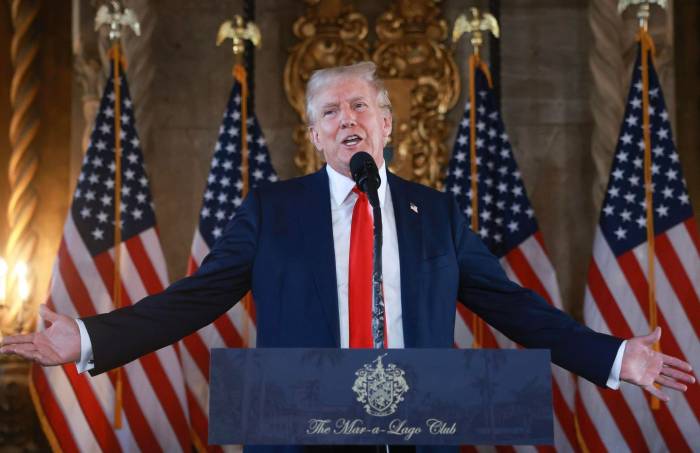
Donald Trump, U.S. president-elect, has heavily backed bitcoin and crypto this year, spurring huge ... [+]Getty Images
Donald Trump’s statements about Greenland and the Panama Canal have reignited debates over U.S. foreign policy and its global ambitions.
His bold declarations, ranging from a desire to purchase Greenland for national security reasons to a controversial suggestion that the Panama Canal should be returned to U.S. control, have raised questions about potential geopolitical implications. These remarks not only hint at strategic calculations but also reflect the expansionist undertones of Trump’s “America First” approach.To explore the significance and possible outcomes of these statements, News.Az reached out to Professor from Hamilton College. Alan Cafruny , an expert in international relations and political economy, to analyze the motivations behind Trump’s rhetoric and its impact on global politics.

- Donald Trump has stated that the Panama Canal should be returned to the United States due to high tariffs. How likely is it that tensions between the two countries will escalate?
- Trump’s comments on Panama and Greenland reflect serious and potentially expansionist aims, drawing parallels with the Monroe Doctrine and growing U.S. hawkishness toward China. The Panama Canal is a critical strategic asset for the U.S., and while Trump’s rhetoric may aim to reduce transit fees—following their recent increase—it also highlights concerns over China’s growing influence in Latin America, particularly through Hong Kong-controlled ports in Panama. These dynamics could elevate tensions between the U.S. and Panama.
- Donald Trump has suggested that Canadians would like to join the United States, calling it a "wonderful idea." What could be the implications for U.S.-Canada relations if the U.S. president-elect were to actively pursue this concept?
- Trump’s remarks about Canada, Panama, and Greenland combine bluster with substantive demands, illustrating his distinctive “America First” foreign policy approach. His comments about Canadian Prime Minister Justin Trudeau, including referring to him as “Governor Justin Trudeau” and suggesting Canada might become America’s “51st state,” were largely rhetorical. However, these provocations hint at the contentious trade negotiations that defined Trump’s presidency, straining U.S.-Canada relations.
- Trump has reiterated his desire to acquire Greenland for national security. Do you think such statements could lead to diplomatic tensions between the United States, Denmark, and other countries in the region? Is such a scenario possible in the future?
- Trump’s interest in Greenland, first articulated in 2019, reflects its growing strategic importance. The island’s melting Arctic ice unlocks access to rare earth minerals and amplifies competition in the Arctic, particularly with China’s expanding interests. Denmark has responded by increasing military spending, but the prospect of negotiations regarding Greenland’s future appears plausible. Trump’s renewed focus on Greenland could lead to heightened tensions with Denmark and other Arctic nations.
- The Philippines is planning to purchase Typhoon missiles from the United States. How do you view this decision in the context of growing tensions between the Philippines and China? Could such arms sales accelerate militarization in the region?
- The Philippines finds itself at the center of escalating Sino-American tensions. This situation is further complicated by internal political rivalries between the Marcos and Duterte factions. While Marcos seeks closer ties with Washington, Duterte has historically favored Beijing. The decision to purchase Typhoon missiles from the U.S. will likely exacerbate both domestic and regional tensions, potentially accelerating militarization in the Indo-Pacific.
- After Syria, Iran is rumored to be the next target of U.S. regime change policy. Do you think such a scenario is likely, and how might it impact international security?
- The Middle East is undergoing significant geopolitical shifts. Alongside the fall of Assad Hezbollah has been gravely weakened and Russia’s ability to support Tehran has been reduced substantially. Iran, meanwhile, grapples with severe economic challenges. In this context, the U.S. and Israel may seize the opportunity to target Iran’s nuclear infrastructure, potentially using air and missile strikes. Such actions could have profound implications for international security.


Similar news