Ukrainian forces halt Moscow’s push to split the Donetsk region defense


.png)
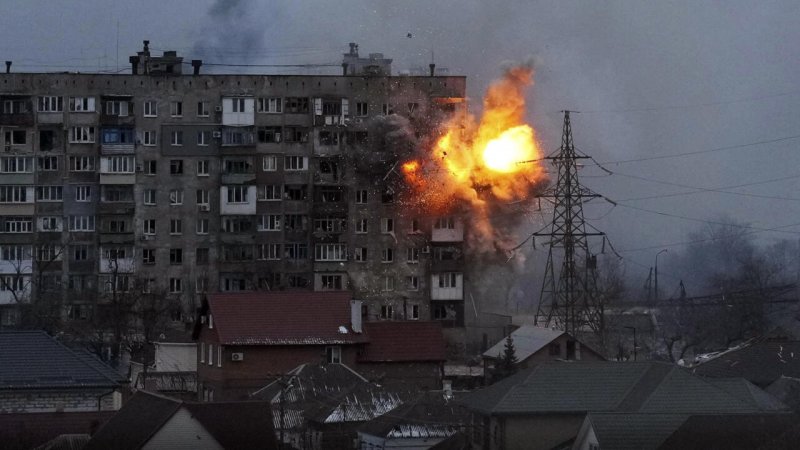
Russia’s war against Ukraine has entered yet another brutal phase. While Ukrainian defense forces have managed to halt enemy advances on several sections of the front and even liberate a number of settlements, the situation remains tense and uncertain.
Moscow continues to pour reinforcements into key directions, seeking to split Ukraine’s defenses in Donetsk and maintain relentless pressure on both the battlefield and civilian populations. Against this backdrop, Ukrainian resilience, tactical adaptability, and the human cost of daily bombardments highlight not only the scale of the struggle but also the urgent need for continued international support.
Speaking to News.Az, Ukrainian political expert Svetlana Kushnir commented on Russia’s recent assaults across multiple regions of Ukraine.

Photo: Ukrainian political expert Svetlana Kushnir
According to Kushnir, Ukrainian defense forces have managed to halt Russian advances on several sections of the front, and in some areas have even gone on the counteroffensive, liberating up to a dozen settlements. “Yet the situation remains extremely difficult,” she noted, “as Russian forces, reinforced with additional manpower, continue to push slowly against our defensive lines.”
Kushnir explained that Moscow’s General Staff is trying to execute a strategy aimed at cutting off Ukraine’s Donetsk grouping of troops. “For now, Ukraine is engaged in a war of attrition against a numerically superior enemy. But our General Staff is working to transform this into a mobile defense, where Ukrainian professional soldiers and mobilized fighters have consistently proven stronger, more creative, and more agile. In maneuver warfare, supported by network-centric operations, our commanders can make tactical decisions independently. This approach has already shown its effectiveness in Kharkiv, Kherson, Kursk, and along the Sumy axis.”
Despite three years of full-scale war, Kushnir stressed, Russia has failed to capture the last settlement in the Luhansk region. Ukraine still controls more than 30 percent of Donetsk region — precisely 32.1 percent — including the key fortified Sloviansk–Kramatorsk agglomeration as well as Kostyantynivka and Druzhkivka. “According to both Ukrainian and Western analysts, it is unlikely that Russian forces will be able to seize these strongholds in the next three years,” she emphasized.
Kushnir also underlined that the war is not limited to the battlefield. “Russia continues to terrorize the civilian population through missile and Shahed drone strikes on major cities like Zaporizhzhia, Kharkiv, and Chernihiv, often adding aerial bombs. Moscow tries to justify these attacks by claiming that military objects are located in civilian areas. But this is false. In densely built urban centers, placing such facilities would be reckless.”
Drawing from personal experience, she recalled: “Fragments of a missile hit a neighboring apartment block, destroying the top two floors of a twelve-story building. By God’s mercy, my family was unharmed, and our own building escaped damage. But in central Kyiv, where I live, nightly mass attacks have become routine. The destruction is visible to the entire world — and this is the reality of the 21st century. While someone abroad may be drinking morning coffee or jogging in a park, Ukrainians are living under bombardment.”
Kushnir pointed out that Ukraine’s resistance will continue, but support is essential. “We cannot achieve peace alone. Every day, my social media feed is filled with obituaries of young Ukrainians who died for the freedom and independence of their country. Children are now used to air-raid sirens and studying in underground classrooms, while the elderly always check for nearby shelters before leaving home. Over the past two months, Russia has intensified its strikes on critical infrastructure, and with winter approaching, such attacks are especially alarming. Still, as long as we live, we will continue our struggle.”
She concluded by condemning Russia’s most recent assault on Zaporizhzhia. “The morning airstrike was the height of cynicism: bombs were dropped directly on residential districts. Before the invasion, more than 700,000 people lived in the Zaporizhzhia agglomeration, though many have since fled. The city endured more than thirty minutes of bombardment — three people were killed, and dozens were injured. Can such actions against civilians truly be called a pursuit of peace?”


Similar news