Why Beijing is still holding back on Power of Siberia 2 – EXPERT OPINION


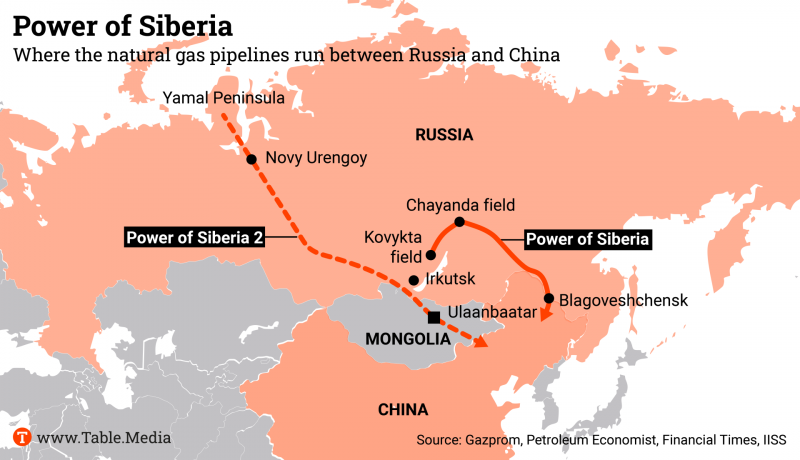
The Russian leadership’s visit to China has once again brought a key issue on the Moscow–Beijing energy agenda into focus — the future of the Power of Siberia 2 gas pipeline. Despite political statements about a strategic partnership, the main commercial contract for the project has still not been signed. This has fuelled debate over whether Moscow has achieved the expected breakthrough in energy cooperation with China, and how willing Beijing is to commit to long-term Russian gas purchases.
Against this backdrop, one question stands out: are the remaining issues merely technical details of a future agreement, or is China deliberately maintaining a tough negotiating position, taking into account Russia’s growing dependence on Asian markets following the decline of gas exports to Europe? Another key issue is whether Russian pipeline gas is becoming an element of China’s energy security amid growing risks to maritime LNG routes, including the Strait of Hormuz and the Strait of Malacca.
News.Az spoke to Igor Yushkov, a leading analyst at the National Energy Security Fund and an expert at the Financial University under the Government of the Russian Federation, about why the Power of Siberia 2 contract has not yet been signed, what conditions remain under negotiation between Moscow and Beijing, and why the project remains strategically important for both sides.
According to the expert, it is still premature to speak of a breakthrough on Power of Siberia 2, as the key commercial contract for gas supplies between Russia and China has not yet been signed.
“In fact, no contract for Power of Siberia 2 has been signed yet. There are previously reached agreements, but as far as we understand, they primarily concern the pipeline itself: the route, volumes, allocation of responsibility for construction of individual sections, financing, and other parameters related specifically to the infrastructure. But for the project to actually function, a gas sales contract is needed. Since there is no such contract yet, construction has effectively not started,” Yushkov noted.
He said the main subject of negotiations is not the broader political framework, but the specific commercial terms of the future agreement.
“In my view, there are two main issues. The first is price. The second, and perhaps even more important, is supply flexibility. This concerns the take-or-pay mechanism — in other words, the principle of ‘take it or pay for it’. The key question is what volumes China will be obliged to take annually, how much it will have to pay in case of underconsumption, whether it can shift purchases between quarters, and how freely it will be able to adjust volumes,” the expert explained.
RECOMMENDED STORIES
According to him, for China, Power of Siberia 2 is important not only as a source of additional gas volumes, but also as a way to reduce dependence on LNG supplies via maritime routes.
“China sees supplies via Power of Siberia 2 partly as an opportunity to reduce LNG purchases. The main advantage of the project is reliability of supply. A pipeline route cannot be blocked in the same way as maritime LNG deliveries,” he said.
“For example, Australia is among the leading LNG suppliers to China, and it is part of the Western world. If the United States were to impose sanctions banning LNG supplies to China, Australia would most likely stop such deliveries,” the expert noted, adding that supplies from the Middle East depend on the Strait of Hormuz, while other routes depend on the Strait of Malacca and other vulnerable maritime chokepoints. “Everything that reaches China by sea from the Middle East or Africa becomes a risk in the event of a major geopolitical crisis,” Yushkov said.
This is why, he continued, Russia is positioning Power of Siberia 2 as a reliable overland route that cannot be blocked by external actors. However, he said China is seeking the most flexible possible terms.
“Beijing likely wants the ability to buy more Russian gas in some periods and less in others, depending on conditions in the LNG market. It is possible the parties are already close to a compromise on the pricing formula. The contract may resemble the model used for Power of Siberia 1, where the price is linked to oil prices and a basket of petroleum products with a time lag — for example, around nine months,” he said, adding that such a mechanism allows China to anticipate future prices and compare them with LNG spot market offers.
However, even if the pricing formula is agreed, the issue of mandatory annual offtake remains.
“China would like to retain flexibility — to choose the most advantageous source of supply at any given time, whether pipeline gas or LNG. Russia, on the other hand, is interested in guaranteed volumes and clear project economics,” Yushkov said. He suggested that when Russian officials say the project has been “largely agreed” but that “technical details” remain, these are likely not minor issues, but core elements of the commercial structure.
“The level of take-or-pay, supply flexibility, and the mechanism for redistributing volumes all directly determine how profitable and sustainable the project will be for each side,” he emphasised.
At the same time, Yushkov does not believe that China has rejected the project or refused in principle to buy Russian gas.
“I would not say that China has fundamentally refused to purchase gas via Power of Siberia 2 or has not given its consent to the project. On the contrary, the parties are fairly close to signing the contract. Both Moscow and Beijing understand that this agreement is ultimately needed by both sides,” he said.
According to the expert, China needs additional gas volumes from a reliable source, especially in the current geopolitical environment.
“China needs additional gas volumes from a reliable source that would be difficult to cut off. In today’s conditions, this is becoming especially valuable,” he said, adding that the situation around a possible closure of the Strait of Hormuz could further push China towards the deal. “The higher the risks to maritime LNG routes, the more attractive Russian pipeline gas via an overland route becomes,” Yushkov said.
Russia, in turn, needs to monetise its West Siberian gas reserves, especially after the decline in supplies to Europe.
“For Russia, this project is also extremely important. It needs to monetise the reserves of its West Siberian fields. This issue became even more urgent after the sharp decline in gas supplies to Europe,” he said. He added that as early as 2021, Gazprom CEO Alexey Miller told President Vladimir Putin that production at already developed fields could be increased by roughly 100 billion cubic metres without major investment in new fields.
“Since then, exports to Europe have fallen significantly, and production has declined accordingly — by approximately another 140 billion cubic metres. That is why finding new markets for West Siberian gas has become an even more urgent task for Russia,” the expert noted.
Yushkov believes the Power of Siberia 2 contract could be signed in 2026, given the long-term nature of the project.
“I would still assume that the contract may be signed in 2026. The pipeline itself will take around five years to build, and additional time will be needed to reach full capacity. Therefore, full implementation is more likely a matter for the mid-2030s,” he said.
By that time, he believes, confrontation between the United States and China may intensify further, increasing the importance of secure overland energy routes.
“By the mid-2030s, confrontation between the United States and China is likely to intensify further. Therefore, the issue of reliable energy supplies will become even more important for Beijing. In this sense, Power of Siberia 2 is not just a commercial gas project for China, but an element of long-term energy security. For Russia, it is an opportunity to redirect the resource base of Western Siberia towards Asia and compensate for the loss of the European market,” Yushkov concluded.
By Samir Muradov


Similar news