Ukrainian war and its destructive impact on the ecosystem of the Caspian Sea


By News.Az
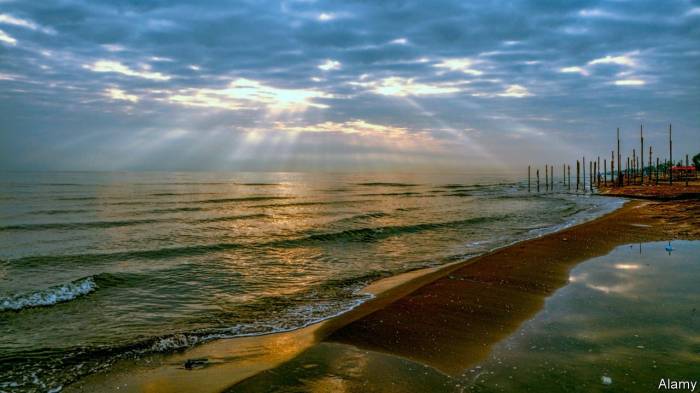
The Ukrainian war, which began in 2022, has far-reaching consequences that extend beyond political and humanitarian crises. One such consequence is its impact on the ecology of the Caspian Sea. Although it may seem that a conflict occurring at a significant distance cannot affect this region, the reality is much more complex.The Ukrainian war has exacerbated the environmental crisis in the Caspian Sea, worsening an already critical situation. The Caspian Sea, like the Aral Sea, is undergoing significant changes due to climate change, leading to a reduction of about one-third of its area.
Mass fish die-offs in Azerbaijan coincided with intense Russian missile strikes on Ukraine, presumably launched from the Caspian Sea. While Azerbaijani authorities attributed the fish deaths to warmer water and low oxygen levels, military activity is also a likely cause of significant pollution. For instance, mass fish deaths on the shores of the Caspian Sea in Govsan and Turkyane were linked to decreased dissolved oxygen levels in the water. Firuddin Aliyev, head of the Biodiversity Conservation Service of the Ministry of Ecology and Natural Resources, stated that analyses of fish samples revealed no infectious disease pathogens, poisoning cases, or external physical impact. Water sample analysis showed that high water temperatures reduced dissolved oxygen levels to 2.2-2.5 mg/L, well below the normal 6 mg/L, causing the fish deaths.
The war in Ukraine has disrupted traditional oil and gas transportation routes, leading to the redirection of flows through the Caspian Sea. Increased tanker traffic poses additional risks to the ecosystem. Even minor oil spills can have long-term negative impacts on marine fauna and flora.
In early November 2022, about 170 carcasses of endangered Caspian seals were found between Bautino and Fort-Shevchenko in Kazakhstan. A month later, around 2,500 dead seals were found on the Russian coast of the Caspian Sea in Dagestan. During the same period, hundreds of dead seals were washed ashore on the Turkmen island of Gyzylsuv.
Various theories were proposed for the mass deaths of these animals. Former Minister of Ecology, Geology, and Natural Resources Serikkali Brekeshev suggested hydrogen sulfide emissions as a possible cause. Russian ecologists blamed natural gas emissions, virus and parasite proliferation due to global climate change, and untreated wastewater discharges into the sea. Later, they claimed that the animals died from natural causes.
Vyacheslav Bizikov, Deputy Director for Research at the All-Russian Research Institute of Fisheries and Oceanography, identified the cause of the mass seal deaths in the Caspian Sea in December 2022. Speaking at the IX Scientific and Practical Conference on "Problems of Preserving the Caspian Ecosystem under Oil and Gas Field Development," he stated that the deaths were due to natural factors. Over 2,500 seal remains were found on the Dagestan coast in December 2022. The monitoring group studied 340 km of coastline and found that about 10,000 animals had died. Autopsies showed that the seals were healthy at the time of death, which occurred two to three weeks before the carcasses were washed ashore.
Similar incidents have happened before. For example, mass seal deaths on the coasts of Kazakhstan and Russia have been linked to military activity, environmental pollution, and rocket fuel. In 2022, unprecedented cases of seal deaths were recorded in Kazakhstan, Russia, and Turkmenistan, causing serious environmental concerns.
Russian bombings and missile system usage over the Caspian Sea contribute to the release of toxic substances like decylin, which can have devastating effects on marine life. These substances accumulate in the food chain, affecting the central nervous system of marine organisms and causing mass animal deaths. Noise and shockwaves from military activities disrupt migratory, reproductive, and feeding patterns of marine species, leading to further ecological problems. The impact of military exercises on the Caspian Sea ecosystem is hard to quantify, but its long-term consequences could be catastrophic.
Growing environmental problems raise questions about potential violations of international agreements. The 2018 Caspian Convention lacks provisions for demilitarization. However, the Framework Convention for the Protection of the Marine Environment of the Caspian Sea (Tehran Convention) could be invoked if significant environmental damage from military actions is identified. This would require an official complaint and international arbitration, which is unlikely in the current geopolitical climate.
Additionally, the decline in Caspian Sea water levels is exacerbated by dam construction and increased water usage amid Western sanctions against Russia. This threatens important transport routes like the Trans-Caspian International Transport Route, crucial for trade between China and Europe. Some suggest that the water level drop is due to Russia intentionally reducing Volga River inflows, causing significant environmental and economic problems for the region.
The upcoming COP29 climate conference in Azerbaijan could provide a platform to discuss these environmental issues. The conference aims to address various aspects of climate change impacts on the region and develop mitigation strategies. However, geopolitical tensions and ongoing military actions complicate the prospect of effective multilateral solutions. Conflicts divert attention and resources from environmental initiatives, delaying necessary measures.
Addressing the Caspian Sea's problems requires coordinated actions from all Caspian states and the international community. However, this seems unlikely under current conditions. Political differences and economic interests often hinder consensus and joint environmental protection projects. The state of the Caspian Sea directly affects the quality of life of millions living in coastal areas and the region's biodiversity.
In conclusion, the Ukrainian war has significant and multifaceted consequences for the Caspian Sea's ecology. Military actions and associated environmental risks require urgent attention and joint actions at the international level to prevent further degradation of the region's unique ecosystem. Effective solutions are possible only through dialogue and cooperation among all interested parties, emphasizing the importance of international conferences like COP29 in advancing the environmental agenda and sustainable development.


Similar news