What the Davos BlackRock deal means for Azerbaijan’s economy


Editor’s note: Abulfaz Babazadeh is a scientist, a Japanese studies scholar and a political observer, as well as a member of the Union of Journalists of Azerbaijan. The views expressed in this article are those of the author and do not necessarily reflect the position of News.Az.
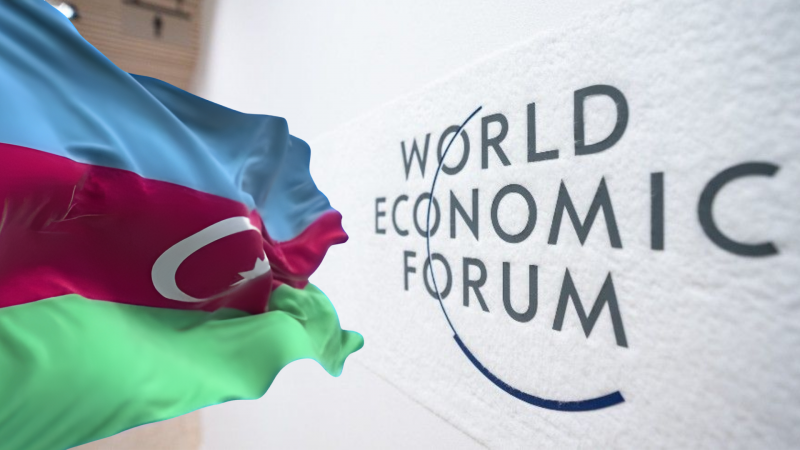
The signing of a memorandum of intent in Davos between the State Oil Fund of Azerbaijan and BlackRock is an event whose significance extends far beyond the framework of formal investment cooperation. This is not merely about capital flows, nor solely about infrastructure. It is about how Azerbaijan positions itself in a changing global economy, and how it is increasingly perceived by the key architects of global capital.
President Ilham Aliyev’s meeting in Davos with BlackRock CEO Larry Fink and Global Infrastructure Partners Chairman Adebayo Ogunlesi effectively served as a public confirmation of long-term mutual trust. This is a crucial point: in an era marked by turbulence, sanctions regimes, and growing fragmentation of the global economy, trust has become a scarce asset. The fact that the world’s largest asset manager is prepared to build a strategic partnership with Azerbaijan speaks volumes.

Source: President.Az
The memorandum envisages potential investments of up to $1.5 billion over three to four years in infrastructure funds managed by Global Infrastructure Partners, as well as joint projects within Azerbaijan itself. Particularly indicative is the focus not on traditional sectors, but on data centers, cloud platforms, artificial intelligence infrastructure, and airport operations. This is not the “classic” economic model of a resource-based state; it is the agenda of countries that plan decades ahead.
It is important to emphasise that BlackRock is not simply a financial giant, but one of the principal strategic navigators of the global market. The company manages assets comparable to the GDP of the world’s largest economies, and its investment decisions shape trust chains for hundreds of other funds and institutional investors. In effect, BlackRock sets the benchmarks for which countries and sectors are considered “safe” and “promising” destinations for long-term capital.
In this context, partnership with the State Oil Fund of Azerbaijan is a signal to the market. A signal that Baku is viewed as a jurisdiction capable of ensuring regulatory stability, institutional predictability, and strategic thinking. For international investors, such signals often matter more than any presentation or roadshow.
Source: APA
Equally significant is the role of Global Infrastructure Partners, a firm specialising precisely in the assets that form the backbone of the modern economy: transport hubs, logistics networks, energy systems, and digital infrastructure. GIP’s experience in managing airports, railway operators, and energy assets allows it to be seen not merely as a financial partner, but as a carrier of world-class governance standards.
Azerbaijan already has practical experience with this type of cooperation. Investments in London’s Gatwick Airport and the Italian high-speed rail operator Italo have demonstrated that SOFAZ is capable of operating in highly competitive developed markets and extracting value from long-term infrastructure projects. These cases are important not only in terms of returns, but also as elements of the fund’s reputational capital.
The Gatwick example is particularly illustrative. As one of Europe’s largest aviation hubs, investments in such an asset imply participation in the management of critical infrastructure, where requirements for efficiency, sustainability, and transparency are exceptionally high. For a sovereign fund from the region, this is effectively a maturity test, and Azerbaijan has passed it.

Source: News.Az
At a broader level, the partnership with BlackRock fits organically into Azerbaijan’s economic diversification strategy. The State Oil Fund has long ceased to be an instrument dependent exclusively on oil and gas revenues. Infrastructure, transport, digital technologies, and renewable energy now form a portfolio that is less sensitive to commodity price volatility and more resilient in the long term.
The geoeconomic context also cannot be ignored. Azerbaijan is increasingly positioning itself as a hub between Europe and Asia — not only in transport terms, but in the digital domain as well. The development of data centers, cloud services, and AI infrastructure could transform the country into a regional hub for the South Caucasus and Central Asia. The participation of BlackRock and GIP in such projects significantly increases their scale and credibility in the eyes of international players.
The reputational effect of the Davos memorandum deserves special attention. Partnership with BlackRock is, in essence, a “pass” into the top tier of global capital. Following such a step, heightened interest from other investment companies, pension funds, and sovereign investors becomes almost inevitable. In the world of big money, the logic is straightforward: if the largest player has already entered, the risks have been thoroughly assessed.
It is noteworthy that back in 2018 in Davos, Larry Fink spoke about the transformation of Azerbaijan’s non-oil sector and expressed hope that the country would become an investment destination for BlackRock. Today, those words are materialising in concrete documents and figures. Moreover, Fink himself, having taken the helm of the World Economic Forum, has emphasised expanding global prosperity and sustainable growth — precisely the agenda into which Azerbaijan is actively integrating.

Source: APA
In this sense, Davos-2026 became for Baku not just another international venue for negotiations and photographs, but a point of qualitative transition. The signing of the memorandum with BlackRock marks Azerbaijan’s definitive move beyond the familiar role of a raw materials exporter and “shadow” investor toward playing by the rules of the global financial center. It represents a shift to a different status — that of a state participating in the creation of future infrastructure, managing long-term capital, and thinking in decades rather than budget cycles.
For international markets, this is a signal of the maturity of Azerbaijan’s institutions, their ability to work with the world’s largest players, and their capacity to meet the highest standards of transparency, risk management, and strategic planning. For Azerbaijan itself, it is a window of opportunity, allowing the country to integrate into new value chains, anchor itself in next-generation infrastructure and technological projects, and gradually evolve from an object of external assessment into one of the co-authors of a new Eurasian economic reality.
This is the core meaning of the Davos agreements: they fix not so much financial parameters as a direction of movement. They represent an investment not only in specific projects and funds, but in trust, reputation, and Azerbaijan’s long-term presence in the global economy.
At a time when global capital is becoming increasingly selective and competition among states is no longer about access to credit but about strategic partners, such agreements become a rare and valuable asset. In this sense, the partnership with BlackRock is not an episode, but a statement of intent, and the market has heard it.
(If you possess specialized knowledge and wish to contribute, please reach out to us at opinions@news.az).


Similar news