Where is Macron leading France?




Editor's note: Moses Becker is a special commentator on political issues for News.Az, a PhD in political science and an expert on interethnic and interreligious relations. The article expresses the personal opinion of the author and may not coincide with the view of News.Az.
It is often said that many leaders suffer from a “Napoleon complex,” but few wear it as visibly as France’s Emmanuel Macron. Comparing oneself to the great emperor who once elevated France to unprecedented heights may be flattering, but history is far less forgiving than ambition. Napoleon’s meteoric rise ended abruptly, though his place among the world’s most consequential leaders is undisputed. Macron, on the other hand, is in danger of being remembered not as a visionary reformer, but as the president who presided over France’s slow unraveling — both at home and abroad.
Macron’s second term has been marked by political chaos and humiliating defeats. The first blow came with the European Parliament elections, where Marine Le Pen’s far-right National Rally emerged victorious. In an attempt to prove her win was merely a fluke, Macron took a bold gamble by calling early parliamentary elections in 2024. It backfired spectacularly. His party suffered another crushing defeat, ushering in a year of revolving-door prime ministers, each toppled by an emboldened opposition majority. Under the constitution, Macron has the option to call another round of early elections after a year, but the risk of an even more devastating loss looms large.
This relentless political churn has left France virtually ungovernable. On September 8, 2025, Prime Minister François Bayrou resigned — the fourth prime minister to fall in two years. Just two days later, massive protests erupted across the country, with demonstrators accusing the government of being out of touch and indifferent to the struggles of ordinary citizens. Against this backdrop, international markets delivered their own verdict: only days after Sébastien Lecornu was appointed as the new prime minister, Fitch Ratings downgraded France’s long-term credit rating to “A+,” the lowest in the country’s modern history.
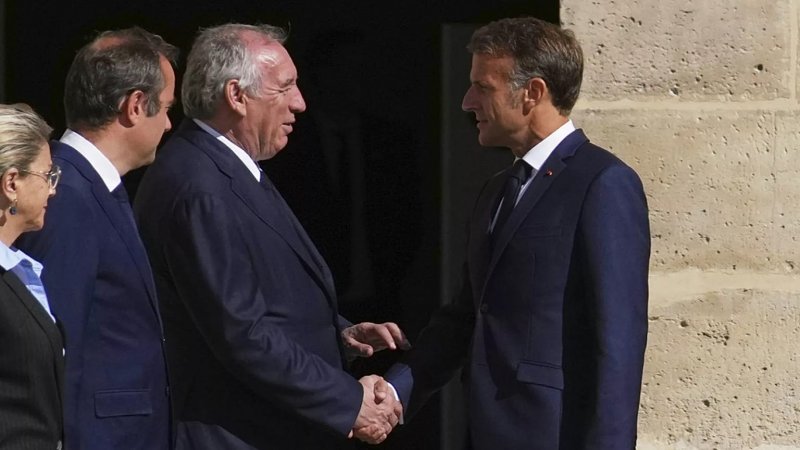 Photo: AP
The downgrade was no surprise. France’s debt continues to spiral, reaching €3.4 trillion in 2025, or 113.2% of GDP, and is projected to hit 121% by 2027. Last year’s budget deficit stood at 5.8% — nearly double the European Union’s legal threshold of 3% under the Maastricht Treaty. For context, the treaty also caps national debt at 60% of GDP, meaning France’s fiscal imbalance has become nothing short of alarming.
Meanwhile, economic output and living standards are steadily declining. Small businesses are shuttering, wine producers and transport companies are going bankrupt, and a growing number of entrepreneurs are relocating to the United States. Inflation continues to climb, even as the government preaches austerity to ordinary citizens while pledging to boost military spending to a staggering 5% of GDP. The social fabric is fraying further as waves of illegal migrants and asylum seekers intensify ethnic and religious tensions.
A foreign policy in disarray
France’s external influence has waned just as dramatically.
“Once, France effectively controlled half of Africa,” observes Austrian geopolitical analyst Patrick Poppel. “Now, African states have turned their backs on Paris, depriving it of access to cheap resources.”
Deprived of its historic spheres of influence, France is lurching from one ill-considered foreign policy move to another. Macron, once hailed as a pro-European reformer, has become increasingly erratic. His latest gamble — the sudden recognition of the State of Palestine in September 2025 — epitomizes this reckless approach.
Marine Le Pen called the decision “catastrophic,” arguing that recognizing Palestine at this moment effectively signals approval of Hamas. With municipal elections looming in March 2026, Macron’s critics accuse him of a cynical ploy to curry favor with certain voter blocs. The move has backfired: the United States, Germany, and the United Kingdom all refused to follow Paris’s lead, leaving France isolated. Washington’s response was particularly sharp, with Secretary of State Marco Rubio condemning the recognition as “a reckless decision that serves only Hamas propaganda and pushes peace further out of reach.”
Analysts have been equally critical.
“This may be important for France’s foreign policy, but it does nothing for Palestinians,” warns Maria Luisa Frantappie of Italy’s Instituto Affari Internazionali.
“The danger is that vast amounts of diplomatic energy will be wasted on a symbolic gesture that fails to address realities on the ground.”
From a legal perspective, recognition of a state requires three basic conditions: a defined population, stable borders, and effective governance. None of these criteria are currently met in the Palestinian territories. Macron knows this — and yet, under pressure from street protests and his party’s declining popularity, he pressed ahead, alienating allies and further polarizing French society.
A nation at a crossroads
France today faces a toxic mix of domestic dysfunction and geopolitical irrelevance. Internally, the country is deeply divided: it is home to both Europe’s largest Jewish community and its largest Muslim population in Western Europe. Macron’s decision risks exacerbating these divisions, while fueling tensions with Washington, which recognized Jerusalem as Israel’s capital in 2017.
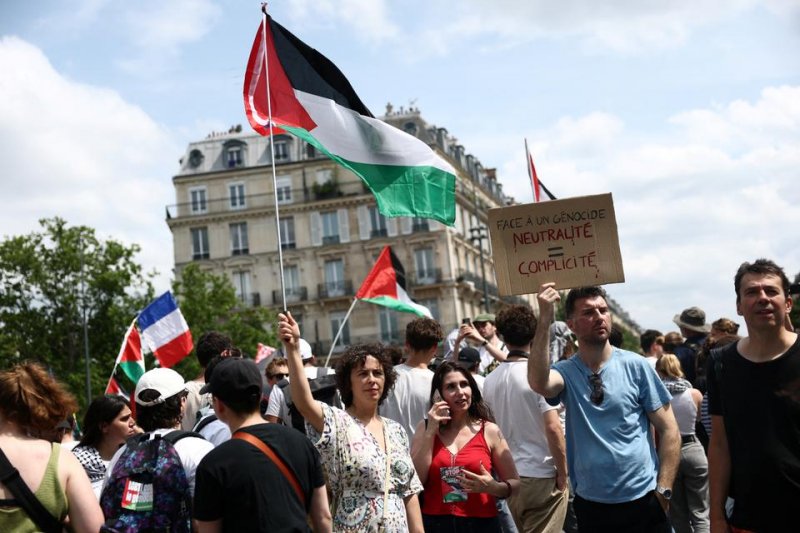 Photo: Reuters
Within Macron’s own party, Renaissance (formerly La République En Marche!), many lawmakers are openly frustrated. Several admit privately that the recognition of Palestine was made “under pressure from the streets,” a sign of a president losing control of his agenda. Far from projecting strength, Macron’s actions have reinforced the perception of a leader adrift — reactive rather than strategic.
What makes this moment particularly perilous is that France’s voice still matters. As a founding member of the European Union and a nuclear power, its decisions reverberate well beyond its borders. Yet the country’s declining economic fundamentals, political paralysis, and diplomatic missteps are eroding its ability to shape the global order.
Macron was elected in 2017 and re-elected in 2022 on promises of reform, stability, and European renewal. Eight years later, those promises ring hollow. If his second term continues along its current trajectory, Macron will not be remembered as a modern-day Napoleon, but rather as the leader who presided over France’s retreat from both domestic stability and international relevance. Napoleon’s mistakes were legendary — but even he might have avoided the blunders now unfolding in Paris.
(If you possess specialized knowledge and wish to contribute, please reach out to us at opinions@news.az).


Similar news