At least 34 injured after powerful quake in northeast Japan


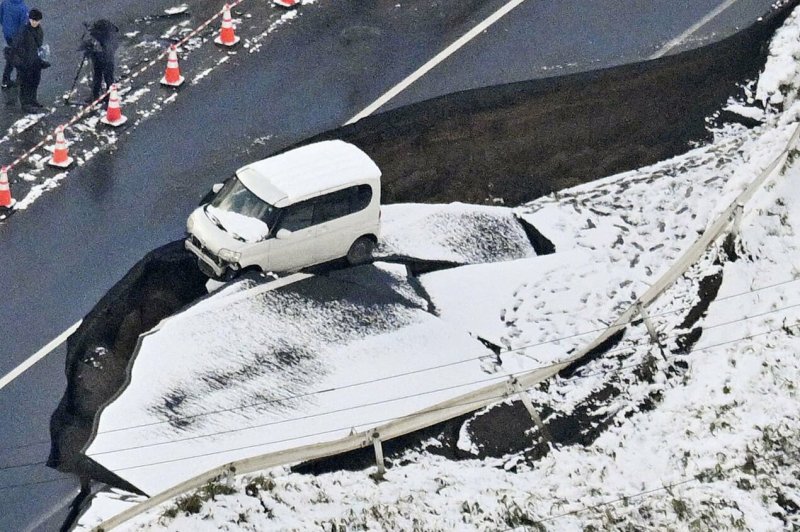
At least 34 people were injured late Monday when a powerful 7.5-magnitude earthquake struck northeastern Japan, causing disruptions to transport and water supplies, and prompting school closures in several areas. Authorities warned of the possibility of a stronger tremor in the coming days.
The Japan Meteorological Agency informed that the quake occurred at 11:15 p.m. off the eastern coast of Aomori Prefecture at a depth of 54 kilometers, News.Az reports, citing Kyodo.
It is the first time the agency has issued such an alert for the coastal regions of Hokkaido and the Sanriku coast, which spans Aomori through Iwate and Miyagi prefectures. Officials said a similar or stronger quake could follow in the same area.
JR East suspended bullet train services on the Tohoku Shinkansen Line between Morioka in Iwate Prefecture and Shin-Aomori in Aomori for inspections, with operations expected to resume Tuesday afternoon.
Prime Minister Sanae Takaichi urged residents to stay alert, follow local government and weather agency updates, and prepare for possible further quakes by securing furniture and remaining ready to evacuate. “The government asks residents to continue social and economic activities while maintaining a readiness to evacuate immediately if any shaking is felt,” she said.
The injured were reported in Hokkaido, and Aomori and Iwate prefectures, while dozens remained in evacuation centers as of Tuesday morning. Water supply was disrupted in roughly 1,360 homes across Aomori and Iwate due to damaged pipes.
School closures affected 139 public schools in Aomori and 48 in Hokkaido, according to the Education Ministry and local authorities. Defense Minister Shinjiro Koizumi said a Maritime Self-Defense Force air base and a Ground Self-Defense Force camp in Hachinohe, Aomori—the hardest-hit area—served as evacuation centers, housing about 620 people and 270 vehicles.
Many residents were forced to evacuate in freezing temperatures when tsunami warnings were issued. Warnings were downgraded to advisories three hours after the quake and lifted at 6:20 a.m. Tuesday. In Hidaka, Hokkaido, more than 200 people sought shelter in a municipal center, using distributed blankets and heaters to stay warm in minus 7.8°C temperatures.
Several residents recounted their experiences. Ikuko Hotta, 74, said she evacuated immediately after the warning, recalling a prior earthquake near Russia’s Kamchatka Peninsula. A 75-year-old woman in Kamaishi, Iwate, described evacuating with her husband and cat to avoid potential dangers, including wildlife.
No abnormalities were reported at nuclear plants in Hokkaido or northeastern prefectures. At a nuclear fuel reprocessing plant in Rokkasho, Aomori, water leaked from a spent fuel storage pool but remained contained within the building.
The agency revised the quake’s magnitude from an initial 7.6 and warned of tsunami waves up to 3 meters, though the highest waves observed were 70 cm in Iwate. Parts of Aomori registered upper 6 on Japan’s seismic intensity scale of 7, where standing or moving without crawling is nearly impossible.
The quake occurred along a trench off Hokkaido and northeastern Japan, where major earthquakes can be triggered as the Pacific Plate subducts beneath Honshu. The “Off the Coast of Hokkaido and Sanriku Subsequent Earthquake Advisory” system, operational since December 2022, signals a one-in-100 chance of an M8 or greater quake within seven days. Even when such alerts are in effect across 182 municipalities in seven prefectures, authorities do not instruct the public to evacuate preemptively.


Similar news