Blue Origin's New Glenn rocket reaches orbit in debut flight - UPDATED/VIDEO


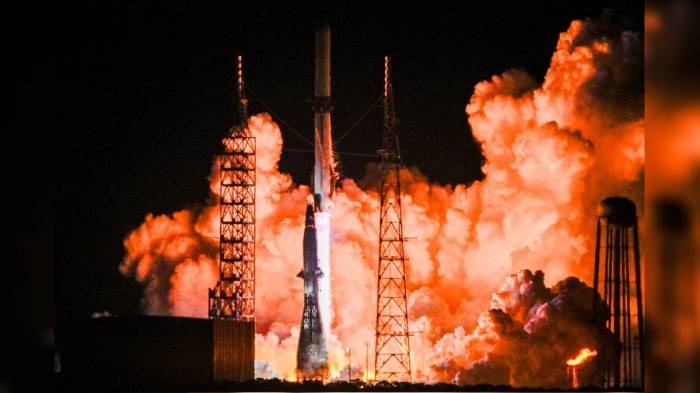
Blue Origin launches its first New Glenn rocket from Cape Canaveral Space Force Station on Jan. 16, 2025. Photo: Rodríguez Carrillo/Getty Images
Blue Origin, led by CEO Jeff Bezos, reached a significant milestone in the satellite launch industry early Thursday morning with the successful maiden flight of its New Glenn rocket, launched from Florida.
About 12.5 minutes later, the rocket's upper stage reached orbit — the main goal of today's test flight, which the company called NG-1, News.Az reports, citing Space.com."We got to orbit safely,” Ariane Cornell, vice president of in-space systems at Blue Origin, said in the company's launch webcast. "Congratulations, everybody. What a day!"
Blue Origin also tried to land New Glenn's reusable first stage on a ship in the Atlantic Ocean, which is nicknamed Jacklyn, after company founder Jeff Bezos' mother. The booster managed to fire up three of its engines in a reentry burn as planned, but it didn't stick the landing.
"We didn't have booster landing, but man, we got close," Cornell said. "We collected so much data."
A successful landing would have been something of a surprise; the company had stressed repeatedly in the leadup to launch that this was a secondary goal that was unlikely to be achieved on NG-1.
Like many rockets, the 320-foot-tall (98 meters) New Glenn took a long road to the launch pad. Its first flight was initially projected to take place in 2020, but development of the rocket's powerful BE-4 first-stage engines slowed the timeline.
There were a few more delays in the home stretch. Today's liftoff was originally planned for Jan. 10, but Blue Origin pushed things back 72 hours due to rough seas in the projected landing area for the booster. A launch attempt on Jan. 13 was scrubbed due to ice buildup in one of the rocket's power units, and Blue Origin then pushed the next try back to this morning.
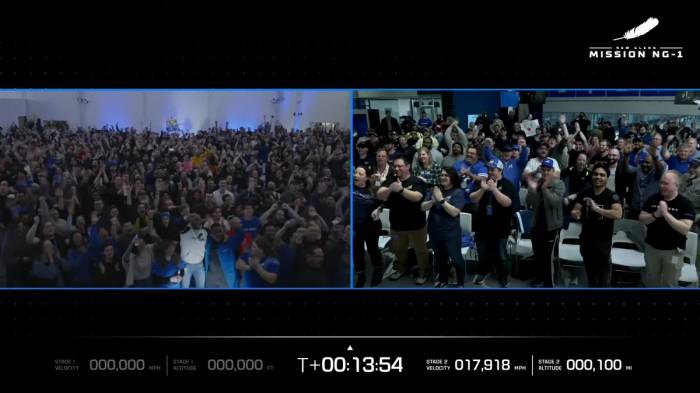
Blue Origin employees in Kent, Washington (left) and Huntsville, Alabama, cheer as the company's New Glenn rocket launches for the first time. Photo: Blue Origin
New Glenn's reusable first stage could help it compete with SpaceX's venerable Falcon 9, the world's first orbital-class reusable rocket. Blue Origin aims to launch each New Glenn booster at least 25 times and already has customers ranging from NASA, various U.S. government agencies, AST SpaceMobile and other telecommunications companies.
New Glenn has also been tapped to help launch Amazon's Project Kuiper broadband internet satellites, which could become a competitor to SpaceX's Starlink megaconstellation. Amazon already has a license to launch over 3,000 Kuiper satellites.
Both Blue Origin and Amazon were founded by Bezos, who has flown to suborbital space aboard the company's smaller New Shepard space tourism rocket.
New Glenn is capable of carrying 50 tons (45 metric tons) of payload to low Earth orbit (LEO). SpaceX's Falcon Heavy rocket, which also features reusable first stage boosters, can lift around 70 tons (64 metric tons) to LEO.
If all goes to plan, NG-1 will help certify the rocket for the U.S. Space Force's National Security Space Launch (NSSL) program, which pairs U.S. military and intelligence spacecraft with commercial launch providers. NSSL launches also include GPS, communications and weather satellites that provide data and services to the U.S. government.
New Glenn was initially scheduled to launch NASA's twin ESCAPADE Mars probes on NG-1, but the space agency decided to delay the mission until the rocket proved itself worthy of flight. ESCAPADE is now scheduled to launch no earlier than Spring 2025.
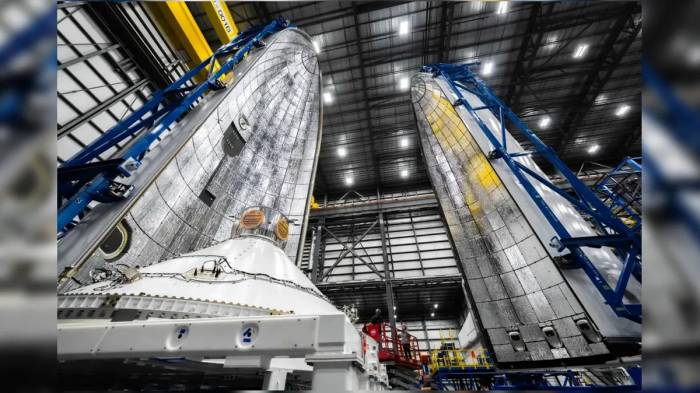
The Blue Origin Blue Ring Pathfinder payload with its massive rocket fairings that flew on the company's first New Glenn rocket. Photo: Blue Origin
RECOMMENDED STORIES
Blue Origin launched its massive new rocket on its first test flight Thursday, sending up a prototype satellite to orbit thousands of miles above Earth.
Named after the first American to orbit Earth, the New Glenn rocket blasted off from Florida, soaring from the same pad used to launch NASA’s Mariner and Pioneer spacecraft a half-century ago, News.Az reports, citing AP.
Years in the making with heavy funding by Amazon founder Jeff Bezos, the 320-foot (98-meter) rocket carried an an experimental platform designed to host satellites or release them into their proper orbits.
For this test, the satellite was expected to remain inside the second stage while circling Earth. The mission was expected to last six hours, with the second stage then placed in a safe condition to stay in a high, out-of-the-way orbit in accordance with NASA’s practices for minimizing space junk.


Similar news