Book on Armenian irredentism and the Karabakh wars presented in Baku


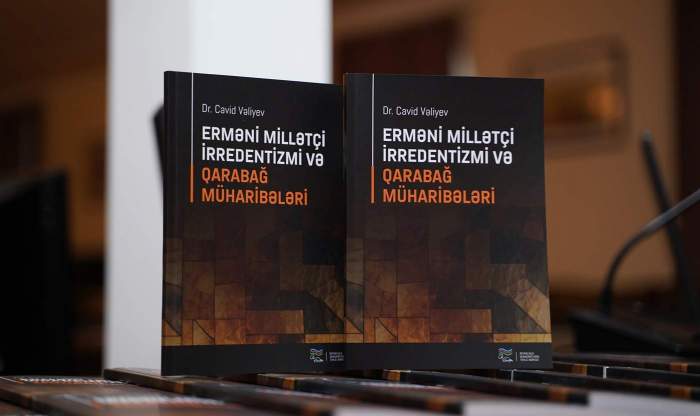
The presentation of the book Armenian nationalist irredentism and the Karabakh wars took place on February 5, in Baku, in the Center for analysis of international relations (CAIR).
The event began with an opening speech by the chairman of CAIR, Farid Shafiyev, News.Az reports.
He emphasized that certain narratives promoted by Armenia and the Armenian diaspora—such as the claim that the events leading to the Karabakh war began after the 1988 Sumgait incidents and the focus on the principle of self-determination—underscore the need to reassess the history of Armenian irredentism. Shafiyev pointed out that the systematic and violent expulsion of Azerbaijanis from their ancestral lands by Armenians is an integral part of this irredentist policy. He also referenced a recent statement by Armenia's Foreign Minister, Ararat Mirzoyan, regarding compensation for the Azerbaijanis of Western Azerbaijan, arguing that it demonstrates Armenia has not abandoned or ceased justifying its irredentist agenda.
Musa Qasımlı, Deputy Speaker of the Milli Majlis (National Assembly) of Azerbaijan, highlighted the book’s chronological structure and underscored its significance in Azerbaijan’s historiography. He noted that, for the first time in Azerbaijani history, Azerbaijan’s sovereignty over all its territories has been fully restored, thanks to President Ilham Aliyev’s successful foreign policy.
Qasımlı explained that Armenian irredentism, backed by major empires since the late 19th century, has been used to promote genocide and terrorism in the South Caucasus, aiming to prevent the formation of a unified Turkic world.
"In the 1940s, they advanced the theory of a 'united front.' Armenian political parties, putting aside their differences, united around a single cause: to demand land and compensation from Türkiye and the annexation of Nakhchivan and Karabakh," said Qasımlı.
Ilqar Niftaliyev, Deputy Director for Scientific Affairs at the Institute of History and Ethnology of the National Academy of Sciences of Azerbaijan, praised the book for drawing from Armenian diaspora archives and the works of Armenian authors. He also noted that, during the Soviet era, Armenian authors dominated the historical narrative of Karabakh, contributing to the spread of Armenian irredentism. Niftaliyev explained that after Azerbaijan regained its independence, significant research was carried out in this field, making it a crucial component of the information war. He also remarked that the Dashnaks, who were used as pawns by empires, adapted their tactics depending on the political context, aligning with either the West or the Soviet Union.
Nazim Mustafa, a senior researcher at the Institute of History and Ethnology, added that the book introduces a fresh perspective and addresses numerous issues that have never before been explored in Azerbaijani historiography.
"The codes of Armenian irredentism are decoded in this book," said Mustafa.
Briefly reviewing the history of Armenian irredentism, Mustafa emphasized that the views expressed by former Armenian President Levon Ter-Petrosyan during his July 23, 1993, meeting with members of the Yerkrapa terrorist organization were an essential part of this policy.
The author of the book, Cavid Valiyev, head of a department at CAIR, explained that the book's theoretical analysis focuses on international relations and foreign policy aspects. He also mentioned that an English translation of the book is planned.
The event concluded with a question-and-answer session.


Similar news