China sets 2026 economic priorities at key conference


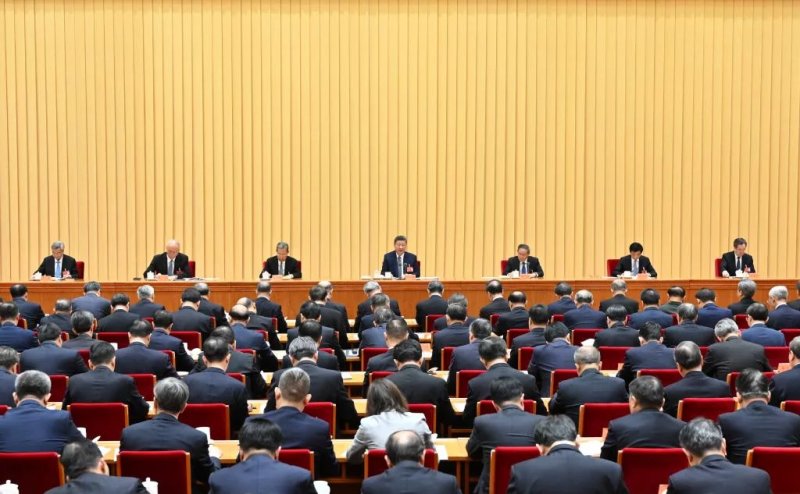
The annual Central Economic Work Conference took place in Beijing from Wednesday to Thursday, where Chinese leaders outlined priorities for the country’s economic work in 2026.
Xi Jinping, general secretary of the Communist Party of China (CPC) Central Committee, president, and chairman of the Central Military Commission, delivered a key speech at the event, News.Az reports, citing Xinhua.
In his address, Xi reviewed China’s economic performance in 2025, assessed the current economic situation, and set the agenda for next year’s economic work.
The conference highlighted that 2025 was an extraordinary year, with the main economic and social development targets expected to be successfully met.
As the 14th Five-Year Plan (2021–2025) nears completion, the meeting noted that China navigated various challenges over the past five years and achieved significant accomplishments for the Party and the nation.
The conference emphasized the need to fully tap economic potential, pursue policy support alongside reform and innovation, balance market vitality with effective regulation, and integrate investment in physical assets with human capital. Strengthening internal capabilities to address external challenges was also stressed.
While acknowledging ongoing and emerging challenges, including deepened impacts from the external environment and risks in key areas, the meeting affirmed that these issues can be managed. The fundamental conditions for China’s long-term economic growth remain unchanged.
Leaders stressed the importance of applying the new development philosophy, accelerating the formation of a new development paradigm, and promoting high-quality development.
China will continue to follow the principle of pursuing progress while maintaining stability, coordinate domestic economic efforts with international economic and trade challenges, and ensure both development and security.
The country plans to implement more proactive and impactful macroeconomic policies, design targeted and well-coordinated measures, expand domestic demand, optimize supply, and develop new productive forces according to local conditions.
Efforts will focus on developing a unified national market, managing risks in key sectors, and ensuring stable employment, business, market conditions, and expectations, setting a strong foundation for the 15th Five-Year Plan (2026–2030).
China will maintain a proactive fiscal policy, manage fiscal deficits and overall debt prudently, standardize tax incentives and subsidies, and address local fiscal challenges. Party and government bodies will continue prudent budget management.
Monetary policy will remain moderately loose, with flexible use of tools such as reserve requirement ratios and interest rates to maintain ample liquidity. Financial institutions will be encouraged to support domestic demand, technological innovation, micro, small, and medium enterprises, and other key sectors.
The RMB exchange rate will remain generally stable at a balanced and adaptive level. The meeting emphasized aligning macroeconomic policies, refining expectations management, and strengthening social confidence.


Similar news