Could Central Asia become the world’s next critical minerals hub?
- 1059814
- Explainers (FAQ)
-
Share
https://news.az/news/could-central-asia-become-the-worlds-next-critical-minerals-hub
Copied
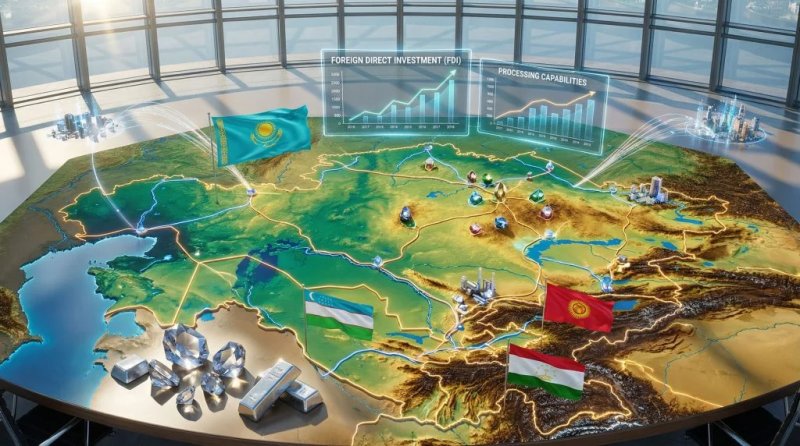
Central Asia is rapidly emerging as one of the world’s most strategically important regions in the global race for critical minerals as governments and industries seek secure supplies of resources essential for electric vehicles, renewable energy, semiconductors, batteries, defense technologies, and advanced manufacturing.
For decades, Central Asia was known primarily for oil, gas, and geopolitical competition tied to the post Soviet space.
RECOMMENDED STORIES
Today, however, the region is increasingly attracting attention because of its vast reserves of uranium, lithium, copper, rare earth elements, cobalt, graphite, and other minerals considered critical for the future global economy.
As countries accelerate transitions toward green energy and high technology industries, competition over access to strategic minerals is intensifying rapidly.
The region’s strategic location between China, Russia, Europe, South Asia, and the Middle East additionally increases its geopolitical importance.
Governments and investors increasingly view Kazakhstan, Uzbekistan, Kyrgyzstan, Tajikistan, and Turkmenistan as potential future pillars of global mineral supply chains.
The growing global rivalry over critical minerals is driven largely by fears of overdependence on China, which currently dominates processing and refining capacity for many strategic resources.
Western countries, Japan, South Korea, and others increasingly seek diversified suppliers and alternative trade routes.
Central Asia therefore stands at the center of a new geopolitical and economic contest involving energy transition, industrial security, and technological competition.
However, major challenges remain.
Infrastructure limitations, governance concerns, environmental risks, water shortages, geopolitical competition, and technological gaps could all influence whether Central Asia successfully transforms into a global critical minerals powerhouse.
What are critical minerals?
Critical minerals are natural resources considered essential for modern technologies, industrial production, national security, and clean energy systems.
These include lithium, cobalt, nickel, copper, graphite, rare earth elements, uranium, and several other specialized materials.
They are called “critical” because modern economies increasingly depend on them while global supplies are concentrated in relatively few countries.
Electric vehicles, wind turbines, solar panels, batteries, semiconductors, smartphones, military equipment, satellites, and data centers all require large amounts of critical minerals.
As countries pursue green energy transitions and advanced technologies, demand for these materials is expected to increase dramatically during coming decades.
Governments therefore increasingly treat access to critical minerals as both an economic and national security priority.
Why is Central Asia attracting attention in the minerals race?
Central Asia contains enormous untapped reserves of strategic minerals spread across a geographically vast region rich in natural resources.
During the Soviet era, many mineral deposits were explored but not fully developed according to modern commercial standards.
Today, rising global demand and improved geological surveys are renewing international interest.
The region also benefits from geographic proximity to major industrial markets including China, Europe, South Asia, and Russia.
Additionally, many countries want alternatives to supply chains dominated by China.
Central Asia therefore offers opportunities for diversification.
Governments and companies increasingly see the region as a potential future source of critical resources necessary for clean energy technologies and industrial manufacturing.
Why is Kazakhstan considered the regional leader?
Kazakhstan is widely viewed as Central Asia’s most important minerals power because of its enormous natural resource base.
The country is already the world’s leading uranium producer and possesses significant reserves of copper, chromium, zinc, lead, rare earth elements, and other strategic minerals.
Kazakhstan’s uranium industry plays a crucial role in global nuclear energy markets.
As countries reconsider nuclear power amid energy security concerns and climate goals, Kazakhstan’s strategic importance continues rising.
The country also seeks to expand rare earth mining and processing capabilities.
Kazakhstan’s relatively developed infrastructure and multi vector foreign policy make it particularly attractive for international investment compared to some neighboring states.
Western, Chinese, Turkish, Gulf, and Russian companies all compete for opportunities in the country’s mining sector.
What minerals does Uzbekistan possess?
Uzbekistan possesses substantial reserves of gold, copper, uranium, silver, tungsten, and rare earth elements.
The country is already one of the world’s leading gold producers.
In recent years, Uzbekistan accelerated economic reforms aimed at attracting foreign investment into mining, energy, and industrial sectors.
Tashkent increasingly positions itself as a regional industrial and logistics hub while modernizing infrastructure and expanding partnerships with foreign companies.
Critical minerals form a major part of Uzbekistan’s long term economic diversification strategy.
The government hopes mining revenues and industrial processing projects can strengthen economic growth and geopolitical influence.
Why are rare earth elements so important?
Rare earth elements are essential for many advanced technologies including electric motors, wind turbines, smartphones, missile systems, lasers, and semiconductors.
Despite the name, many rare earths are not actually extremely rare geologically.
However, extraction and refining are technologically difficult and environmentally sensitive.
China currently dominates global rare earth processing and refining.
This created growing concern in Western countries about supply chain vulnerabilities.
As geopolitical competition intensifies, governments increasingly seek diversified sources and processing capabilities.
Central Asia’s rare earth reserves therefore attract rising strategic interest from multiple global powers.
How does uranium increase the region’s importance?
Uranium is becoming increasingly important because many countries are reconsidering nuclear energy as part of climate and energy security strategies.
Nuclear power generates electricity without direct carbon emissions and provides stable baseload energy unlike intermittent renewable sources.
Kazakhstan dominates global uranium production and therefore occupies a highly strategic position in global energy markets.
Uzbekistan also produces uranium.
As nuclear energy investment increases worldwide, Central Asia’s role in supplying fuel for reactors could become even more important.
This gives the region geopolitical leverage extending far beyond traditional oil and gas exports.
Why is lithium drawing global attention?
Lithium is one of the world’s most sought after minerals because it is essential for rechargeable batteries used in electric vehicles, smartphones, and renewable energy storage systems.
Global demand for lithium is expected to increase dramatically during coming decades as countries shift toward electric transportation and clean energy technologies.
Some Central Asian countries possess promising lithium reserves that remain relatively underdeveloped.
Governments and foreign investors increasingly seek exploration opportunities across the region.
Although Central Asia is not currently among the world’s top lithium producers, future development could significantly increase its importance in battery supply chains.
How is China involved in Central Asia’s mining sector?
China already plays a major role in Central Asia’s mining and infrastructure sectors.
Chinese companies invest heavily in mineral extraction, transportation networks, industrial processing, and logistics projects connected to the Belt and Road Initiative.
Beijing seeks secure access to strategic resources necessary for industrial production and technological development.
China also dominates much of the world’s refining and processing capacity for critical minerals.
Expanding access to Central Asian resources strengthens Beijing’s supply chain security.
However, growing Chinese involvement also creates concerns within some Central Asian societies about debt dependence, sovereignty, and excessive foreign control over natural resources.
Why are Western countries interested in Central Asia?
Western governments increasingly view Central Asia as strategically important for diversifying critical mineral supply chains.
The United States and European Union worry about excessive dependence on China for rare earth processing and battery materials.
They also seek alternative suppliers of uranium and other strategic resources.
As a result, Western countries increasingly promote investment, infrastructure cooperation, and industrial partnerships involving Central Asia.
The region also fits broader Western goals involving energy diversification, transportation corridors, and geopolitical balancing across Eurasia.
Europe in particular sees Central Asia as part of long term green transition strategies.
What infrastructure challenges exist?
Infrastructure remains one of the biggest obstacles limiting Central Asia’s mining potential.
Many mineral deposits are located in remote areas with limited transportation access, electricity networks, or industrial facilities.
Railways, roads, ports, and processing infrastructure often require modernization.
Because Central Asia is landlocked, exporting minerals also depends heavily on transportation corridors crossing neighboring countries.
The Middle Corridor linking Central Asia to Europe through the Caspian Sea and the Caucasus is therefore becoming increasingly important.
Developing modern processing and refining industries additionally requires enormous investment and technical expertise.
Without such infrastructure, many countries may remain exporters of raw materials rather than high value industrial products.
Could environmental issues become a major problem?
Yes.
Mining projects often create significant environmental risks including water pollution, soil degradation, toxic waste, and ecosystem damage.
Central Asia already faces major environmental challenges linked to water shortages, desertification, and climate change.
The region’s history also includes environmental disasters connected to Soviet industrial policies such as the collapse of the Aral Sea.
Expanding mining operations without strong environmental protections could worsen ecological pressures.
Water availability may become especially sensitive because mining and mineral processing often require large amounts of water in already water stressed regions.
Governments therefore face difficult choices balancing economic development with environmental sustainability.
Why is processing capacity so important?
Control over mineral processing is becoming nearly as important as control over mining itself.
China currently dominates refining and processing for many critical minerals.
Even countries possessing large mineral reserves often still depend on Chinese facilities for processing.
As a result, many governments now seek to develop domestic or regional refining industries.
Central Asian countries increasingly recognize that exporting only raw materials limits long term economic benefits.
Developing processing industries could create jobs, industrial growth, and greater economic value.
However, building modern refining capacity requires advanced technology, skilled labor, energy infrastructure, and major investment.
Could Central Asia become a major industrial hub too?
Potentially yes.
If governments successfully develop processing industries, manufacturing sectors, and transportation infrastructure, the region could evolve beyond raw material extraction.
Critical minerals may help stimulate broader industrialization involving batteries, renewable technologies, metallurgy, and advanced materials.
Improved connectivity through Eurasian trade corridors may also support manufacturing expansion.
However, achieving this transformation would require long term strategic planning, investment in education and technology, and stronger institutions.
How does geopolitics affect the minerals race?
Critical minerals increasingly sit at the center of global geopolitical competition.
The United States, China, Europe, Russia, Türkiye, Gulf countries, Japan, and South Korea all seek influence over future supply chains.
Central Asia’s strategic location and resource wealth therefore make it an important arena in broader geopolitical rivalry.
Competition may involve investment, infrastructure financing, diplomatic partnerships, transportation corridors, and industrial agreements.
At the same time, Central Asian governments attempt to balance relations with multiple powers rather than depending exclusively on any single country.
This balancing strategy increases the region’s geopolitical importance further.
What role does the Middle Corridor play?
The Middle Corridor transportation network connecting China to Europe through Central Asia, the Caspian Sea, the Caucasus, and Türkiye is becoming increasingly important for mineral exports.
The route offers alternatives to transportation corridors passing through Russia.
European countries especially support the corridor as part of supply chain diversification efforts.
Efficient logistics networks are essential for exporting critical minerals competitively to global markets.
As mineral demand rises, transportation infrastructure may become one of the decisive factors shaping Central Asia’s economic future.
Can Central Asia truly become a global minerals powerhouse?
The region certainly possesses the natural resources necessary to become one of the world’s major critical minerals centers.
Its reserves of uranium, rare earth elements, copper, lithium, and other strategic materials give it enormous potential.
However, success will depend on several factors including infrastructure development, political stability, environmental management, industrial modernization, foreign investment, and regional cooperation.
The region must also avoid becoming merely a source of raw material exports without developing higher value industries.
If managed effectively, Central Asia could become one of the key pillars of the global clean energy and high technology economy during the coming decades.
The growing race for critical minerals is therefore not only reshaping global geopolitics but also transforming Central Asia into one of the world’s most strategically important emerging regions.
By Faig Mahmudov