Did Trump really say Giorgia Meloni begged him for a photo at the G7 Summit?


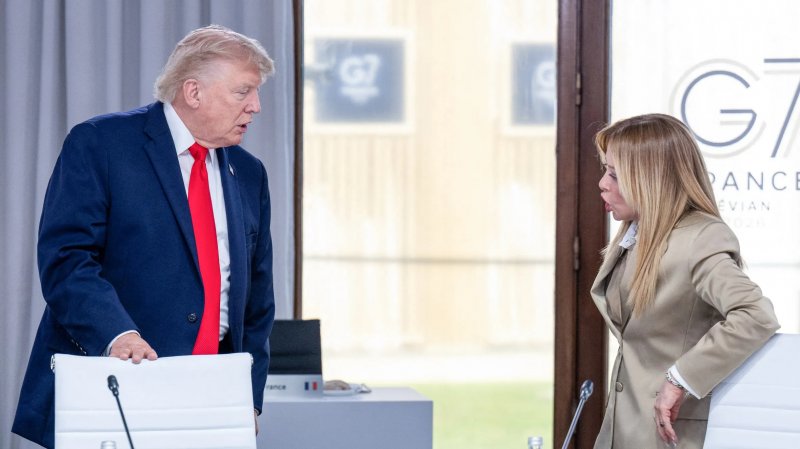
A public dispute between U.S. President Donald Trump and Italian Prime Minister Giorgia Meloni has triggered a diplomatic controversy that is attracting attention on both sides of the Atlantic.
The row erupted after Trump reportedly claimed that Meloni had “begged” him for a photograph during the recent G7 summit, a statement the Italian leader has categorically denied, News.az reports.
The controversy has since escalated into a broader debate about diplomatic etiquette, the state of U.S.-Italy relations, and the increasingly personal nature of international politics.
What happened?
The dispute began when Trump reportedly made remarks during an interview with Italian television channel La7 regarding his interactions with Meloni at the G7 summit.
According to the broadcaster, Trump claimed that Meloni had repeatedly sought a photograph with him and that he only agreed because he felt sorry for her. The reported comments quickly circulated in Italian media and sparked strong reactions from political leaders and commentators.
Meloni responded publicly, rejecting the account and accusing Trump of inventing the story. In a video posted on social media, she stated that the remarks were “completely made up” and said she was surprised by the comments.
The disagreement rapidly transformed from a personal exchange into a diplomatic issue, with senior Italian officials entering the debate and questioning Trump's approach toward allied nations.
What exactly did Trump reportedly say?
According to reports from La7, Trump claimed that Meloni had strongly wanted a photograph with him during the summit.
The reported remarks suggested that Meloni repeatedly requested the photo and that Trump reluctantly agreed. The comments immediately attracted attention because they appeared to portray one of Europe's most prominent leaders as seeking personal approval from the American president.
However, the controversy has been complicated by the fact that the broadcaster reportedly did not release an audio recording of the conversation, making independent verification difficult.
As a result, political observers have focused not only on the alleged remarks themselves but also on questions surrounding their reporting and interpretation.
Regardless of the precise wording, the comments were perceived in Italy as disrespectful toward both Meloni and the country she represents.
How did Meloni respond?
Meloni's response was unusually direct for a dispute involving allied leaders.
In her public statement, she rejected the story entirely and accused Trump of fabricating the incident. She expressed surprise at what she described as a pattern of behavior toward allies and suggested that such determination would be better directed toward adversaries of the West.
Perhaps the most widely quoted part of her response was her declaration that neither she nor Italy would ever beg for anything.
The statement was widely interpreted as an attempt not only to defend her personal reputation but also to protect Italy's national dignity. Political analysts noted that Meloni framed her response in national terms rather than merely as a personal disagreement.
That approach helped transform the controversy into a broader question of how foreign leaders should treat one another in public discourse.
Why has the phrase “Italy never begs” become so significant?
The phrase quickly became the defining message of Meloni's response because it touched on themes of national pride, sovereignty, and respect.
For many Italians, the issue was not simply whether a photograph was requested. Instead, it became a matter of whether the country's leader had been publicly portrayed in a way that diminished Italy's status on the world stage.
Political leaders frequently seek photographs at international summits because such images symbolize diplomatic engagement and cooperation. Requesting a photo is generally viewed as a routine aspect of summit diplomacy rather than an indication of personal dependence.
Meloni's statement therefore sought to reject the implication that Italy needed validation from any foreign leader.
The phrase resonated across Italy's political spectrum because it emphasized national self-respect rather than partisan politics.
Why are photographs important in international diplomacy?
Photographs may appear trivial, but in diplomacy they often carry substantial symbolic significance.
Images from summits, bilateral meetings, and international gatherings can communicate political messages without a single word being spoken. A photograph can signal cooperation, friendship, support, reconciliation, or strategic partnership.
For this reason, world leaders routinely participate in carefully choreographed photo opportunities during major events such as the G7, G20, NATO, and United Nations meetings.
Images are often used domestically as evidence of a leader's international influence and global standing. They can also reassure allies, signal unity to adversaries, and shape public perceptions of diplomatic relationships.
Because photographs have symbolic value, disputes involving them can sometimes evolve into larger political controversies.
Why did the controversy become a diplomatic issue?
The dispute moved beyond personal disagreement because Meloni is not only a political figure but also the head of government of one of Europe's largest economies and a key member of NATO, the G7, and the European Union.
When a foreign leader is publicly criticized or ridiculed, governments often interpret such comments as reflecting attitudes toward the nation itself.
This appears to be one reason why Italian officials reacted strongly. The controversy was no longer viewed simply as a disagreement between two politicians but as an issue involving respect between allied countries.
Diplomatic relationships often depend heavily on mutual trust and public messaging. Statements that undermine confidence or create embarrassment can complicate cooperation even when official policies remain unchanged.
As a result, the dispute attracted attention far beyond the original remarks.
Why did Italy's foreign minister cancel his U.S. trip?
One of the most dramatic consequences of the controversy was the decision by Italian Foreign Minister Antonio Tajani to cancel a planned visit to the United States.
Tajani stated that Trump's reported remarks were offensive not only to Meloni but to Italy as a whole. By canceling the trip, he sent a political signal that the comments had consequences beyond media headlines.
Although the cancellation does not necessarily indicate a fundamental breakdown in relations, it demonstrates the seriousness with which some Italian officials viewed the dispute.
Diplomatic visits are carefully planned and often involve discussions on security, trade, defense, and international cooperation. Canceling such a visit is therefore a notable gesture in international politics.
The move highlighted how quickly a personal controversy can affect broader diplomatic interactions.
What has the relationship between Trump and Meloni been like?
The dispute is particularly surprising because Trump and Meloni have often been viewed as political allies.
Both leaders have been associated with conservative political movements and have frequently expressed similar views on issues such as migration, national sovereignty, and criticism of certain international institutions.
Meloni was widely regarded as one of the European leaders most capable of maintaining constructive relations with Trump. She was also the only European leader invited to attend his inauguration last year, a fact often cited as evidence of their close relationship.
Because of this history, many observers were surprised by the public nature of the disagreement.
The episode has raised questions about whether personal chemistry between the two leaders has deteriorated or whether the controversy represents a temporary dispute rather than a lasting rupture.
Could this affect U.S.-Italy relations?
At the moment, most analysts believe the controversy is unlikely to fundamentally alter relations between the two countries.
The United States and Italy share extensive strategic, military, economic, and diplomatic ties. Both are members of NATO and cooperate closely on security issues, trade, energy policy, and regional stability.
Such relationships are built on institutional foundations that generally survive changes in political leadership and personal disagreements.
However, diplomatic tensions can still influence the tone of cooperation. Public disputes may create temporary friction, complicate negotiations, or affect public perceptions in both countries.
The key question is whether the controversy remains a short-term political story or develops into a more sustained source of tension.
What does this incident reveal about modern diplomacy?
The dispute highlights how international politics has become increasingly personalized in the age of social media, television interviews, and instant global communication.
In previous decades, disagreements between leaders were often managed privately through diplomatic channels. Today, many disputes unfold in public view, with politicians responding directly through interviews, social media posts, and video messages.
This environment increases the political impact of personal remarks and can transform relatively minor incidents into international controversies.
The episode also illustrates how symbolism, image management, and public perception have become central components of diplomacy. What might once have been dismissed as a casual comment can now dominate headlines and shape international discussions.
As a result, leaders must navigate not only traditional diplomacy but also the pressures of a constantly connected media environment.
What happens next?
The immediate future will depend on whether either side chooses to escalate or de-escalate the controversy.
If no additional statements are made, the dispute may gradually fade as attention shifts to other international developments. Diplomatic channels between Washington and Rome remain active, and neither government has suggested a fundamental change in policy.
However, if further comments are exchanged or additional details emerge regarding the alleged conversation, the controversy could continue to generate headlines.
Observers will also be watching for signs of reconciliation, such as future meetings, joint appearances, or statements emphasizing cooperation.
For now, the dispute serves as a reminder that even among close allies, personal comments can rapidly evolve into diplomatic incidents with international repercussions.
By Faig Mahmudov


Similar news