Georgia: New restrictive laws effectively criminalize peaceful protest, HRW warns


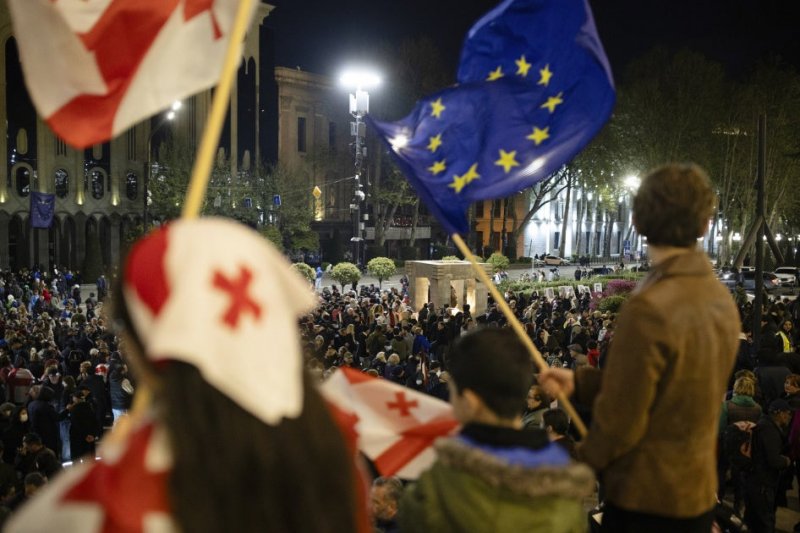

Georgian authorities have enacted a raft of laws that severely restrict the right to peaceful assembly and are being used to stifle dissent, Human Rights Watch (HRW) said on Thursday, News.az reports, citing HRW.
The organization warned that, alongside aggressive policing tactics and harsh financial penalties, these measures undermine the ability of Georgians to protest without fear of retaliation.
“The Georgian government is steadily dismantling essential safeguards for peaceful assembly and free expression,” said Giorgi Gogia, deputy director for Europe and Central Asia at HRW. “People are being detained or hit with devastating fines simply for exercising their basic rights.”
Large-scale protests have erupted nationwide since the ruling party announced in November 2024 that it would withdraw from the country’s EU accession process. Authorities have responded with police force, and human rights groups report hundreds of administrative detentions and thousands of fines related to alleged protest violations. The result, HRW said, is an increasingly punitive environment aimed at deterring public participation.
Since November 2024, lawmakers have pushed through multiple amendments that, taken together, effectively criminalize routine protest activity.
Escalating penalties and new restrictions
Amendments passed in December 2024 introduced steep increases in financial penalties—raising fines from 500 to 5,000 Georgian lari (US$185–1,850) for activities such as blocking building entrances, wearing masks, displaying political graffiti, or possessing laser pointers. With Georgia’s average monthly income around 2,212 lari (about $820), HRW noted that these penalties approach criminal-level sanctions yet remain classified as administrative offenses, leaving accused individuals without full criminal procedural protections.
The same amendments granted police broad preventive powers to detain and search individuals for up to 48 hours if they had previously been implicated in an administrative violation and deemed likely to reoffend. HRW said such vague standards violate international norms prohibiting arbitrary detention.
Further amendments approved in February 2025 extended administrative detention from 15 to 60 days—mainly for protest-related charges such as “petty hooliganism,” refusal to obey police instructions, or violating assembly regulations. New offenses were also created, including “verbal insults” directed at officials, punishable by up to 45 days in detention. Additional barriers include notification requirements for spontaneous gatherings and mandatory prior written approval for indoor assemblies.
In July 2025, the parliament introduced automatic 30–60-day detention for individuals with unpaid protest-related fines who committed even minor infractions.
October 2025 amendments escalated penalties further by reclassifying repeated minor violations—including wearing masks at protests, blocking roads, erecting temporary structures, or participating in a disbanded demonstration—as felonies. These offenses now carry prison sentences of up to two years, and up to four years for those identified as organizers.
Arbitrary enforcement and disproportionate penalties
HRW said that authorities have aggressively applied these laws, frequently detaining demonstrators on questionable grounds. Protesters have been arrested for wearing masks, stepping briefly onto a roadway, or allegedly obstructing traffic.
Defense lawyers reported a pattern of convictions based primarily on surveillance footage and, in some cases, facial recognition technology. Officers who claim to identify protesters from video recordings are not questioned in court, and judges routinely overlook due-process requirements applicable when detention is possible.
Financial sanctions have also reached extreme levels. One notable case involved teacher and researcher Gota Chanturia, 36, who was fined a total of 365,000 lari ($135,200) for 73 alleged “road-blocking” incidents. Evidence presented by police consisted of short surveillance clips showing Chanturia standing peacefully near parliament. Chanturia’s 60-year-old father has reportedly accumulated around 70 similar fines, including in situations where police had already closed the road. Lawyers say courts have upheld these penalties without assessing proportionality.
Another case involves philologist Rusudan Kobakhidze, 61, who, while already in detention for administrative offenses, received three separate 5,000-lari fines—amounts far exceeding her income.
HRW said such cases illustrate a broader pattern of heavy-handed policing and punitive administrative proceedings that create a “climate of fear” around participation in peaceful assemblies.
Lack of transparency and growing international concern
The Interior Ministry releases only limited data, making the overall scale of penalties difficult to assess. Available figures show that in 2024 and the first nine months of 2025, authorities sanctioned 4,444 people for petty hooliganism and 6,725 for disobeying police orders—charges commonly linked to protests—and imposed detention in 6,504 cases.
As a member of the European Convention on Human Rights (ECHR), Georgia is obligated to protect freedom of expression and assembly. Any restrictions must be lawful, necessary, and proportionate. HRW stressed that harsh sanctions labeled as “administrative” still require criminal procedural safeguards if they carry penalties equivalent to criminal punishment.
International institutions have repeatedly criticized the changes. The Venice Commission warned that the December 2024 amendments significantly weaken freedom of assembly and risk producing a “chilling effect.” The OSCE Office for Democratic Institutions and Human Rights, in urgent opinions issued in March and November 2025, also condemned the disproportionate sanctions and expanded detention powers, cautioning that they could be used to silence peaceful demonstrators and civil society groups.
“Over the past year, the Georgian government has responded to widespread public protests with a coordinated effort to suppress criticism and keep people off the streets,” Gogia said. “Georgia’s international partners should press authorities to urgently reverse this repressive trajectory and reopen space for peaceful assembly.”


Similar news