Vučić goes to China: Why Serbia needs its “iron friendship” with Beijing


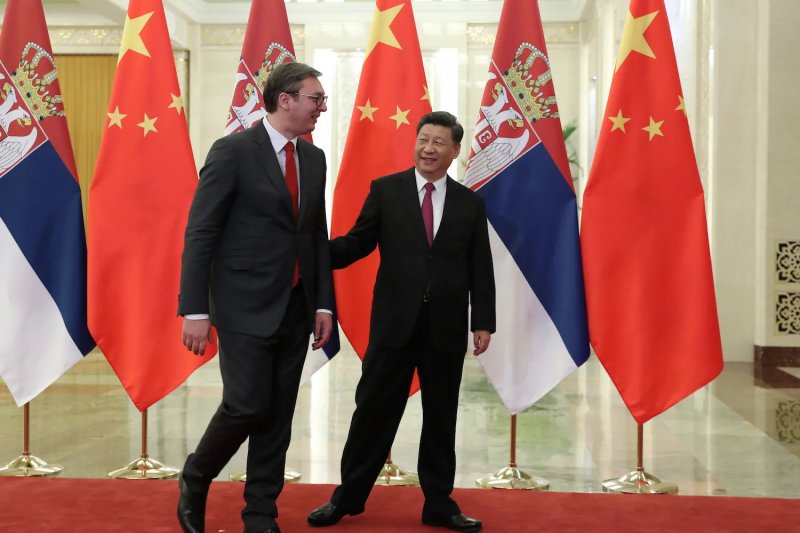
Serbian President Aleksandar Vučić will pay a state visit to China from 24 to 28 May at the invitation of Chinese President Xi Jinping. The dates of the trip were officially announced by China’s Ministry of Foreign Affairs, underscoring the high status of the visit and Serbia’s special place in Beijing’s policy towards the Balkans.
For Belgrade, this is not just another diplomatic trip. It is an attempt to consolidate one of Serbia’s key foreign policy approaches in recent years: remaining a candidate for EU membership while refusing to abandon close ties with China, Russia and other centres of power.
Vučić’s visit to China comes at a time when Serbia is trying to make the most of its geopolitical position. The country lies at the heart of the Balkans, is not a member of the EU or NATO, maintains ties with Moscow, actively develops relations with Beijing and, at the same time, remains economically dependent on the European market. For Vučić, the Chinese direction is therefore not secondary diplomacy, but an important tool of strategic balancing.
RECOMMENDED STORIES
Belgrade is showing Brussels that it has alternative partners, while signalling to Beijing that Serbia can remain China’s most reliable foothold in Southeast Europe.
China has long described its relationship with Serbia as an “iron friendship”. In February 2026, during Vučić’s meeting with Chinese Foreign Minister Wang Yi, the Serbian president thanked China for supporting Serbia’s sovereignty, independence and territorial integrity. China, in turn, said it was ready to deepen political trust, expand trade, infrastructure and technological cooperation, and ensure the stable operation of the Budapest–Belgrade railway project.
The main practical reason for the trip is the economy. Serbia wants to gain more from the Chinese market than it currently does. Trade between Serbia and China has grown sharply over the past decade — from about $1.5 billion in 2014 to $6 billion in 2023. In 2024, Serbian exports to China reached around $1.9 billion, while imports from China rose to about $5.5 billion. This means trade is expanding rapidly, but the imbalance remains significant: Serbia buys far more from China than it sells.
This imbalance is one of the main issues for Vučić. Belgrade wants its free trade agreement with China to become not only a political symbol, but also a real economic instrument. The Serbia–China free trade agreement entered into force on 1 July 2024. The Serbian government said that 60 per cent of product lines were exempted from customs duties from the first day of the agreement, while tariff reductions on another roughly 30 per cent of goods would be phased in over the next five to 15 years.
For a relatively small economy such as Serbia’s, this represents a major opportunity, but only under one condition: Serbian producers must be able to enter the Chinese market not only with raw materials, but also with higher value-added products.
For now, the structure of Serbian exports to China remains vulnerable. The bulk of exports consists of copper ore, concentrates and refined copper. This is linked to China’s strong presence in Serbia’s mining sector, particularly through Zijin, which controls major assets in the Bor region. In 2023, copper ore and concentrates accounted for around $842 million of Serbian exports to China, while refined copper accounted for another $301 million. This shows that Serbia still largely functions as a raw materials base for China rather than as a full-scale industrial partner.
That is why Vučić is going to China with the aim of broadening the economic agenda. Belgrade needs new export opportunities for Serbian agriculture, food products, wine, fruit, meat, industrial goods and the IT sector. Serbia understands that if the Chinese market remains mainly a destination for raw materials, then the “iron friendship” will be politically loud but economically limited. If Belgrade manages to increase supplies of finished products, however, the free trade agreement could become a historic advantage.
The second important issue is investment. China has already become one of the most visible foreign investors in Serbia. Its presence is especially strong in metallurgy, mining, infrastructure and energy. China’s HBIS acquired the Smederevo steel plant, which has not only economic but also symbolic importance for Serbia: for decades, the plant was considered one of the country’s industrial symbols. China’s Zijin has become a key player in the copper industry. Linglong is implementing a major tyre production project in Zrenjanin. For Vučić, such projects matter because they bring jobs, exports, tax revenues and visible industrial growth.
However, Chinese investment in Serbia is also controversial. Critics point to a lack of transparency in some contracts, environmental risks, labour concerns and growing dependence on Chinese capital. This is especially true of mining and industrial projects, where the environmental burden can be high. Vučić’s task is to show that cooperation with China does not turn Serbia into a periphery of the Chinese economy, but helps it modernise. During the visit, Belgrade is therefore likely to seek discussions not only on new loans or supplies, but also on higher-quality investments — technology, manufacturing, logistics, digitalisation and export chains.
The third major issue is infrastructure. Serbia has become one of the main European hubs of China’s Belt and Road Initiative. The most prominent project is the Budapest–Belgrade railway, which is intended to connect Central Europe with the Balkans and further with the Greek port of Piraeus, where China also has a strong presence.
In October 2025, Serbia launched regular traffic on the Chinese-built high-speed Belgrade–Subotica railway line, designed for speeds of up to 200 km/h. Chinese official sources describe the project as an important part of the Belt and Road Initiative.
For Serbia, this railway is strategically important. It turns the country from a peripheral Balkan state into a transit corridor between Central Europe, the Balkans and the Mediterranean. For China, it is even more important: Beijing gains an infrastructure route connecting Chinese goods, the port of Piraeus, the Balkans and EU markets.
That is why the Budapest–Belgrade railway is not just a transport project, but a geo-economic instrument. It shows that China is entering Europe not only through trade, but also through roads, bridges, ports, railways and industrial zones.
At the same time, Serbia cannot ignore the European Union. The EU remains Belgrade’s main economic partner. According to Serbia’s Statistical Office, the country’s total foreign trade in 2025 amounted to $84.54 billion, up 12.3 per cent from the previous year. Exports reached $37.31 billion, imports stood at $47.23 billion, and the trade deficit amounted to $9.91 billion. EU countries accounted for more than half of Serbia’s foreign trade.
This means that Vučić cannot replace Europe with China. China is important, but the EU remains Serbia’s main market, main investor and main economic reference point. Serbia’s strategy is therefore more complex than the simple formula that “Belgrade is turning to Beijing”. In reality, Vučić is trying to play on several boards at once.
With the EU, Serbia has negotiations, trade, investment and access to the European market. With China, it has infrastructure, political support, technology, industry and access to a vast Asian market. With Russia, it has energy, historical ties, political links and the Kosovo issue. This policy gives Belgrade room for manoeuvre, but also increases pressure from all sides.
The political significance of the visit is also clear. China supports Serbia’s position on territorial integrity, while Serbia supports the One China principle. For Beijing, this is important in the context of Taiwan. For Belgrade, it matters in the context of Kosovo. The two countries effectively exchange diplomatic support on the most sensitive issues of national policy. This is why Serbia–China relations have a deeper character than an ordinary trade partnership.
For Vučić, the trip to China is also a domestic political signal. He is showing Serbian society that the country is valued by major global powers, that Belgrade is not isolated and that Serbia can attract attention not only from Brussels or Moscow, but also from Beijing. Amid domestic political disputes, protests and pressure from the West, such visits help Vučić reinforce the image of a leader capable of pursuing an independent foreign policy and negotiating with powerful global actors.
For China, Serbia also has special value. It is a country in Europe that demonstrates readiness for strategic cooperation without strong ideological distance. Belgrade does not promote an anti-China agenda, does not oppose the Belt and Road Initiative, does not support pressure on Taiwan and actively welcomes Chinese investment.
Against the backdrop of China’s more difficult relations with a number of EU states, Serbia has become a convenient partner for Beijing — politically loyal, geographically important and economically open.
That is why Vučić’s visit may become not merely a protocol event, but a new stage in strengthening China’s presence in the Balkans. The two sides are likely to discuss new agreements in trade, industry, technology, infrastructure, logistics and possibly agriculture. Belgrade will seek to show that the free trade agreement is already opening new opportunities. Beijing will seek to demonstrate that Serbia remains an example of a successful Chinese partnership in Europe.
The key question after the visit will be what concrete results Serbia receives. If the trip leads to expanded exports, new production investments and more balanced trade, Vučić will be able to present it as a strategic success. If cooperation again revolves mainly around imports of Chinese goods, raw material supplies and infrastructure loans, then the political effect of the visit may prove stronger than its real economic impact.
In any case, the visit highlights an important trend: Serbia continues to build its foreign policy as a country that does not want to choose only one centre of power. Belgrade seeks to be an EU partner, China’s friend, Russia’s ally on certain issues and an independent player in the Balkans.
By Samir Muradov


Similar news