How Russia’s military strategy evolved in 2025


The year 2025 became a turning point in Russia’s war against Ukraine — not because of dramatic large-scale breakthroughs, but because the conflict finally solidified into a systematic war of attrition. The front line moved more in 2025 than in the previous two years, yet territorial gains remained gradual and costly, measured in destroyed equipment and growing casualty lists rather than swift offensives.
Moscow continued to emphasize “successful advances” in official rhetoric, strengthening its negotiation posture and signaling that time was supposedly on Russia’s side. Still, the broader dynamic showed something different: territorial control expanded unevenly, and every kilometre demanded significant resources.
Russia claimed nearly 5,000 square kilometers of new territory, although independent verification is difficult. The most notable gains were in Donetsk, where after nearly two years of grinding assault operations Russian forces approached full control of Pokrovsk and Mirnograd. Local advances were also recorded near Siversk and in Zaporizhzhia, partially due to Ukraine’s shortage of manpower, overstretched reserves and delays in Western ammunition deliveries. Early in the year, Russia also pushed into the Kursk region and briefly into Sumy, but momentum faded, and the operation stabilized without further breakthroughs. The picture is one of slow but persistent expansion, where progress in some sectors reached dozens of kilometres while others saw only shifts of trenches by mere meters.
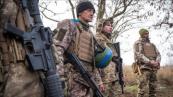
The defining feature of 2025 was the evolution of warfare itself. The conflict, once dominated by tanks and heavy artillery, increasingly turned into a battlefield ruled by drones, electronic warfare tools and compact assault groups. Russia rapidly expanded production and deployment of UAVs, including fibre-optic controlled systems that are less vulnerable to jamming. These drones adjusted artillery fire, monitored logistics and struck equipment behind the frontline, making them a central tool of Russian battlefield strategy. Instead of mass tank offensives, Russia relied on swarms of cheap FPV drones and small tactical units that pushed into weak points, held captured tree lines and gradually widened control.
This technological shift came with a cost, placing pressure on industrial production and pushing Russia deeper into a wartime economy. Although defence output has grown, it still depends on imports of microelectronics and components from China, Türkiye and the Global South, as sanctions remain an obstacle. Russia compensates through quantity: simplified armoured vehicles, mass-produced munitions and tens of thousands of drones each month. It is a strategy built around exhaustion rather than maneuver — one that assumes long conflict rather than a quick victory.
Despite this industrial push, logistics remained a weak link. The Ministry of Defense has not fully established a stable supply chain for units at the front. Soldiers in many formations continued to rely on volunteers, private fundraising networks, bloggers and crowdsourcing to obtain radios, vehicles, thermal imaging devices and even basic supplies. The result was uneven combat readiness — some units were well equipped, others struggled. In modern war, supply speed is as decisive as firepower, and unless Russia centralizes logistics more effectively, large breakthroughs will remain difficult.
Inside the country, the Kremlin maintained internal stability by avoiding open mass mobilization and instead relying on contract recruitment, salary incentives and regional quotas. This reduced social backlash, especially in major cities, but shifted the burden of fighting toward poorer regions where military service became an economic alternative. While Russia managed to stabilize its political environment, the long-term strain of casualties, migration and war-focused budgets may surface more clearly in the coming years.
The dynamics of the battlefield also depended heavily on external factors. Ukraine faced ammunition shortages and fluctuating Western aid cycles. Where support was steady, the frontline held. Where supplies slowed, Russian advances followed. The war in 2025 did not answer the key strategic question: Can Russia break Ukraine’s defense decisively? As of today, it appears unlikely without a significant drop in Western support or a new mobilisation wave on either side. Still, the war’s direction remains highly sensitive to political decisions in Washington, Brussels and Kyiv.
Looking ahead to 2026, several trajectories seem possible. The most plausible is a continuation of slow Russian advances — tactical, costly, incremental. Another possibility is Ukrainian stabilization and potential counteractions if aid resumes in sufficient volume. A frozen front resembling Korea could emerge if neither side gains momentum and negotiations revive under external pressure. A more dangerous path would involve escalation beyond Ukraine through intensified infrastructure strikes or strategic attacks, although this remains a less likely scenario. What seems certain is that the war will not end quickly. Both sides are preparing for a long conflict measured in months and years, not weeks.
Russia’s military adapted significantly in 2025, especially through the mass deployment of drones and small assault tactics. Yet adaptation is not equivalent to victory. Gains were real but not decisive, and every kilometre demanded manpower, ammunition and industrial effort that will be increasingly difficult to sustain. The war has entered an endurance phase, where industrial capacity, logistics and international alliances may matter more than territorial shifts visible on the map today. As the year ends, there is no final winner — only the recognition that this conflict is reshaping European security and is likely to continue shaping it well beyond 2026.


Similar news