India's PSLV rocket faces apparent failure in 2nd launch


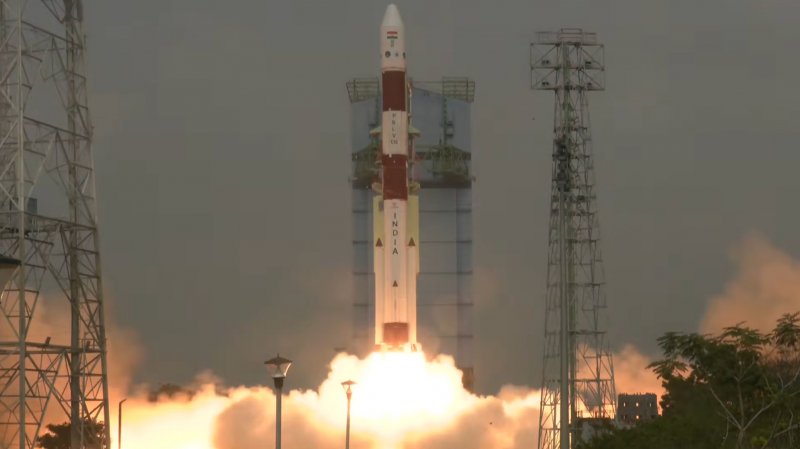
India’s PSLV rocket appears to have encountered problems during its return-to-flight mission for the second consecutive launch.
The PSLV, carrying the EOS-N1 military satellite along with 15 other payloads, lifted off from India’s Satish Dhawan Space Centre on Sunday, January 11, at 11:48 p.m. EST (0448 GMT; 10:18 a.m. India Standard Time, Monday, January 12), News.Az reports, citing Space.com.
This mission marked the PSLV’s first liftoff since May 2025. That previous flight ended in failure, resulting in the loss of the Indian Space Research Organisation’s (ISRO) EOS-09 Earth-observing satellite. Early indications suggest Sunday night’s launch also experienced an anomaly.
“Close to the end of the third stage [engine burn], we are seeing a little more disturbance in the vehicle roll rates, and subsequently, there is a deviation observed in the flight path,” ISRO Chairman V. Narayanan reported during the agency’s launch webcast. “We are analyzing the data, and we shall come back at the earliest [opportunity]. Thank you.”
Notably, the May 2025 issue also occurred during the PSLV’s third-stage burn. If confirmed, Sunday’s setback would mark the fourth failure for the 145.7-foot-tall (44.4-meter) PSLV in its 64 missions to date.
Despite these recent challenges, the PSLV has successfully launched a number of high-profile payloads over its three-decade history. Highlights include the Chandrayaan-1 lunar probe in October 2008, the Mars Orbiter Mission in November 2013, and Aditya-L1, India’s first dedicated solar observatory, in September 2023.
EOS-N1, also known as Anvesha, is a small Earth-observation satellite. Multiple sources identify it as a hyperspectral imaging satellite, meaning it was designed to study our planet in hundreds of different wavelengths of light. And it was supposed to do so for the Indian military.
"The satellite will constantly scan the Earth's surface, sending back images that can generate valuable intelligence," wrote The Tribune, an English-language daily paper based in northern India.
"It will join India’s growing family of spy satellites that use radar and optical technology," the outlet added. "India has an active program to develop a fleet of military satellites for surveillance and communication."
The other payloads that launched atop the PSLV on Sunday night were a diverse bunch. Among them were a Thai-U.K. Earth-observing satellite, a Brazilian satellite designed to help distressed fishing boats, an in-orbit fueling demonstration by an Indian company and a reentry capsule from the Spanish startup Orbital Paradigm.
All of the payloads headed to low Earth orbit except the reentry capsule, which is known as KID (Kestrel Initial technology Demonstrator). It was supposed to separate from the PSLV's fourth stage late in the flight and come back to Earth for a splashdown in the South Pacific.
Sunday's mission was the ninth organized by NewSpace India Limited, ISRO's commercial arm.


Similar news