Irina Tsukerman:" A deep invasion of Iran is far less realistic than maritime control” - INTERVIEW



The Middle East is once again entering a phase of dangerous military uncertainty, where a single vessel can alter both the operational balance and the psychology of the conflict. The arrival of the USS Tripoli in the region has already raised a series of questions: is this a show of force, preparation for targeted operations, or a sign of a broader escalation strategy by Washington?
News.Az discusses where the line lies between deterrence and actual entry into war with American political analyst Irina Tsukerman.
– Irina, in your view, is the arrival of USS Tripoli in the Middle East a tool of psychological pressure on Iran or already preparation for a scenario of limited ground operations under the guise of “targeted tasks”?
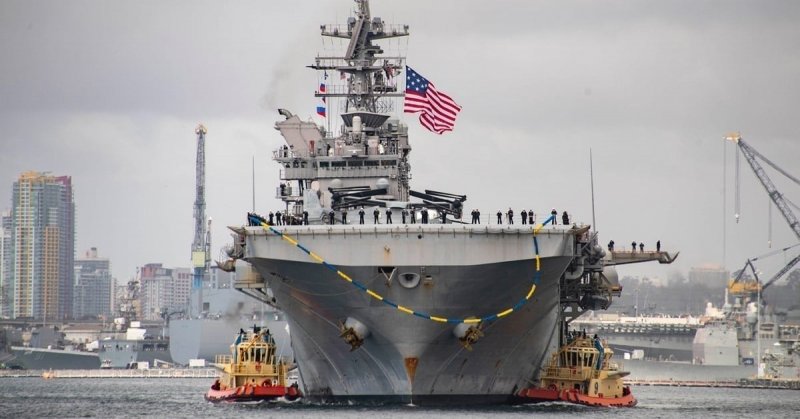
– The arrival of theUSS Tripoli in the region should primarily be seen as an instrument of strategic pressure aimed at creating in Iran a sense of an expanding range of American military options. In such situations, the very presence of an amphibious assault ship often serves as a signal of readiness for actions that go beyond air strikes or naval patrols. This affects not only Tehran’s military planning but also its political calculations, as it increases uncertainty about which forms of forceful intervention might be used.
The appearance of such a ship also forces the Iranian command to redistribute resources. There is a need to strengthen coastal defenses, monitor islands, protect port infrastructure, and secure facilities of the Islamic Revolutionary Guard Corps along the coastline. Even if no ground operation begins, the mere risk of one compels Iran to prepare for multiple scenarios simultaneously, increasing the burden on its military system.
USS Tripoli represents a mobile base capable of supporting Marine Corps operations, vertical assault operations, tiltrotor and helicopter missions, as well as command and control of special operations. In regional crises, such ships are valued precisely for their versatility. They allow maintaining flexibility and avoiding being tied to a single specific scenario.
It is important to understand that deploying such a resource does not automatically mean a transition to ground operations. American practice is usually based on creating capabilities in advance. The political decision to use force may come much later. First, a military toolkit is formed that makes various courses of action possible. Only after that is a decision made on whether to use those capabilities.
Source: Reuters
This approach is linked to the specifics of American military strategy, where rapid response capability is highly valued. Tripoli can perform tasks ranging from humanitarian missions to limited force operations. This allows Washington to maintain initiative and avoid dependence on urgent troop deployments in case of sudden escalation.
– But the psychological factor is also clearly visible.
– Absolutely. The psychological factor associated with the U.S. Marine Corps has particular significance. Their presence is traditionally perceived as a signal of readiness for ground action, even if the operations are limited in scope. This creates an additional layer of pressure, as it demonstrates that not only remote forms of warfare are being considered.
At the same time, such deployment fits well into the concept of controlled escalation. Within this logic, the demonstration of force is used to deter the adversary from taking more drastic steps. In this sense, Tripoli acts as a warning tool. Its presence signals that further expansion of the conflict could meet a more direct military response.
– What about the factor of U.S. regional allies?
– The presence of an amphibious assault ship increases their confidence in American security guarantees. This is especially important for the states of the Persian Gulf, which closely monitor the ability of the United States to respond quickly to threats from Iran. Such signals play a role not only in relation to Iran, but also in maintaining the trust of allies.
It is also possible that such deployment has a preparatory character. Military forces are often positioned in advance to avoid a strategic pause if the situation deteriorates. If the crisis deepens sharply, the presence of Tripoli allows limited operations to be conducted without a lengthy preparation period.
– How, in general, can potential limited U.S. ground operations in Iran be characterized?
– In such conditions, limited ground operations usually do not imply deep invasion. They may involve raid actions, short-term landings, the liberation of captured facilities, or the neutralization of specific threats. Such operations are often described as targeted tasks precisely because they are limited in time and scale. From a political perspective, this flexibility is especially valuable. It allows demonstrating strength without escalating into full-scale war, leaving room for diplomacy even as military pressure increases.
– If Washington is still avoiding a direct declaration of a ground phase, for what purposes might it need such an amphibious resource: seizure of islands, coastal control, evacuation, special operations, or creating a foothold for further escalation?
– The deployment of an amphibious ship of this class is usually linked not to a single task but to the creation of a set of practical capabilities that can be used depending on how the crisis develops. American military logic in the Persian Gulf is built around flexibility. The same ship can perform tasks related to force projection, protection of sea lanes, evacuation of civilians, and limited military operations.
One of the most likely tasks is always the evacuation of U.S. citizens and allies. In any situation where there is a risk of escalation with Iran, the first practical issue is the safety of American personnel, diplomats, contractors, and energy specialists in Gulf countries. Amphibious ships are designed precisely for this purpose. They can quickly take on thousands of people, provide medical assistance, and offer temporary accommodation.

Source: sundayguardianlive
The second direction involves possible actions against Iranian naval assets that may threaten shipping. This may include small islands, observation platforms, boat bases, or drone launch sites. Such operations do not require a full-scale invasion and can take the form of short, limited missions aimed at temporarily disabling specific infrastructure.
Control of certain islands in the Strait of Hormuz area, including Kharg Island, also remains a theoretically possible task. Some islands serve as observation points and locations for missile systems. In the event of sharp escalation, their temporary neutralization could be considered as a way to reduce threats to shipping. Such operations are usually planned as short actions with rapid withdrawal rather than prolonged occupation.
Another possible task involves special operations. Tripoli can serve as a base for units tasked with locating and neutralizing specific military targets. This may include the capture of equipment, destruction of drone stockpiles, detention of certain commanders, or rescue of detained individuals. Such missions are rarely publicized, but the presence of such a platform significantly expands the ability to carry them out.
An important role is also played by the capability to respond quickly to attacks on commercial shipping. If Iran or affiliated forces begin seizing tankers or attacking vessels, the presence of marines nearby allows operations to free ships. Similar scenarios have been considered in the past as part of ensuring freedom of navigation.
– What other objectives might the United States pursue in this context?
– There is also the task of demonstrating the capability to seize coastal facilities without actually doing so. Military planning often uses demonstrative readiness as a way to influence the adversary’s calculations. The mere presence of forces capable of conducting such operations can alter Iran’s behavior without a single shot being fired.
Another factor is support for allies. Tripoli can function as a logistical hub, enabling rapid redeployment of forces between regional bases. This is especially important when allies fear attacks on their infrastructure.
There is also the possibility of creating temporary forward basing points for helicopters and drones. This can be used to enhance monitoring of sea routes and Iranian activity. In this role, the ship functions as a mobile airfield.
– Many experts view Tripoli as a potential platform for further escalation.
– This is generally considered a worst-case scenario. In American strategy, such forces are deployed in advance precisely to avoid situations where a response comes too late. It is a form of insurance against unexpected developments.
More broadly, such a ship allows the United States to preserve freedom of choice. It does not bind Washington to a specific decision but makes possible decisions that would otherwise be more difficult or slower.
– Could the appearance of USS Tripoli indicate that the United States is preparing less for a deep invasion of Iran and more for a struggle over key maritime nodes, particularly the Strait of Hormuz and nearby islands?
The current logic of American military planning suggests that scenarios related to maritime control appear far more realistic than a deep invasion of Iranian territory. The geography of the region itself points in this direction. Iran’s main strategic vulnerability lies not in the depth of its territory but in its dependence on the maritime space of the Persian Gulf.
The Strait of Hormuz remains a key point of the global energy system. Any conflict with Iran automatically raises the issue of the security of this route. Therefore, any additional American forces in the region are almost always linked to ensuring the safe passage of vessels.
American military doctrine clearly recognizes that control over maritime chokepoints can produce strategic effects without the need for ground warfare. Control over sea routes can limit Iran’s ability to influence global markets and regional security.
USS Tripoli is particularly suited for such a scenario because it can support operations on islands used as observation or missile positions. This includes the capability to temporarily suppress such facilities in case of threats to shipping.
It is also important to consider that American strategy often focuses on preventing the blockade of the strait. This implies readiness to respond quickly to mining attempts, missile deployments, or attacks on tankers. Amphibious forces can be used to secure specific points.
Another factor is enhanced surveillance. Tripoli can support aviation assets that monitor the movement of boats, missile systems, and drones, creating a more detailed operational picture in the region.
A deep invasion of Iran would require an entirely different scale of forces, including tens of thousands of troops, heavy armored equipment, and prolonged preparation. The presence of a single amphibious ship does not indicate preparation for such a scenario.
In this case, a maritime strategy appears more limited and manageable, allowing specific objectives to be achieved without escalating into full-scale war.
– Where is the red line after which American “increased presence” stops being deterrence and turns into actual entry into a full-scale war with Iran?
– The line between deterrence and war is usually determined not by the number of ships or aircraft, but by how they are used. As long as forces remain in a posture of readiness and demonstration, it is considered presence. When they begin systematically striking Iranian territory, it is already perceived as participation in war.
One of the key indicators is the regularity of combat actions. A single retaliatory strike may be seen as a limited response, but a series of strikes on military infrastructure changes the status of the conflict.

Source: CNN
Another important factor concerns the nature of targets. Strikes against proxy forces differ from strikes on targets within Iran itself. Direct attacks on Iranian bases create a completely different level of conflict.
Ground operations are also a critical indicator. Even limited deployment of U.S. troops on Iranian territory significantly alters the perception of the conflict. This is already seen as direct war.
– And what about Iran’s own reaction to these processes?
– Iran’s reaction is equally important. If Tehran begins to treat the United States as a direct party to the conflict and responds with strikes against American bases, the conflict automatically shifts to a different phase.
– And finally, the political framing of escalation. What can you say about it?
– The political framing of escalation plays a crucial role, as official statements, military diplomatic steps, changes in rules of engagement, and the expansion of military command authority all indicate that the situation is entering a more dangerous phase.
Moreover, economic measures are also part of this logic. For example, a full naval blockade or attempts to halt all Iranian oil exports could already be considered acts of war.
Ultimately, the threshold is reached when military actions begin to define relations between states more than diplomacy, deterrence signals, and political settlement channels. At that point, military presence ceases to be a tool of pressure and becomes an element of war.
Such a transition almost never happens instantly. It is usually a gradual process in which each new action expands the boundaries of what is acceptable and makes the next step more likely. In this context, the deployment of such ships should be viewed as part of a step by step escalation dynamic.


Similar news