Proxy firms warn Starbucks may be overlooking labor risks


Two major shareholder advisory firms are warning investors that Starbucks may be underestimating the financial and reputational risks tied to its ongoing labor disputes in the United States.
Institutional Shareholder Services (ISS) and Glass Lewis raised the concerns ahead of Starbucks’ annual shareholder meeting scheduled for March 25. Both firms said the company may lack sufficient board oversight of labor relations at a time when tensions with unionized workers remain unresolved, News.Az reports, citing Reuters.
The warnings come more than a year after contract negotiations between Starbucks and a union representing thousands of baristas stalled.
RECOMMENDED STORIES
ISS analysts said recent controversies related to labor disputes raise questions about whether the company’s leadership is adequately managing the issue.
“There are ongoing controversies related to labor disputes, and it is not clear there is sufficient board oversight of the company’s management of labor relations,” ISS wrote in its analysis to shareholders.
The advisory firm pointed to several developments, including worker strikes and a $38.9 million settlement Starbucks agreed to pay over allegations it violated New York City laws requiring predictable schedules for fast-food employees.
Glass Lewis echoed those concerns and specifically criticized the company’s decision to dissolve a board committee that had been tasked with overseeing labor issues.
Starbucks created the Environmental, Partner, and Community Impact Committee in 2023 after pressure from shareholder groups concerned about the company’s labor practices.
The committee was formed during the tenure of former CEO Laxman Narasimhan and was responsible for supervising labor relations and social impact issues.
However, the company recently dissolved the committee and redistributed its responsibilities to the broader board and other internal committees.
Glass Lewis said the decision could weaken oversight of labor risks. As a result, the advisory firm recommended shareholders vote against the re-election of board director Beth Ford, who chairs Starbucks’ nominating and corporate governance committee.
According to Glass Lewis, the governance committee bears responsibility for ensuring the board properly monitors risks that could affect shareholder value.
Several shareholder groups are also pushing the company to address the issue more aggressively.
Organizations including the New York State Comptroller’s Office and the union-aligned SOC Investment Group recently sent a letter criticizing Starbucks for what they described as prolonged labor conflicts.
The letter argued that unresolved disputes with workers could threaten the turnaround strategy currently being pursued by CEO Brian Niccol.
Starbucks, however, responded that these groups represent only a minority of shareholders.
In its latest proxy filing, Starbucks said dissolving the committee was part of a broader effort to simplify the board’s structure and allow directors to focus more effectively on long-term value creation.
The company stated that labor oversight responsibilities would now fall to the full board rather than a single committee.
Starbucks spokesperson Jaci Anderson said the board has the necessary expertise to manage the company’s strategy, including issues related to employees.
“The board has the skills and experience to effectively oversee our strategy, including human capital management,” Anderson said.
Unionization efforts at Starbucks have slowed since their peak in 2022 but continue to expand gradually.
According to the company, unions currently represent employees at about 6% of Starbucks stores in the United States.
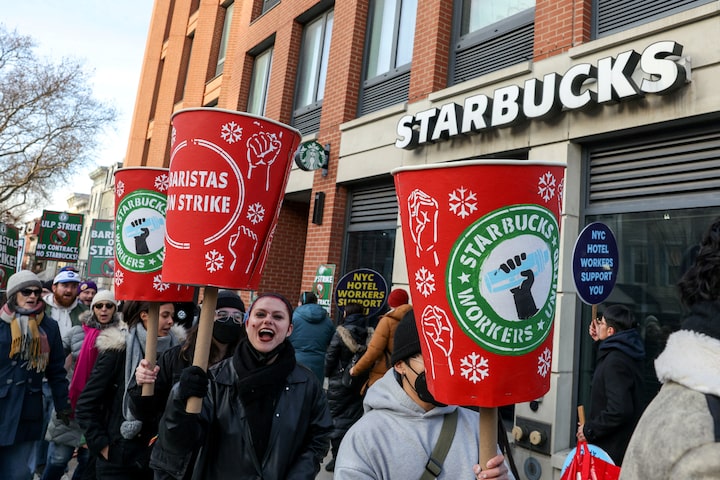
Labor tensions intensified in December when unionized café workers across 40 U.S. cities launched an open-ended strike demanding higher wages and improved working conditions.
Although the strike largely subsided, work stoppages continued on a rotating basis at various locations.
Starbucks said fewer than 1% of its stores were affected and that workers have since returned to their jobs.
Negotiations between Starbucks and the union broke down in late 2024, with both sides blaming each other for the collapse of talks.
Despite the stalemate, both the company and union representatives have recently said they are open to restarting negotiations.
For investors, however, the uncertainty surrounding labor relations remains a potential risk.
Proxy advisory firms argue that unresolved labor disputes could lead to operational disruptions, reputational damage, and financial costs if conflicts escalate again.
As Starbucks prepares for its annual shareholder meeting later this month, the debate over how the company manages its relationship with workers is likely to remain a key issue for investors.
By Aysel Mammadzada


Similar news