Samsung faces massive strike after failed wage talks


Wage negotiations between Samsung Electronics and its largest labor union collapsed on Wednesday, just one day before a planned large-scale strike at the world’s biggest memory chipmaker that could disrupt global semiconductor supply chains.
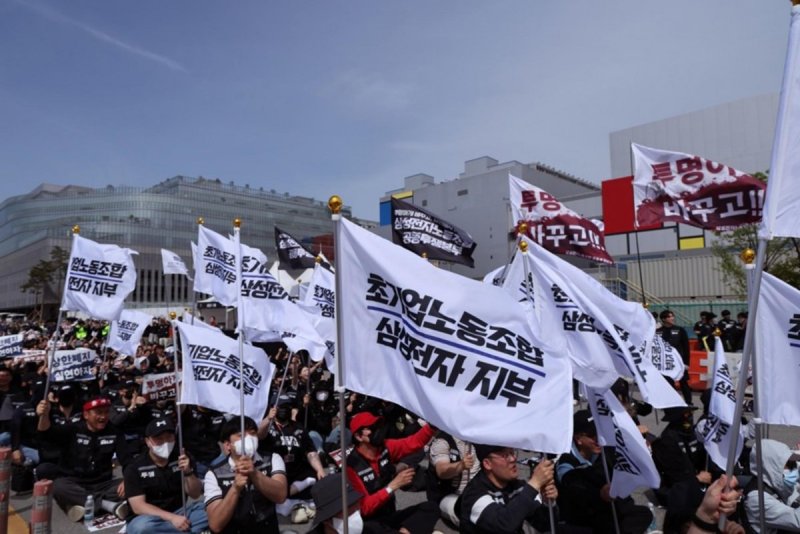
Around 48,000 workers are expected to walk off the job for 18 days starting Thursday after company management rejected a mediation proposal accepted by the union following several rounds of government-led negotiations, News.Az reports, citing Yonhap.
“We accepted the mediator’s proposal,” the company’s largest labor union said, confirming that the legally scheduled general strike would proceed as planned.
Samsung management expressed “deep regret” over the breakdown in talks and urged the union to continue negotiations, insisting that a strike should not occur under any circumstances.
RECOMMENDED STORIES
“Despite the company largely incorporating the union’s demands, it continues to insist on an unreasonably large compensation package even for loss-making business units,” the company said in a statement.
Park Soo-keun, head of the National Labor Relations Commission, said the mediation proposal had been presented and accepted by the union, but Samsung declined to sign the agreement.
“Since an understanding will be reached, if both sides agree, we will respond to a change in stance, at any time, day or night, weekday or holiday,” Park said.
Labor and management have remained deadlocked since late last year over performance-based bonuses linked to earnings from Samsung’s artificial intelligence-related semiconductor operations amid the continuing global memory chip boom.
Samsung proposed keeping its current excess profit incentive system while allowing the bonus pool to be calculated using 10 percent of operating profit. The company also suggested introducing a special compensation system aimed at creating a more flexible incentive structure.
The union, however, is demanding fixed performance bonuses equal to 15 percent of the semiconductor division’s operating profit and wants existing payout caps removed.
According to an industry source, the two sides made progress during government-mediated talks by agreeing to eliminate bonus caps currently set at 50 percent of annual salary.
However, disagreements persisted over how bonuses should be distributed to employees in loss-making business divisions and whether the agreement should be formally institutionalized.
Industry officials have warned that a full-scale strike at Samsung could have enormous consequences for the broader South Korean economy, with estimated losses potentially reaching 100 trillion won (about $66.98 billion).
Semiconductors account for around 35 percent of South Korea’s exports, driven by rising global investment in AI data centers.
In the first quarter of 2026, South Korea’s exports climbed to a record $219.9 billion, while semiconductor shipments surged 139 percent year-on-year to $78.5 billion.
Analysts have also warned that a strike at Samsung Electronics — which represents roughly one-quarter of the market capitalization of the benchmark Korea Composite Stock Price Index (KOSPI) — could accelerate declines in the country’s stock market.
Government officials have raised concerns over the possible strike, with some suggesting Seoul could use emergency arbitration powers to prevent the walkout.
International companies dependent on South Korea’s semiconductor supply chain have also expressed concern about potential disruptions.
Samsung controls about one-third of the global dynamic random-access memory (DRAM) market. DRAM chips, widely used in laptops and smartphones, have become increasingly critical for AI data centers worldwide.
The company regained its position as the global DRAM market leader in the fourth quarter of last year, supported by stronger sales of high-bandwidth memory (HBM) chips, according to market research firm TrendForce.
Industry estimates indicate that an 18-day strike could reduce global DRAM supply by 3 to 4 percent and NAND flash supply by 2 to 3 percent, potentially leading to further price increases across the semiconductor market.
By Nijat Babayev


Similar news