SpaceX launches Falcon Heavy rocket after 18-month pause - VIDEO


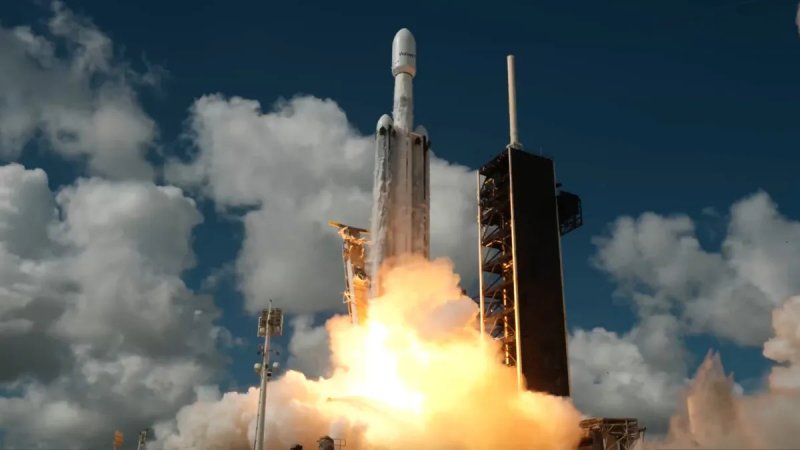
A Falcon Heavy carrying the large ViaSat-3 F3 communications satellite lifted off from NASA’s Kennedy Space Center (KSC) in Florida on Wednesday, launching at 10:13 a.m. EDT (1413 GMT).
The 6.6-ton (6 metric tons) satellite is bound for geostationary orbit (GEO), located 22,236 miles (35,786 kilometers) above Earth. If everything proceeds as planned, it will be deployed approximately five hours after launch, News.Az reports, citing Space.com.
Falcon Heavy uses three modified first stages of SpaceX’s Falcon 9 rocket, strapped together. The central booster supports an upper stage that carries the payload.
Together, the three boosters generate about 5.1 million pounds of thrust at liftoff, making Falcon Heavy the second-most-powerful operational rocket. The most powerful is NASA’s Space Launch System (SLS), producing 8.8 million pounds of thrust. SpaceX’s Starship produces about 16.7 million pounds of thrust at liftoff, though it is still under development.
RECOMMENDED STORIES
Falcon Heavy first flew in February 2018, on a demonstration mission that sent SpaceX founder Elon Musk’s red Tesla Roadster into orbit around the Sun. Since then, it has completed 10 additional missions, all successfully.
However, the rocket has not flown recently. Its previous launch was in October 2024, when it sent NASA’s Europa Clipper spacecraft toward the Jupiter system.
Teams complete back-to-back launches of Falcon Heavy and Falcon 9 pic.twitter.com/PyHfGNrogD
— SpaceX (@SpaceX) April 30, 2026
As indicated by its name, ViaSat-3 F3 is the third satellite in the ViaSat-3 series to reach space. ViaSat-3 F1 was launched aboard a Falcon Heavy in April 2023, while ViaSat-3 F2 was launched in November 2025 using a United Launch Alliance Atlas V rocket.
These satellites operate in geostationary orbit, where orbital speed matches Earth’s rotation, allowing them to remain fixed over the same region of the planet. ViaSat-3 F3 will provide high-throughput broadband coverage across the Asia-Pacific region.
ViaSat-3 F1 currently delivers in-flight internet services for airline passengers, while ViaSat-3 F2 is expected to begin serving customers across the Americas next month. With ViaSat-3 F3, the company completes its planned ViaSat-3 mini-constellation.
“This launch marks a pivotal moment in our journey to bring fast, secure and reliable high capacity, highly flexible broadband to our commercial, defense and consumer customers,” said Dave Abrahamian, vice president of space systems at Viasat, in a company statement earlier this month.
After launch, the Falcon Heavy’s two side boosters successfully returned to land at Cape Canaveral Space Force Station about eight minutes later, landing at SpaceX’s recovery sites near the launch area. The central booster, as planned for this mission profile, was not recovered and instead fell into the Atlantic Ocean after completing its role.
SpaceX had originally planned to launch the mission on Monday (April 27), but it was delayed due to unfavorable weather conditions.
By Nijat Babayev


Similar news