Tesla falls behind BYD in some foreign markets


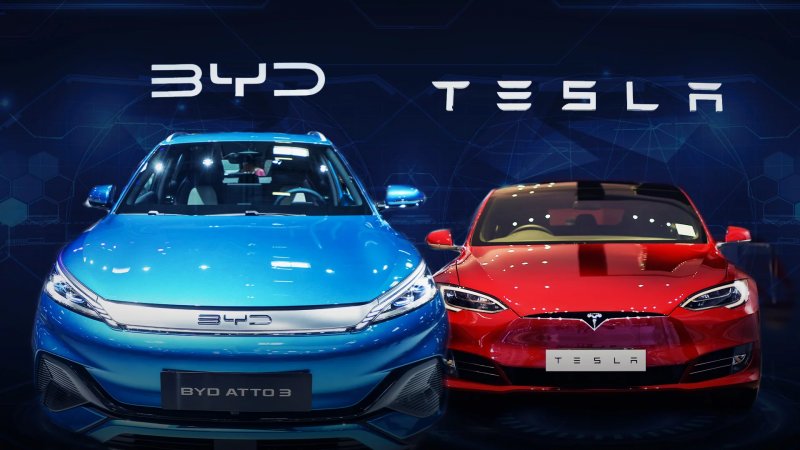
In April, BYD sold 13,000 electric vehicles in the UK, capturing over 7% of the market and rising to the top spot among British EV brands, surpassing Tesla, Volkswagen, Kia, and other international automakers.
That same month, BYD sold 15,000 vehicles in Brazil, overtaking the Volkswagen brand. It marked the first time a Chinese automaker surpassed Volkswagen in Brazil's monthly retail rankings, News.Az reports, citing Gasgoo.
RECOMMENDED STORIES
In Australia, the BYD SEALION 7 alone notched 1,780 deliveries — outpacing the Tesla Model Y and rival models.
These three data points point to one fact: across multiple key overseas markets, BYD is seizing the sales crown from Tesla.
Overseas Sales Account for 40%
In April, BYD exported 135,000 vehicles — up 70% year-on-year and breaking the export record set just a month earlier. Cumulative exports for the first four months reached 454,000 units. Overseas sales now account for more than 40% of BYD Group's total volume.
At the market level, BYD has cracked the top tier of the UK auto market. The company's UK country manager noted: "With fuel prices remaining high, more drivers are choosing electric vehicles as a smarter, more economical option."
Driven by automakers like BYD, the UK EV market grew 22% year-on-year. "What makes us even prouder is that BYD has become a leading EV brand in the UK in just over three years."
BYD currently sells five pure electric models in the UK: the DOLPHIN, DOLPHIN Surf, YUAN Plus, SEAL, and SEALION 7, along with three DM-i plug-in hybrid models. The YUAN Plus 2 is also launching soon.
Brazil's growth trajectory is even more aggressive. According to Brazilian auto industry media, BYD's market share hit 12.8%. The DOLPHIN led retail sales for three straight months, with 5,900 units sold in April alone, while the SONG plug-in hybrid series moved 4,100 units over the same period.
BYD Brazil's commercial director said: "In March, BYD set an all-time high with over 16,000 registrations nationwide. In April, we broke through again with over 18,000 units sold across all channels. Registrations for the first four months are up 86% year-on-year." BYD Brazil general manager Li Tie revealed that the Camaçari plant now employs over 4,100 workers and is hiring 1,600 more to prepare a third production shift, with plans for 24-hour continuous operations this year.
Australia presents a direct model-level upset. The BYD SEALION 7 became the best-selling EV in April with 1,780 deliveries, followed by the Geely EX5, ZEEKR 7X, Tesla Model Y, and Kia EV5. That means Tesla's flagship SUV was outsold by a single new BYD model that month.
Notably, BYD has built brand awareness even in markets where it hasn't officially launched. Research by Canadian online auto marketplace AutoTrader.ca shows that among consumers planning to buy an EV, 12% are aware of the BYD brand.
Baris Akyurek, vice president of insights and intelligence at AutoTrader, put it bluntly: "Even though BYD hasn't sold a single car in Canada, it has already built considerable brand awareness among local consumers." The study also found that 53% of potential Canadian EV buyers would consider Chinese brands, with 74% citing price as the primary reason.
Overseas Becomes Critical Pillar
The overseas shift is no longer just about sales growth. Financially, it is becoming a core profit pillar for BYD.
BYD's first-quarter earnings show overseas revenue already accounts for about 70% of vehicle revenue. Citigroup estimates BYD's per-vehicle net profit on exports at roughly 18,000 yuan in Q1. JPMorgan projects overseas per-vehicle net profit will reach about 20,000 yuan by 2030, versus roughly 6,000 yuan domestically — a gap of more than three times. For reference, overseas revenue made up about 40% of BYD's vehicle revenue in 2025.
BYD's first-quarter net profit attributable to shareholders was 4.1 billion yuan, down 55% year-on-year. Multiple investment banks offered varying interpretations after stripping out non-recurring items. But the main drag was clear: a foreign exchange loss of about 2 billion yuan in Q1.
Excluding forex effects, BYD's Q1 gross margin rose 140 basis points quarter-on-quarter to 18.8%, with per-vehicle net profit at roughly 8,900 yuan — higher than the 6,800 yuan a year earlier and essentially flat against the 8,800 yuan in Q4. Citigroup analysts calculate that after adjusting for forex, domestic NEV per-vehicle net profit stands at about 751 yuan.
Localized overseas production is also ramping up. Once plants in Brazil, Hungary and elsewhere come online, BYD's annual production capacity outside China will exceed 800,000 vehicles.
Meanwhile, BYD plans to deploy 6,000 flash charging stations overseas by April 2027 — 3,000 in Europe, with the rest covering ASEAN and emerging markets.
This structural shift is reshaping how the market values BYD. JPMorgan raised its target price for BYD's H-shares from HK$110 to HK$120, and for A-shares from 95 yuan to 120 yuan, maintaining an "overweight" rating on both.
The rationale includes: Q1 was a profit trough, with sales set to accelerate from Q2 onward; overseas markets will grow in importance, with full-year overseas revenue offsetting domestic competitive pressures; and near-term catalysts such as the flash-charging network rollout, overseas plant launches, and ADAS technology showcases.
For BYD itself, overseas business has evolved from a sales add-on to a core profit driver. For other Chinese automakers, BYD's path offers three reference points: first, localized production is a prerequisite for bypassing tariff barriers and entering mainstream supply chains; second, exporting charging infrastructure in parallel helps build systemic moats; third, brand awareness can take root before products even arrive.
By Ulviyya Salmanli


Similar news