What ballistic missiles does Iran have in its arsenal — and what do their ranges mean? - PHOTO


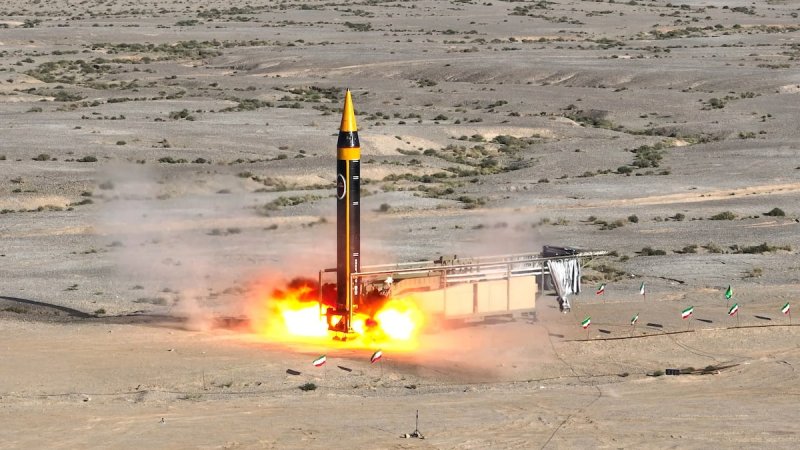
Iran possesses one of the largest and most diverse ballistic missile arsenals in the Middle East. According to open-source data and defense assessments, Tehran has developed missiles with ranges from 75 kilometers to up to 3,000 kilometers — a capability that significantly reshapes the strategic balance across the region and beyond.
From short-range to potential intercontinental reach
Iran’s missile inventory covers three major categories:
Short-range ballistic missiles (SRBMs) — up to 300 km
These include systems such as Fath 360 (75 km), Tondar (150 km), and Fateh-110 (300 km).
These weapons are primarily designed for battlefield use and regional tactical operations.
Medium-range ballistic missiles (MRBMs) — 300–1,500 km
Among them are Shahab-2 (500 km), Zulfiqar (700 km), Qiam (~700 km), Shahab-3 (1,150–1,200 km), Qassem Basir (1,200 km), Fattah-1 (1,400 km), Kheibar Shekan (1,450 km) and Fattah-2 (1,500 km).
These systems allow Iran to strike targets across the Middle East, including Israel and U.S. bases in the Gulf.
Long-range ballistic missiles — 1,500–3,000 km
Missiles such as Ghadir-H (~1,600–1,750 km), Emad (~1,700–1,800 km), Sejjil-2 (2,000 km) and Khorramshahr (2,000–3,000 km) significantly extend Iran’s reach.
At the upper end of this spectrum, parts of southeastern Europe and South Asia fall within theoretical range.
RECOMMENDED STORIES
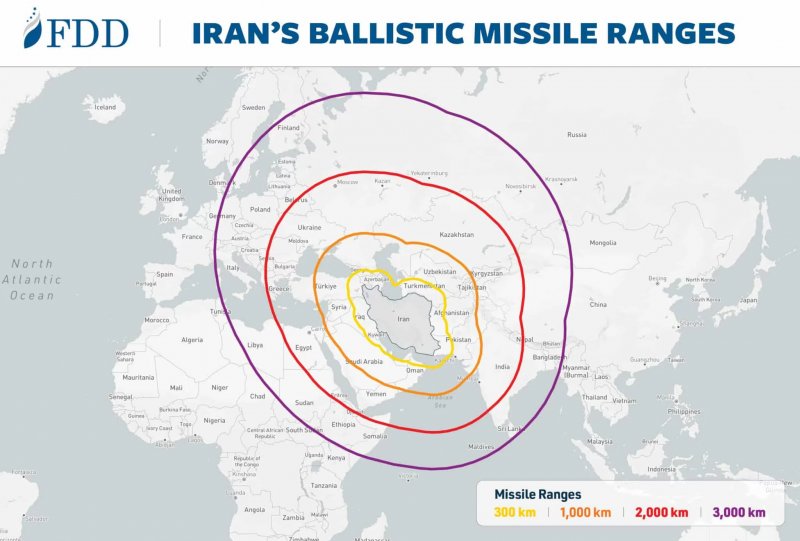
What the range map shows
When plotted geographically, Iran’s missile reach forms concentric circles extending outward from its territory:
-
A 300 km radius covers Iraq, parts of the Persian Gulf and immediate neighboring areas.
-
A 1,000 km radius includes Israel, Saudi Arabia, Türkiye and much of the Levant.
-
A 2,000 km radius reaches southeastern Europe, North Africa and parts of Central Asia.
-
A 3,000 km range would theoretically place much of Europe, western China and parts of the Indian subcontinent within reach.
While range alone does not determine operational capability — factors such as payload, accuracy (CEP), survivability and missile defense interception matter — the geographic spread highlights why Iran’s missile program remains one of the central security concerns for the United States, Israel, Gulf states and NATO.
Technological evolution
Over the past decade, Iran has shifted from liquid-fueled systems (such as early Shahab variants) toward more advanced solid-fuel missiles like the Sejjil-2 and the newer Fattah series. Solid-fuel technology enables faster launch preparation, greater mobility and improved survivability against preemptive strikes.
Iran has also emphasized precision upgrades, claiming improved guidance systems and maneuverable re-entry vehicles in some models. Western defense analysts continue to debate the true accuracy and reliability of these systems, but even incremental improvements significantly increase their deterrent value.
Strategic implications
Iran frames its missile program as a defensive deterrent in the absence of a modern air force and under decades of sanctions. However, its expanding range and sophistication create a layered strike capability that complicates regional military planning.
In any potential escalation scenario, missile exchanges would likely play a central role — whether against regional adversaries, U.S. bases, or maritime infrastructure in the Gulf.
The missile arsenal is therefore not only a military asset but also a political tool. It strengthens Tehran’s negotiating position, enhances deterrence signaling, and shapes the broader security architecture of the Middle East.
In an era of rising regional tensions, Iran’s ballistic missile capabilities remain one of the most consequential — and closely watched — elements of the global security landscape.


Similar news