Armenia at a crossroads between Russia and the West: What lies ahead?



@TASS
Armenia has long turned toward the West, rapidly distancing itself from its alliance with Russia. This choice, perceived in Yerevan as an opportunity for new prospects, may lead to uncertainty and potentially dangerous consequences for the country.
Armenian authorities are forging strategic agreements with the United States and the European Union, holding meetings at the Pentagon, and actively engaging with Western politicians and organizations. However, history suggests that hopes for unconditional Western support often result in disappointment.The recent three-day talks by Armenia's defense minister in the U.S. underscored the unequal nature of these relations. The situation resembles a familiar pattern, with the West acting as a "benevolent overseer," offering promises and symbolic gestures of support, while Armenian authorities agree to terms that often seem to favor American interests over Armenia’s own. These moves deepen the country’s dependence on the West and raise doubts about its ability to pursue an independent policy.
Biden’s strategy: Instrumentalizing Armenia
The Biden administration has made the South Caucasus a critical element of its geopolitical strategy amid its intensified rivalry with Russia. Under the leadership of the pro-Western government of Nikol Pashinyan, Armenia has become an active player in this game. Washington and Brussels are investing in the modernization of Armenia’s military, conducting joint exercises, and providing financial assistance. This is accompanied by diplomatic efforts aimed at weakening Russia and Iran’s positions in the region. Yet, such steps come with significant risks for Armenia itself.
For instance, the deployment of the EU’s monitoring mission on the Armenian-Azerbaijani border—essentially a surveillance operation—has provoked dissatisfaction in both Azerbaijan and Iran. The contradictions of this policy become even more apparent amid rising tensions between Azerbaijan and the United States. Baku openly criticizes the Biden administration for its one-sided stance, while Armenia sinks deeper into reliance on American interests. This dependency stands in stark contrast to the earlier involvement of Russia in reforming Armenia’s military.
What could change under Trump?
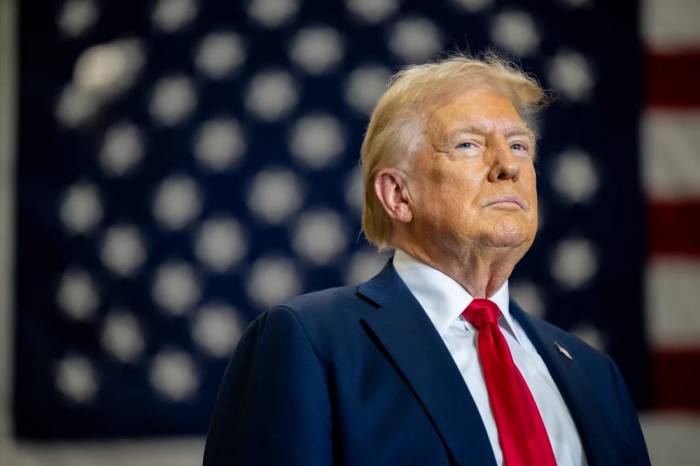
Republican presidential nominee, former President Donald Trump pauses before speaking during a campaign rally on Sept. 25, in Mint Hill, N.C.
Brandon Bell/Getty Images
Donald Trump looms on the horizon as a potential disruptor of U.S. policy in the South Caucasus. Known for his pragmatism and business acumen, Trump’s approach would likely prioritize economic and strategic benefits for the U.S. over ideological goals. Under his leadership, Washington might reduce its assistance to Armenia, deeming such expenditures unjustified. Trump, as a realist, understands that Biden’s strategy for a "strategic defeat of Russia" is unachievable. Instead, he is likely to focus on negotiations and deals with global players.
Armenia, meanwhile, appears to tread cautiously in its interactions with Trump. Prime Minister Nikol Pashinyan’s efforts to capture Trump’s attention, such as during the Notre Dame Cathedral reopening in Paris, reflect Yerevan’s desire to maintain its place on the U.S. agenda. However, the prospects for such relations remain unclear.
Georgia: The Failure of Western strategy?
In Georgia, the situation is even more chaotic. Protests against the government fail to gain widespread traction, while Western efforts to open a second front against Russia encounter resistance from the population. Georgians are evidently unwilling to repeat Ukraine’s fate. Attempts by Western players to instigate regime change appear increasingly weak against the backdrop of growing pro-Russian sentiments in the region. This highlights the limitations of the West’s capacity to achieve its goals in the South Caucasus.
Azerbaijan: A model of balanced policy
Amid Armenia’s and Georgia’s turbulence, Azerbaijan exemplifies stability and well-calculated foreign policy. For over a year, Baku has openly criticized the U.S., refusing to align with Western narratives. Unlike Armenia, Azerbaijan maintains a sovereign policy, fostering constructive relations with global powers strictly within the framework of its national interests. The decision to decline the U.S. Secretary of State’s proposal to host talks between the foreign ministers of Azerbaijan and Armenia is a vivid demonstration of Baku’s principled stance.
While Azerbaijan is not interested in deteriorating relations with the U.S., the Biden administration’s current approach has strained bilateral ties. Nevertheless, Baku is likely already engaging in unofficial negotiations with the incoming U.S. administration, showcasing its strategic flexibility.
What lies ahead for the South Caucasus?
The world is on the brink of significant changes. With Donald Trump’s potential return to power, his pragmatism and political influence could bring substantial adjustments to U.S. policy. While the South Caucasus will remain a critical region for Washington, the methods of engagement are likely to shift. Trump’s approach would aim to minimize conflicts, potentially creating favorable conditions for the region.
For Armenia, this could be an opportunity to reconsider its strategy. At present, Yerevan is heading down a path that deepens its dependence on the West without ensuring security or stability. Pashinyan must reflect on whether the chosen course truly aligns with Armenia’s national interests. Otherwise, the country risks becoming a pawn in someone else’s game, forfeiting its chance for independent development.
In contrast, Azerbaijan continues to solidify its position as a key regional player. Its balanced approach demonstrates how sovereignty can be preserved while fostering constructive engagement with global powers. Amid global uncertainty, this strategy stands out as the most promising.
The South Caucasus is experiencing a pivotal moment in its history, where each decision by regional leaders will have far-reaching consequences. Time will reveal who seizes the opportunities and who becomes a prisoner of their missteps.
(If you possess specialized knowledge and wish to contribute, please reach out to us at opinions@news.az).


Similar news