“Armenian economic miracle”: Where did it come from and who's to blame?


By Tural Heybatov
Suspicions that something might be amiss with the Armenian economy emerged by the end of 2022. Initially, the European Bank for Reconstruction and Development (EBRD) positioned Armenia as the leader of the South Caucasus in terms of economic growth. Subsequently, the World Bank estimated the country's GDP growth in 2022 at 10.8%, which was 3% higher than forecasted. Remarkably, Armenia's GDP growth was the highest among countries in Europe and Central Asia. This was a shock to everyone except the Armenians themselves, who had already experienced the surprise when they reviewed the year's economic outcomes.
State budget revenues amounted to an unpredictable $5 billion at the beginning of 2022, and the GDP, initially forecasted at 1%, soared to 15%. Encouraged by this success, Armenian economists made optimistic forecasts for 2023, predicting GDP growth of 7% and budget revenue growth of 18%. However, no one anticipated growth in production and industry revival.Upon analysis, sensible economists warned Armenians against euphoria, pointing out that the true reason for the fantastic growth was the influx of Russian relocants who would eventually leave. The GDP growth was solely driven by the service sector, restaurant and hotel business, and retail trade. Growth was also observed in the IT sector due to companies relocating from Russia or established by relocants.
High figures persisted into 2024. According to Armenia's Statistical Committee, the country's GDP grew by 9.2% in the first quarter, reaching 1.97 trillion drams ($4.8 billion).

This "economic miracle" raised suspicions among economists and those knowledgeable in economics and geopolitics. No one denies that the miracles of the Armenian economy are linked to the Russia-Ukraine war and sanctions against Russia. For some, this situation brings problems, while for others, it replenishes the "gray" budget.
Observing from the outside allows one to draw conclusions, but an even more accurate opinion can be formed by directly encountering the situation. A film crew from CBC TV Azerbaijan visited Armenia incognito. Yerevan strongly denies its involvement in re-exporting and circumventing Western anti-Russian sanctions, so Azerbaijani journalists decided to take a closer look. The results of their investigation can be seen in the film produced by CBC, which contains many interesting facts.
The new CBC documentary "The Gray Economy of Armenia" reveals the hidden mechanisms of Armenian policies and the "forbidden techniques" used. The economic boom is the result of manipulating partners' interests to gain illegal benefits and playing on the contradictions between the West and Russia. The film shows what happens behind the scenes of the Armenian "economic miracle," exposing Yerevan's murky schemes aimed at maximizing benefits from the Russia-Ukraine war.
The first part of the film discusses the suspicious growth of economic indicators achieved without objective reasons and reforms. In the first half of 2023, exports from Armenia increased by 73% compared to the same period of the previous year. During the same period, the trade turnover between Russia and Armenia grew by 86% and reached a record 5 billion rubles. Armenian exports to Russia increased by a record 3.3 times. How were such results achieved, and what valuable products did Armenia start producing to see its exports soar multiple times?
History knows the concept of the Chinese economic miracle, but no one has ever heard of the Armenian one.
Levan Osidze, Professor of Law and International Relations at Georgian Technical University in a conversation with Azerbaijani journalists, Professor Levan Osidze noted that even China did not experience such an economic leap. "This raises suspicions – is this growth due to circumventing sanctions? Furthermore, the Armenian lobby plays a significant role in the global economy and has influence, wielding considerable finances," said the Georgian professor. According to him, 44% of goods exported to Armenia are then re-exported to Russia.
Another striking figure highlighted in the film is that in 2023, the volume of cargo transportation between Armenia and Russia increased sixfold compared to 2022. By a strange coincidence, direct exports from European countries and the US to Russia sharply decreased, while exports from Europe and the US to Armenia surged. Isn't this a "miracle"?
Professor and economic analyst Demur Giorkhelidze believes that such activities would be impossible without state approval. The volumes are too large to attribute them to the private sector. Since March 2022, Armenia has seen a boom in the export of products that are neither produced in the country nor previously imported. The Armenian Statistical Committee records these re-exports not as re-exports, but as regular exports.
The Armenian side is so confident that it doesn't even attempt to maintain a balance in its manipulations, which would at least partially dispel doubts. One paradox follows another. For example, while production in Armenia grew by 2.7%, overall exports soared by more than 50%. Armenian companies circumvent sanctions and transport Western goods to Russia using Georgia as a transit country. This might explain why the trade turnover between Russia and Armenia set a record in 2023, exceeding 7 billion rubles.
Professor Giorkhelidze believes that Armenia has developed a "fraudulent economy." The observed growth is not the development of a real economy, and only clans close to the Armenian leadership will profit from it.
The Armenian leadership, not understanding that the country is heading towards a precipice in such a situation, tries to present these "achievements" as the merit of their government and economic policy. The euphoria continues, and this is clearly evident in CBC's investigation.
In the second part of the film, the situation is examined in more detail. "Gray" schemes, particularly the re-export of cars from Armenia to Russia, are analyzed. Car exports from Armenia to Russia increased by 225 times. Incredible! Just imagine – by 225 times! Such figures could not be achieved even by the most developed country.
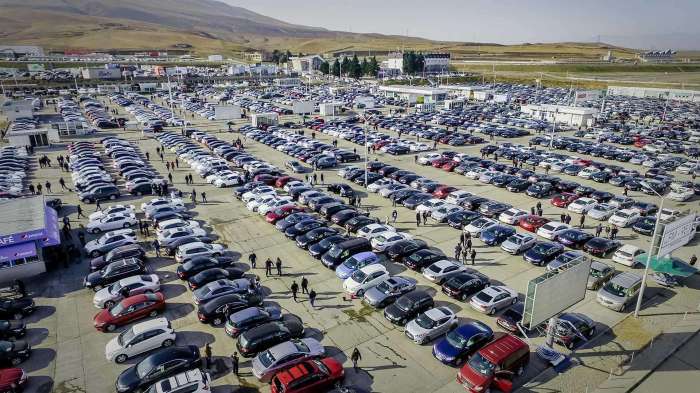
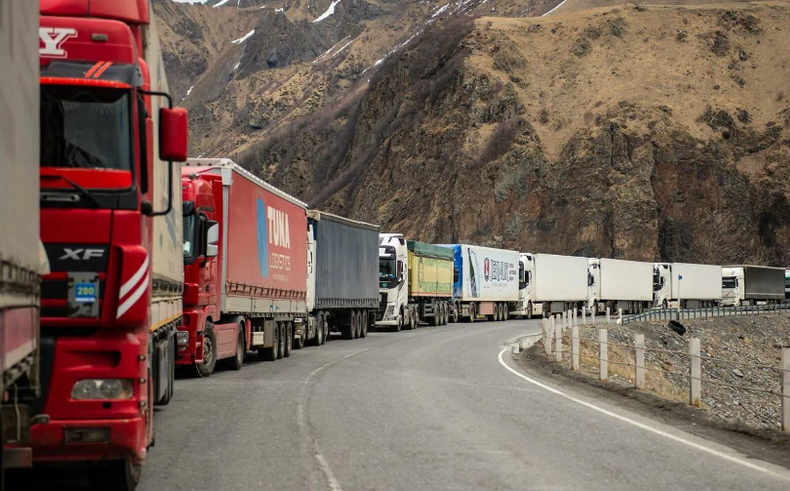
Investigators from the Azerbaijani TV channel traced the route of Armenian trucks, spoke with experts and market participants. Following the caravan of Armenian trucks, the film crew went to Georgia, to Rustavi. This city hosts the largest car market in the Caucasus. Thousands of transactions are made here daily, and Armenian re-exports flourish. The scheme is as follows: a car bought in Georgia is cleared through customs in Armenia, and then through Georgia again, via Upper Lars, is driven to Russia on Armenian plates without the need for re-clearance. Clever? Very clever indeed! And there's no threat of sanctions from Georgia when crossing the border. Georgian customs officers have nothing to complain about.
Last year, the Ministry of Finance of Georgia introduced a ban on the export and re-export of Western-made cars to Russia and Belarus. The Georgian government effectively blocked the channel through which goods prohibited from export to Russia, particularly certain classes of passenger cars, were reaching the Russian market from Armenia via Georgia through parallel import methods. It is known that cars are not produced in Armenia, yet the country ranks high among exporters of cars to Russia. According to The Financial Times, in January 2023 alone, the re-export of cars from Armenia to Russia increased more than 200-fold to $180 million. These are mostly used cars of well-known European and American brands, but Armenia also ranks among the top five countries supplying new cars to Russia. After the Georgian ban on re-export through the Upper Lars checkpoint took effect, cars can only be imported to Russia if they belong to Armenian citizens and there is no reason to believe that these individuals are car dealers.
Journalists from CBC TV Azerbaijan visited the port of Poti and uncovered some details. Receiving sanctioned goods at the port of Poti, Armenian trucks head to Armenia. Typically, the cargo consists of products not produced in Armenia. A significant portion of the sanctioned goods includes cars. Additionally, Armenia re-exports household appliances, electronics, computer equipment, precious and semi-precious stones and metals, machinery, bulldozers, graders, excavators, land, air, and water transport, heavy metals, food products, medical equipment, and more.
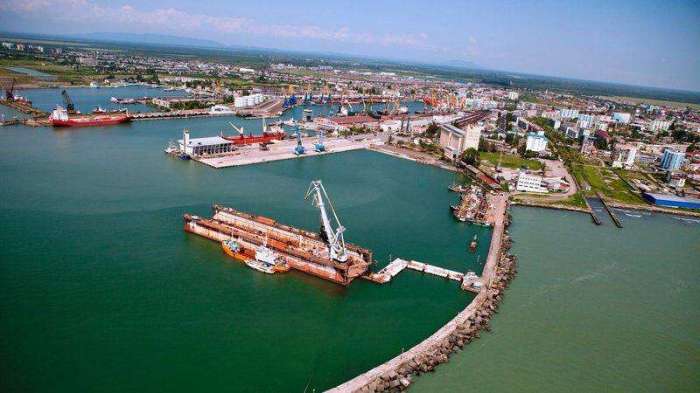
Goods received in Poti are transported to Armenia, to the customs office in Gyumri. Despite the prohibition on filming without special permission, journalists learned that sanctioned goods, including cars, undergo customs "clearance" and miraculously transform from import items into export items.
Prime Minister of Armenia Nikol Pashinyan called the suspicions of Armenia's or Armenian firms' involvement in sanction circumvention schemes "nothing more than talk." However, data from the Armenian State Revenue Committee shows that in 2022, about 46,300 cars were imported into the country, four times more than in 2021. The sharpest increase occurred in the first half of 2023 when Armenia imported 52,100 cars. It is not reported how many of these were re-exported to Russia. The State Revenue Committee explained, "We only handle the customs clearance of cars imported into Armenia. We do not keep statistics on how many of them subsequently leave the country."
Armenian Finance Minister Vage Ovannisyan admitted that in 2022, Armenian goods contributed to the growth of exports to Russia by only 47%, while overall shipments from Armenia to Russia increased by 187%. This discrepancy indicates the use of shadow schemes and data manipulation.
In the second part of the film, the situation is examined in more detail, particularly the re-export of cars from Armenia to Russia. Car exports from Armenia to Russia increased by 225 times. Incredible! Just imagine – by 225 times! Such figures could not be achieved even by the most developed country.
Journalists from the Azerbaijani TV channel traced the route of Armenian trucks, spoke with experts and market participants. Following the caravan of Armenian trucks, the film crew went to Georgia, to Rustavi.
This city hosts the largest car market in the Caucasus. Thousands of transactions are made here daily, and Armenian re-exports flourish. The scheme is as follows: a car bought in Georgia is cleared through customs in Armenia, and then through Georgia again, via Upper Lars, is driven to Russia on Armenian plates without the need for re-clearance. Clever? Very clever indeed! And there's no threat of sanctions from Georgia when crossing the border. Georgian customs officers have nothing to complain about.
P.S. The CBC TV Azerbaijan film "The Gray Economy of Armenia" delves deeply into the hidden mechanisms of the Armenian economy, revealing manipulation schemes and circumvention of international sanctions. These schemes include re-export and the use of complex logistic routes, allowing Armenia to showcase artificially inflated economic figures. As a result, an illusion of an economic miracle is created, which is actually the result of opaque and illegal actions.
An economy based on sanction circumvention and manipulations is not only unsustainable but also undermines trust in the country's official data and reports. This can lead to significant reputational losses and increased international isolation for Armenia. Additionally, participation in such schemes could lead to the imposition of additional sanctions, worsening the country's economic situation.
It is important to emphasize that sustainable economic development should be based on transparent and legal methods. Economic growth supported by real reforms, innovations, and investments in production is much more reliable and promising than temporary gains obtained through sanction circumvention.
The international community should pay attention to such investigations and take measures to prevent the spread of such practices. This may include strengthening control over trade routes, introducing additional checks, and imposing sanctions against companies and individuals involved in illegal schemes.
For Armenia, it is crucial to realize the necessity of transitioning to a more transparent and sustainable economic development model. The government should focus its efforts on supporting internal reforms, improving the business climate, and attracting foreign investments through legal channels. Only in this way can the country ensure long-term and sustainable economic growth that benefits all segments of society.


Similar news