Azerbaijan marks 36 years since January 20 tragedy


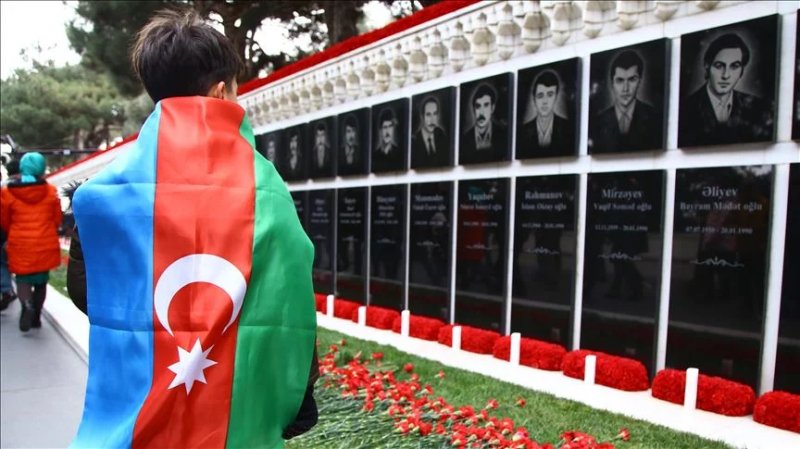
Thirty-six years have passed since the January 20 tragedy, when Soviet troops entered the capital, Baku, and several other regions, leading to the deaths of scores of civilians, News.Az reports.
On the night of January 19–20, 1990, military units of the Soviet Union were deployed to Azerbaijan on the orders of Mikhail Gorbachev, then secretary-general of the Communist Party of the Soviet Union. Forces from the USSR Ministry of Defence, the State Security Committee, and the Ministry of Internal Affairs moved into Baku and the surrounding areas.
According to official accounts, Soviet troops opened fire on peaceful civilians using armoured vehicles and a range of military weapons. The operation resulted in widespread casualties and is remembered as one of the bloodiest episodes of the final years of Soviet rule.
Large contingents of Soviet special forces and internal troops occupied Baku amid what Azerbaijani sources describe as extreme brutality and unprecedented violence. Before a state of emergency was formally announced to the population, 82 people were killed and 20 others sustained fatal injuries. After the state of emergency was declared, a further 21 people were killed in Baku over the following days.
In other districts where a state of emergency was not introduced, additional deaths were reported. Eight people were killed on January 25 in Neftchala and on January 26 in Lankaran.
In total, 131 people were killed, and 744 were injured in Baku and surrounding areas as a result of the deployment of Soviet troops. The victims included women, childre,n and elderly people, as well as ambulance workers and police officers.
The operation was also accompanied by mass arrests. During the events, 841 civilians were detained in Baku and other cities and districts across the republic. Of these, 112 were transferred to prisons in various parts of the Soviet Union.
There were also reports of extensive damage to property. Military personnel opened fire on around 200 houses and 80 vehicles, including ambulances. Fires caused by incendiary ammunition destroyed significant amounts of both state-owned and private property.
Those killed in the events are collectively referred to in Azerbaijan as the January 20 martyrs. According to official figures, there are 150 people recognised as January 20 martyrs nationwide.
The day after the tragedy, on January 21, 1990, Azerbaijan’s national leader Heydar Aliyev visited Azerbaijan’s permanent mission in Moscow together with members of his family. He publicly protested against the military operation carried out by the Soviet leadership and condemned those responsible.
While January 20 is observed as a day of national mourning, it is also remembered as a moment that highlighted the determination and resilience of the Azerbaijani people. Despite the presence of Soviet troops and the state of emergency in Baku, a mass mourning procession was held in the capital on January 22.
Nearly two million people are reported to have taken part in the burial ceremony at Martyrs’ Alley. Following public pressure, an extraordinary session of the Supreme Soviet of the Azerbaijan Soviet Socialist Republic was convened, and a decision was adopted to lift the state of emergency in Baku. Many senior officials of the republic did not attend the session, amid fears of public anger.
A formal legal and political assessment of the January 20 tragedy was made several years later. On March 29, 1994, at the initiative of Heydar Aliyev, the events were officially evaluated for the first time at the level of the country’s highest legislative body, the Milli Majlis.
Since then, January 20 has been commemorated annually in Azerbaijan as a national day of mourning. Each year, officials and ordinary citizens visit the Martyrs’ Alley to pay their respects to those who lost their lives.
As part of commemorative arrangements, traffic restrictions are introduced on streets and avenues leading to Martyrs’ Alley from 08:00 on January 20 until the end of the ceremonies. Authorities advise people to limit the use of private vehicles in the area and to use public transport instead.
At 12:00 local time on January 20, a nationwide one-minute silence is observed in memory of the victims. During this time, ships, cars, and trains sound their horns. State flags across Azerbaijan are lowered as a sign of mourning.
Commemorative events are also organised abroad to draw international attention to the events of January 1990. Azerbaijan’s embassies, diplomatic mission,s and Azerbaijani communities overseas hold ceremonies and remembrance activities marking what is often referred to as Bloody January.


Similar news