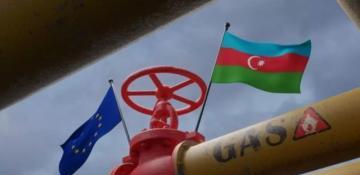
Azerbaijan strengthens transport corridors and new energy architecture in Central Asia - EXPERT OPINIONS


.png)
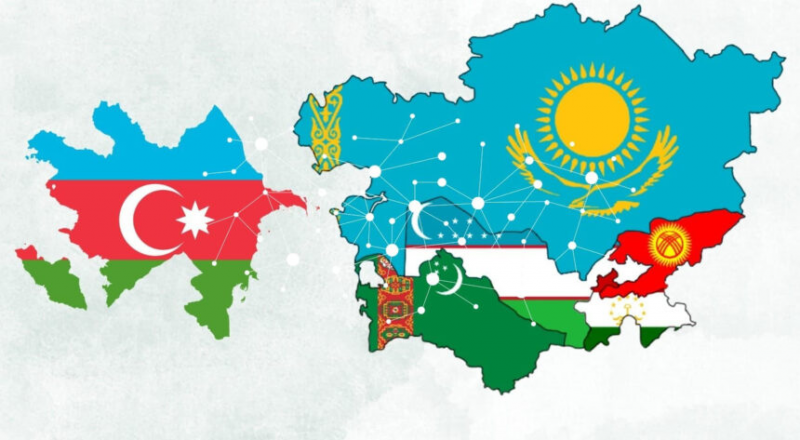
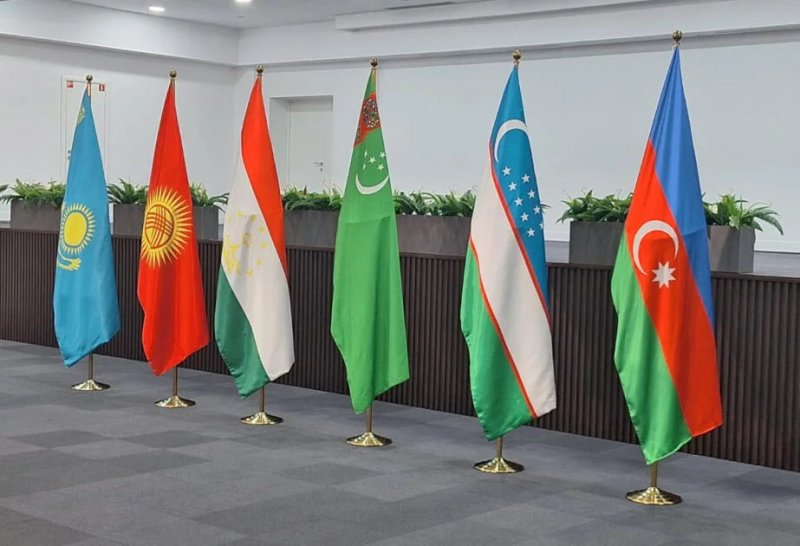
The growing partnership between Azerbaijan and the Central Asian states is reshaping the geopolitical and geoeconomic landscape of Eurasia. As regional connectivity accelerates, the Caspian Basin is emerging as a unified strategic space where transport corridors, energy routes, and diplomatic initiatives increasingly intersect. This momentum reflects a shared understanding that long-term stability and prosperity require deeper coordination, diversified cooperation, and a balanced approach toward global powers.
Against this backdrop, the News.Az analytical portal examined the emerging trends and potential risks of this new phase of regional integration, speaking with leading political scientists from several Central Asian countries. Their assessments provide insight into how Azerbaijan’s engagement is perceived across the region and the implications for connectivity, security, and the evolving geopolitical balance between East and West.
In an interview with News.Az, Professor Azamat Seitov, Head of the Laboratory for Anthropology and Conflict Studies at the Institute for Advanced International Studies of Uzbekistan, highlighted that Azerbaijan’s inclusion in Central Asia’s integration processes reflects the region’s shift toward an open, pragmatic, and sovereignty-based model of cooperation. He added that it strengthens connectivity, balances relations with global powers, and demonstrates a new level of political maturity and collective regional will.
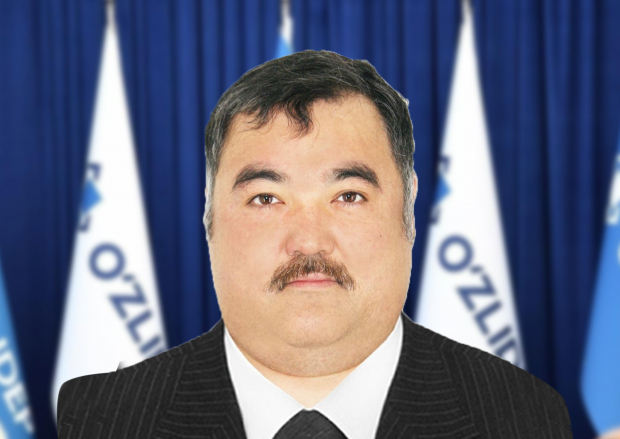
Photo: Professor Azamat Seitov, Head of the Laboratory for Anthropology and Conflict Studies at the Institute for Advanced International Studies of Uzbekistan
“This is not a sudden or unexpected development; rather, it aligns with the logic of Central Asian countries gradually forming an open, inclusive, and neutral model of regional cooperation with respect to external actors,” Seitov said.
He emphasized that this model is not directed against any third party but is built on principles of trust, mutual support, transparency, and respect for sovereignty. Citing Uzbek President Shavkat Mirziyoyev, he noted, “We do not build walls, we build bridges,” adding that this vision accurately reflects the region’s approach to partnership.
Seitov also acknowledged that, as with any major initiative, certain potential risks exist. He pointed out that various alarmist interpretations of Azerbaijan’s participation in the Central Asian leaders’ format are circulating on social media, often without empirical basis.

Source: AzerTAG
Despite these narratives, Seitov said, Central Asian states clearly understand the importance of shielding the region from external geopolitical confrontations. “The potential risks mentioned are not related to Azerbaijan’s accession, but rather to how some external actors may misperceive the new cooperation architecture as a redistribution of influence,” he explained.
“But this is not the case,” the professor stressed, highlighting two key points: first, Central Asia is striving to act as a unified team, consistently strengthening openness; second, regional cooperation is built strictly on pragmatic foundations and focuses on development rather than the formation of political or military blocs.
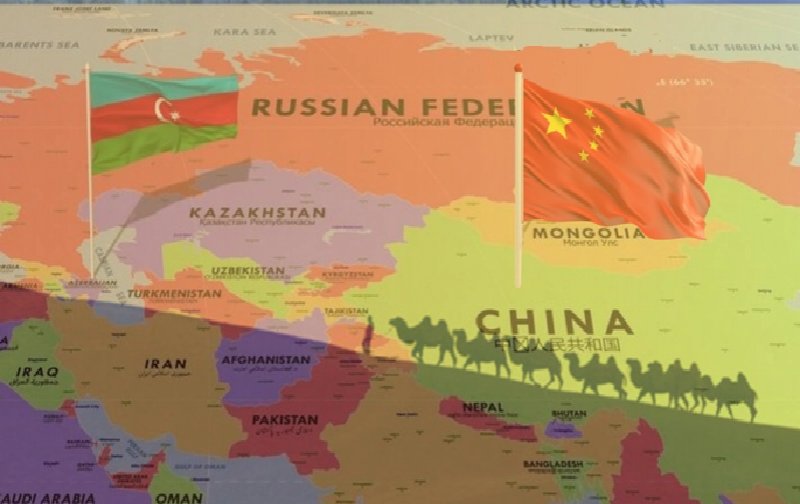
Regarding Russia’s possible reaction, Seitov noted that Moscow traditionally emphasizes stability in Central Asia. “From a pragmatic standpoint, Azerbaijan’s participation strengthens transport corridors and energy connectivity, which aligns with the strategic interests of the broader Eurasian space,” he said, adding that Russia’s response is likely to be “cautiously positive,” as Moscow seeks reliable logistics routes and a predictable regional environment.
Source: Reuters
On China, he stated that Beijing views Central Asia as a key link in its Belt and Road Initiative. “Deeper cooperation with Azerbaijan, an important bridge between China, the Caspian region, and Europe, fully aligns with the development logic of the Trans-Caspian transport route,” he noted, describing China’s reaction as constructive and focused on expanding mutually beneficial cooperation.
Seitov emphasized that the current transformation of Central Asia reflects a gradual shift away from restrictive frameworks inherited from the past toward genuinely self-defined development priorities. He noted that the Central Asian leaders’ format has historically had to consider the interests of external actors, as the region has long been a crossroads of major geopolitical strategies.
“This inevitably influenced agendas, coordination mechanisms, and the depth of cooperation while also imposing limitations that forced states to balance internal objectives with external pressures,” he said.
The expert added that Azerbaijan’s accession demonstrates that the region is no longer merely an object of competing global strategies but is becoming a self-sufficient actor shaping its own open, development-oriented cooperation architecture. “Central Asia is increasingly succeeding in creating an atmosphere of trust in which decisions are made based on shared interests,” he underscored.
Source: News.Az
Seitov noted that any risks associated with Azerbaijan’s accession would arise only if the region abandoned cooperation or adopted bloc-oriented thinking toward global powers. “However, the opposite is happening: the new format involving Azerbaijan enables more balanced, pragmatic, and mutually beneficial relations with Russia, China, the European Union, Türkiye, the United States, and other partners,” he said, adding that external actors are beginning to view Central Asia not as a field of geopolitical rivalry, but as a reliable, predictable, and dynamically developing partner.
“Central Asian states and brotherly Azerbaijan today demonstrate a fundamentally new level of political maturity, where cooperation is shaped by internal needs, the pursuit of sustainable development, and the collective political will of participating countries. This constitutes a key achievement of the current stage of regional integration,” he concluded.
Political analyst from Kazakhstan Zamir Karazhanov told News.Az that Azerbaijan’s participation in the Consultative Meeting of the Heads of State of Central Asia reflects the already advanced level of cooperation between Baku and the region. He noted that the growing frequency of President Ilham Aliyev’s visits to Central Asian countries demonstrates strong mutual interest and creates a stable foundation for long-term partnership.

Photo: Kazakh political analyst Zamir Karazhanov
“This development is also linked to anticipated changes in the South Caucasus. A possible peace treaty between Azerbaijan and Armenia is expected to open new opportunities for economic projects, strengthen regional security, and enhance overall connectivity between Central Asia and the South Caucasus,” he said.
Karazhanov added that amid global geopolitical tensions, regional cooperation becomes increasingly attractive, as the consultative meetings of Central Asian leaders provide participating countries a platform to reduce geopolitical risks and deepen economic coordination. “Joint projects being implemented across various sectors contribute to the diversification of national economies and trade flows,” he said.

Source: Trend
The analyst stressed that Azerbaijan’s participation does not pose risks for China, noting that Beijing traditionally maintains a pragmatic approach toward regional partners and views Azerbaijan as a key link in the Middle Corridor logistics chain.
“The expanded format ensures additional stability and predictability for China in a vital transit area and helps mitigate risks related to sanctions on Russia,” he said.
Regarding Russia, Karazhanov described the situation as “more complex,” adding that while Moscow publicly supports consolidation efforts in Central Asia, it remains sensitive to competition between transport routes.
“The Middle Corridor, which runs through Azerbaijan and the Caspian Sea, increasingly competes with the northern route across Russian territory. As trade volumes shift toward South Caucasus routes, Russia faces a decline in transit flows and views with caution regional projects developing near its borders without its direct involvement,” he emphasized.
In an interview with News.Az, political analyst from Kyrgyzstan Almaz Tazhybay stated that the “Central Asia + Azerbaijan” format, which brings together both sides of the Caspian Sea, represents a positive and strategic development for the region. “The initiative signals an expansion of the geopolitical and geoeconomic space of the Central Asian states and should be viewed as mutually beneficial, including for Azerbaijan,” he said.

Photo: Kyrgyz analyst Almaz Tazhybay
Speaking about potential risks, Tazhybay noted that no serious challenges are expected, as external pressure from Russia is unlikely to play a decisive role, given Moscow’s diminished influence in the South Caucasus following Azerbaijan’s restoration of full sovereignty over its territories.
He added that Russia continues to seek alternative ways to influence regional developments, but recent exchanges between Donald Trump and Vladimir Putin show clear messages discouraging interference amid ongoing efforts to secure peace.
Commenting on China’s position, Tazhybay explained that concerns related to the so-called “Trump route,” which largely passes through Armenia, are limited. “On the contrary, China stands to gain from having multiple westward routes for its goods. One pathway may pass through Iran, while another — an important alternative — runs through Azerbaijan,” he said, adding that such diversification benefits Beijing and enhances the stability of its trade links.
Tazhybay also emphasized the political significance of the unified support of the five Central Asian states for Azerbaijan, describing it as a substantial advantage that strengthens Baku’s position against any external pressure, including in international forums such as the UN. “Central Asia is steadily expanding its geopolitical and geoeconomic presence, and its cooperation with Azerbaijan is becoming an integral part of that broader regional evolution,” he noted.
Khayotjon Ibragimov, Head of the Center for Energy Diplomacy and Geopolitics at the Uzbekistan Institute for Advanced International Studies, told News.Az that Uzbekistan views Azerbaijan’s engagement in Central Asian integration as a strategic step that expands regional cooperation and strengthens the emerging economic and energy space across Eurasia.
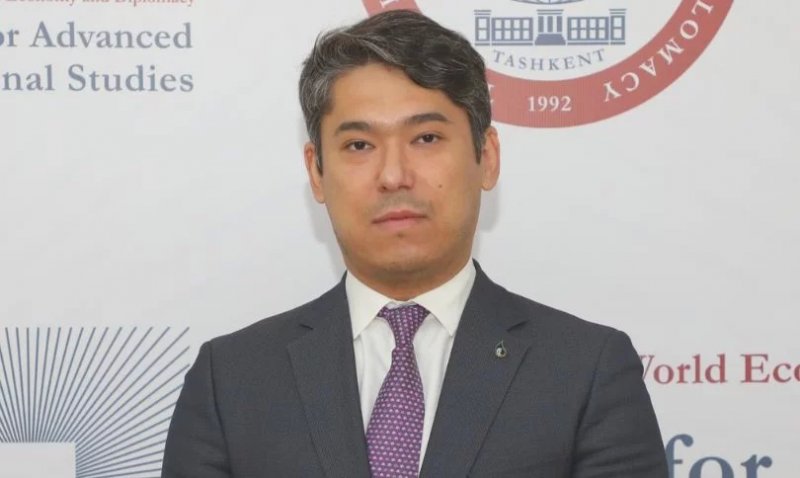
Photo: Khayotjon Ibragimov, Head of the Center for Energy Diplomacy and Geopolitics at the Uzbekistan Institute for Advanced International Studies
“For Uzbekistan, it is a strategically important decision that opens new horizons for regional partnership,” he said. “We view Azerbaijan as a key ally in shaping a unified economic and energy space stretching from the Caspian Sea to Central Asia,” Ibragimov added.
He emphasized that both sides are actively developing cooperation in the energy sector, including joint projects in hydrocarbons, renewable energy, synchronization of energy systems, and new routes for transporting energy resources. “Azerbaijan’s involvement in Central Asia’s regional integration significantly strengthens our ability to implement these initiatives,” he said.
The expert also noted that such integration aligns with the interests of all major global actors. For China, he said, it opens additional opportunities to access European markets through the Middle Corridor and the China–Kyrgyzstan–Uzbekistan railway routes currently under construction. For Russia, it creates new prospects for reaching South Asian markets via the Middle Corridor.
“Thus, the strengthening of regional ties should not contradict the interests of major powers; on the contrary, it creates opportunities for mutually beneficial synergy,” he added, emphasizing that the new cooperation architecture contributes to the stability and prosperity of Central Asia, the South Caucasus, and neighboring regions.


Similar news