Azerbaijani think tank responds to ISPI analysis


Mattia Massoletti, a former research assistant at the Department for Russia, the Caucasus, and Central Asia at the Italian Institute for International Political Studies (ISPI), recently published an article on the ISPI policy paper website in which he sought to analyse why global actions are directed at Russia but not at Azerbaijan. However, despite its length, the piece relies heavily on demagoguery and reveals a limited understanding of the realities and developments in the South Caucasus.
Such "ignorance" can be understood to some extent. Prior to his position at the ISPI, Massoletti worked as an editor and translator for Russian media outlets. Currently, he is conducting research and volunteering in Yerevan with the NGO “International Comparative Law Center” (I.C. Law). Massoletti’s knowledge of the South Caucasus, the Karabakh conflict, and Azerbaijan seems to come predominantly from Armenian and pro-Armenian sources. Naturally, his article is far from objective or grounded in international law and reality. However, this does not make his provocation or slander forgivable.
In his article, Massoletti focuses on the ongoing war in Ukraine, where Ukrainian and Western officials have consistently centered peace efforts around the concept of a "just peace." This, he argues, hinges on holding Russia accountable for its war crimes and violations of international humanitarian law as a prerequisite for any sustainable settlement. Yet, Massoletti expresses confusion as to why the “refusal to hold Azerbaijan accountable” is perceived as an obstacle to peace with Armenia.
His views are heavily influenced by information from Armenian NGOs advocating for a revanchist philosophy. Massoletti claims that since at least 2016, Azerbaijani forces have been committing documented war crimes during clashes with Armenia. This narrative includes unsubstantiated claims of "atrocities" and “prisoners of war” that have not been proven to exist. He is perplexed as to why no member state of the International Criminal Court has initiated an investigation into these alleged crimes, nor has any special tribunal or joint international initiative been formed.
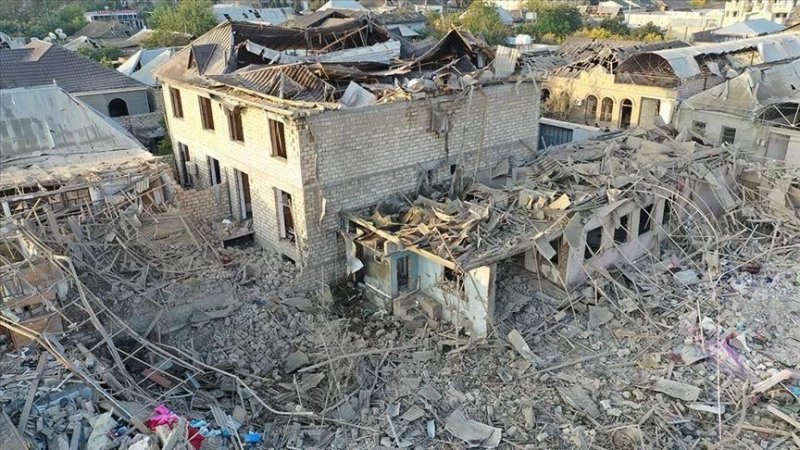 The debris of destroyed buildings hit by Armenian shelling, in a residential area of the city of Ganja, Azerbaijan, October. 22, 2020. (Photo: AFP)
In response, the AIR Center (the Baku-based Center of Analysis of International Relations) issued a detailed rebuttal to Massoletti’s article titled “Selective Justice? Comparing Peace Efforts in Armenia and Ukraine.” The Azerbaijani think tank pointed out the fundamental flaw in Massoletti’s argument: the presumption that responsibility in the Armenia-Azerbaijan conflict is ambiguous, unresolved, or dependent on future peace agreements. In fact, the responsibility is clear and legally assigned to Armenia, making such an assumption is not only incorrect but misleading.
The AIR Center emphasized that any analysis of the conflict must start with the premise that Armenia holds responsibility for its actions in the region. Ignoring this legal framework distorts both the political and legal realities surrounding the conflict. The key legal basis for Armenia’s responsibility has existed for decades. First, the United Nations Security Council has adopted a series of resolutions — 822, 853, 874, and 884 — that unequivocally affirm the territorial integrity of Azerbaijan and recognize Nagorno-Karabakh and the surrounding territories as part of Azerbaijan. These resolutions do not use conditional language, nor do they refer to “disputed territories” or acknowledge competing sovereignty claims.
Secondly, the European Court of Human Rights’ ruling in the case of “Chiragov and Others v. Armenia” serves as another pivotal legal pillar. This landmark case established that Armenia exercises control over Nagorno-Karabakh and surrounding occupied territories, and is therefore responsible for violations of the European Convention on Human Rights in those areas. The AIR Center stresses that Massoletti’s failure to mention this case in his analysis is a significant oversight and weakens his argument, making any comparison with Ukraine fundamentally flawed.
The AIR Center further notes that the occupation of Azerbaijani territories by Armenia was not merely a matter of territorial control. It also involved the systemic destruction of civilian infrastructure, the looting and desecration of cultural and religious heritage, and the displacement of hundreds of thousands of Azerbaijanis. These actions were not unforeseen; they were the inevitable consequences of a prolonged occupation. From a legal standpoint, this gives Azerbaijan grounds to file claims related to the illegal occupation, destruction of property and infrastructure, human rights violations, and damage to cultural heritage. The Center also pointed out that peace treaties may shape future relations, but they do not erase past wrongdoings unless explicitly agreed upon by the injured party.
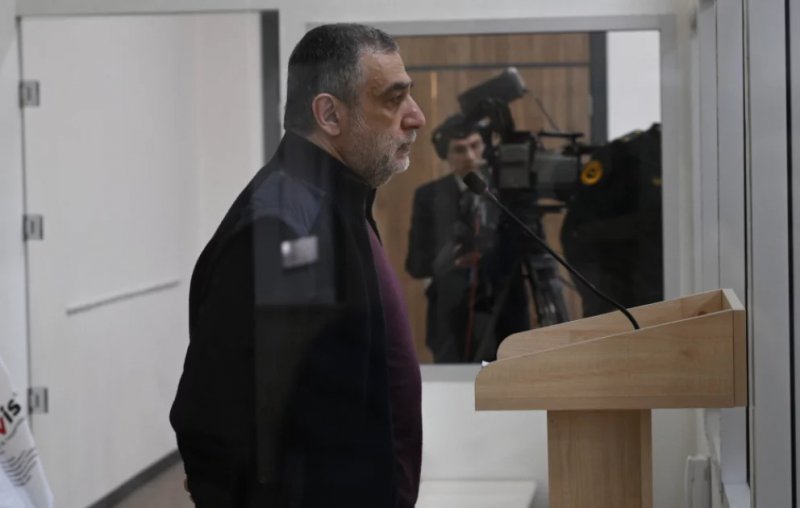 Ruben Vardanyan, accused of serious grave crimes, including war crimes, against Azerbaijanis, stands trial at the Baku Military Court (Photo: AZERTAC)
Massoletti also mischaracterizes Ruben Vardanyan, a controversial figure, by failing to address his financial past and the serious allegations related to his activities. Vardanyan’s financial dealings are not speculative; they are well-documented and have been examined by international investigative bodies.
Moreover, his political role in the post-2020 period was far from neutral. Vardanyan’s involvement directly contributed to the strengthening of separatist structures on Azerbaijani territory and undermined efforts to normalize relations after the conflict. Ignoring this context, Massoletti essentially whitewashes both the financial misconduct and the political obstructionism that hindered peace efforts.
Ultimately, the AIR Center’s response underscores that the Armenia-Azerbaijan conflict is not an example of “selective justice,” as Massoletti suggests, but rather a case of selective legal interpretation. International law has already clarified issues of territorial integrity, attribution, and accountability in this conflict. Attempts to blur these established conclusions, the Center warns, are not conducive to peace.
The Azerbaijani think tank also posits that Massoletti’s claims are likely the result of a deliberate distortion of reality. While one could assume that Massoletti is unaware of the First Karabakh War, the Armenian occupation of Azerbaijani territories, the urban destruction, and the ethnic cleansing of Azerbaijanis, it is hard to believe he is truly ignorant of these issues. As a member of the ISPI working on the Caucasus, he cannot have overlooked these critical topics.
Therefore, his attempts to equate Russia’s actions in Ukraine with Azerbaijan’s efforts to liberate its territories seem like a deliberate attempt to mislead public opinion and distort the truth to serve the interests of the Armenian side.
The two conflicts, the AIR Center concludes, are fundamentally different in every respect, casting doubt on Massoletti’s competence. In legal matters, deliberate distortions driven by political, ethnic, and religious biases should not be tolerated. These biases, particularly the last one, are at the root of Massoletti’s failure to grasp the issues on which international law has long been clear.
By Tural Heybatov


Similar news