Brussels faces rebellion as Eastern Europe rejects new migration pact


Moses Becker is a political commentator for News.Az. He holds a PhD in political science and specializes in interethnic and interreligious relations. The views expressed in this article are the author’s own and do not necessarily reflect the position of News.Az.
After the dissolution of the Soviet Union in 1991, the members of the European Economic Community sought to bring the former socialist bloc into a single economic and political framework. The 1992 Maastricht Treaty laid the foundation for the European Union, which officially came into being in 1993. For centuries, countless rulers had attempted to unite Europe through conquest, yet each effort ended in failure. This time, however, the continent achieved integration not by force of arms but through shared economic, political, and social interests.
The western part of Europe, more developed and prosperous, shouldered the cost of modernizing the East. The process was slow and difficult, but integration moved forward.
The EU emerged as a powerful rival to the United States. Its economy thrived on cheap energy and a steady influx of labor from developing countries. For a while, this model worked, creating prosperity and stability. But it could not last forever.
Over time, migrants became a costly and politically divisive factor, drawing billions from social funds financed by native taxpayers and testing the limits of European solidarity.
The first serious blow came with Brexit in 2019, when the United Kingdom left the European Union, openly rejecting what many Britons saw as the heavy-handed dictates of Brussels. Yet that was only a prelude to a much deeper challenge now threatening to divide the Union from within: migration policy.

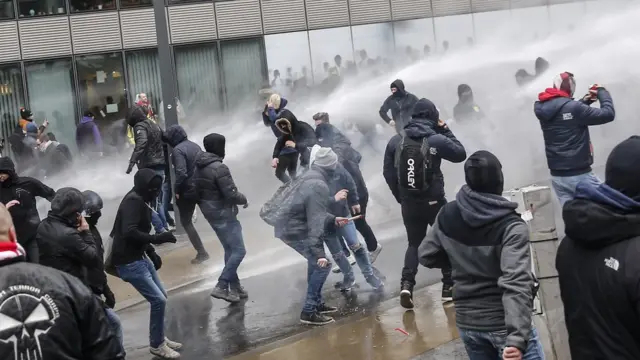
Source: socialistsanddemocrats
In late 2023, the European Commission introduced a Pact on Migration and Asylum, a reform plan meant to balance responsibilities among EU member states and improve how migrants and asylum seekers are received and integrated. France and Germany, the EU’s largest economies and the chief architects of globalization within the bloc, strongly supported the plan. But in Eastern and Central Europe, the reaction was hostile.
Poland and Hungary voted against it, while Slovakia, the Czech Republic, and Austria abstained. Together, they formed an informal alliance - successors to the lands of the former Austro-Hungarian Empire, openly defying Brussels. This political geography reveals an enduring divide between Europe’s east and west, one that reaches back centuries.
Hungary, since the migration crisis of 2015–2016, has taken the most uncompromising position. Prime Minister Viktor Orbán has built border fences, tightened asylum laws, and repeatedly refused to accept refugees or economic migrants.
According to official data, Hungarian authorities prevented 270 000 attempts at illegal border crossings last year, though Viktor Marsai, head of Budapest’s Institute for Migration Research, believes the real number was much higher. He warns that Europe is again approaching crisis-level migration flows: “Given the continuing instability in Libya, the situation in Syria, and the civil war in Sudan, it is clear that the number of migrants will only increase.”
Marsai notes that most of those attempting to reach Europe today are not war refugees but economic migrants - people seeking better living standards rather than safety. Orbán, reflecting this sentiment, denounced the Brussels plan as “unacceptable,” calling it a “coup d’état” against national sovereignty. “This decision, imposed on the majority of Europeans without their consent, was both hasty and dangerous,” he declared on Hungary’s Kossuth Radio.
The new pact, drafted by Swedish politician Tomas Tobé, was designed to find a compromise between two groups of EU members: the states with external borders, which face the immediate burden of refugee arrivals and demand greater assistance, and those located inland, which complain that migrants move through the Schengen zone without control.
Under the proposal, border countries would be allowed to tighten asylum procedures and deport rejected applicants more quickly. Other EU members could choose between accepting a set number of migrants each year or contributing financially to a common fund: around €20 000 for every person they decline to take in.
The system envisions two asylum tracks: a stricter border procedure lasting up to 12 weeks, potentially involving detention, and a faster, lighter process for those who appear legitimate. Officials would determine eligibility during a preliminary screening.
Initially, the EU aims to redistribute about 30 000 migrants annually, gradually increasing the figure to 120 000. When a country reaches its quota, applications would be suspended, an amendment insisted upon by Italy and Greece.
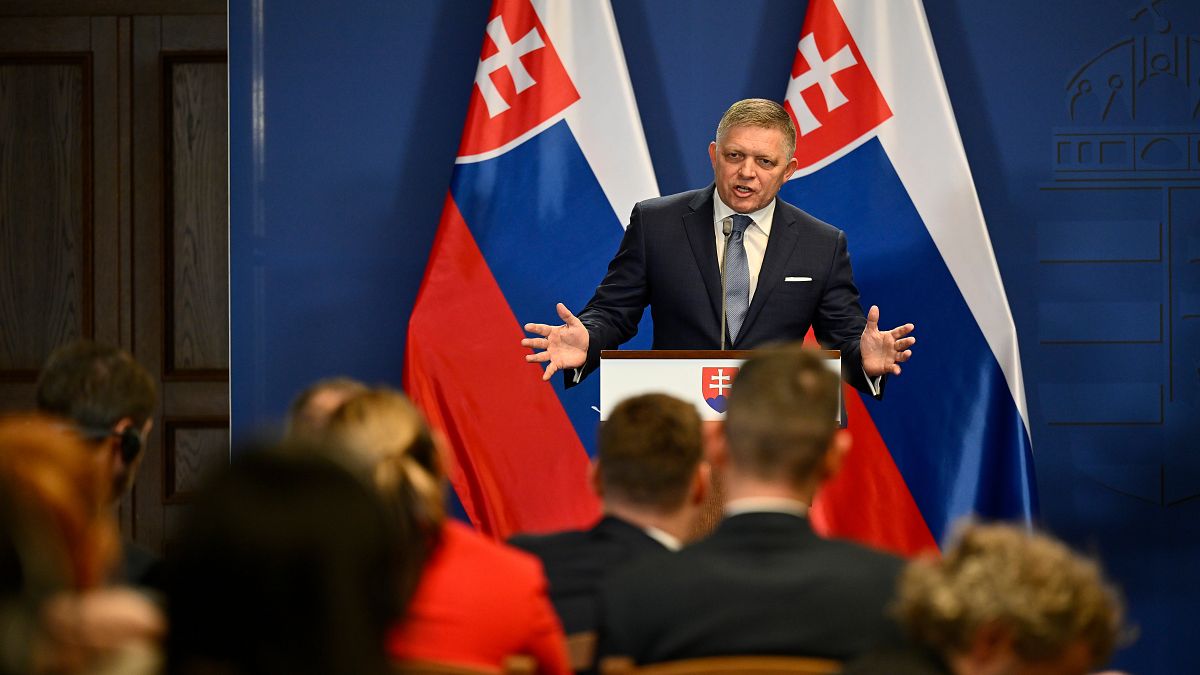
Source: Slovak Prime Minister Robert Fico
But many governments reject the very premise of forced redistribution. Slovak Prime Minister Robert Fico stated bluntly: “You cannot order a country like Slovakia to take 300 migrants it knows nothing about or pay €20 000 for each of them. That is not solidarity; that is diktat.”
Polish Prime Minister Donald Tusk voiced a similar view: “Even if the migration pact comes into force in its current form, we will find ways to protect Poland from the relocation mechanism.”
Italy’s position is more nuanced but no less significant. Foreign Minister Antonio Tajani has emphasized that Rome’s migration policy must shift “from redistribution within Europe to the regulation of migration into the region itself.” In practical terms, this means limiting arrivals before they reach the EU’s borders.
This approach is reflected in Italy’s agreement with Albania to establish two reception centers on Albanian soil where asylum seekers will wait for their applications to be processed. Both centers will be administered entirely by Italy.
Given Rome’s economic weight and its growing assertiveness within the EU, many analysts believe Italy’s stance could reshape Brussels’ migration framework.
Another sign of this evolution is Italy’s Mattei Plan for Africa, named after the visionary founder of ENI, Enrico Mattei. The plan aims to promote economic and social development across Africa, addressing the root causes of illegal migration by creating jobs and stability where people live rather than resettling them in Europe. It represents a shift from reactive humanitarianism to proactive partnership, a move that may redefine Europe’s long-term migration strategy.
Meanwhile, the political landscape across the continent is changing rapidly. In the Netherlands, France, and Germany, right-wing parties are gaining ground, fueled by frustration over immigration and rising costs of living.
In Germany, Alice Weidel, co-leader of Alternative für Deutschland (AfD), captured the sentiment of many when she declared: “The only logical step for all nation states is to immediately leave the European Union, which no longer represents the interests of sovereign nations or free peoples. This structure has outlived its purpose and become an obstacle to development.”
Her words, though radical, reflect a growing perception that Brussels has become detached from the realities of its citizens.
For many Europeans, the EU’s approach to migration epitomizes that disconnect, a top-down policy conceived by technocrats rather than by the societies expected to bear its consequences.
Critics argue that the new pact treats migration as a bureaucratic problem to be managed rather than a political and cultural challenge that threatens to redefine Europe itself. Supporters counter that a coordinated system is essential to prevent chaos and maintain humanitarian standards. The truth lies somewhere between: Europe needs both compassion and control, yet neither can survive without consensus.
The migration debate has also revived deeper questions about what kind of union Europe wants to be. Is it a federation of states sharing sovereignty for common goals, or a loose confederation of nations defending their own identities?
The Pact on Migration and Asylum was meant to demonstrate unity and collective strength; instead, it has exposed how fragile that unity really is.
The issue cuts to the heart of the European project. For Western Europe, open borders and multiculturalism remain pillars of its liberal vision. For Central and Eastern Europe, forged by different historical experiences, migration evokes fears of lost identity and eroded control. These are not simply political disagreements, they are competing visions of civilization itself.
As tensions mount, Italy’s pragmatic diplomacy may offer a model for compromise. By seeking to address the causes of migration abroad and improve coordination within Europe, Rome could bridge the divide between ideological camps. Yet much depends on whether Brussels is willing to adapt its approach and acknowledge the concerns of those who feel left behind.
Europe’s migration dilemma is, at its core, a test of the EU’s survival instinct. The bloc was founded on the ideals of solidarity and shared responsibility. But solidarity cannot be imposed; it must be chosen.
If the EU continues to push uniform solutions on diverse nations, it risks accelerating the very fragmentation it seeks to prevent.
The European Union stands at a crossroads. One path leads toward renewed cooperation, a balanced approach that combines humanitarian duty with respect for national sovereignty. The other leads toward deepening division, populist backlash, and the erosion of the European ideal itself.
Migration, once seen as a temporary challenge, has become the ultimate mirror of Europe’s contradictions. Whether Brussels can reconcile its lofty rhetoric with the practical realities on the ground will determine not only the fate of its migration policy but the future of the Union as a whole.
(If you possess specialized knowledge and wish to contribute, please reach out to us at opinions@news.az).


Similar news