Causes of the colour revolution in Bangladesh



Editor's note: Dr. Ricardo Martins. He lives in the Netherlands. He is a specialist in Geopolitics and International Relations by training and hold a PhD in Sociology with a focus on policy and international relations. The article expresses the personal opinion of the author and may not coincide with the view of News.Az.
Former Bangladesh Prime Minister Sheikh Hasina , unlike the Philippines, refused U.S. pressure to sell or cede St. Martin's Island for transformation into a U.S. base, as it is a strategic point to counter China.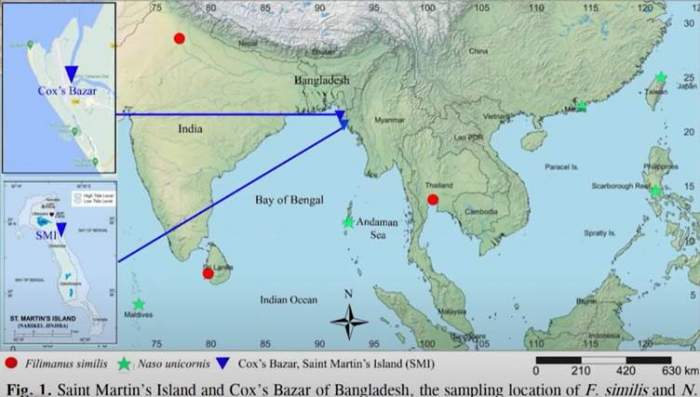
Photo: Map showing the strategic location of St. Martin's Island
In a speech in India, she accused the U.S. of orchestrating her ousting: “I could have remained in power if I had surrendered the sovereignty of St. Martin's Island,” according to The Economic Times.
Sheikh Hasina's previous refusal to join the U.S.-led Quad, a loose strategic alliance among the U.S., Australia, India, and Japan aimed at maintaining influence in the Indo-Pacific and countering China's growing dominance, along with Bangladesh's recent refusal to allow the U.S. to establish a naval base on St. Martin's Island, and the deepening ties between Bangladesh, China, and India, may have been the final straw. This move is also a message to India, which has not fully aligned with U.S.-NATO-led strategic initiatives in the Indo-Pacific region.
The proposed American base on St. Martin's Island would be adjacent to Myanmar, a country that holds strategic significance for China, primarily due to its role in facilitating China's efforts to bypass the Strait of Malacca. The Strait of Malacca is one of the world's most critical maritime chokepoints, through which a substantial portion of China's oil imports and trade must pass. However, this route is vulnerable to potential blockades and geopolitical tensions, making it a strategic vulnerability for Beijing. To mitigate this risk, China has invested in alternative routes, with Myanmar emerging as a key partner in these efforts.
Myanmar's geographical location offers a direct overland route to the Indian Ocean, enabling China to establish energy and trade corridors that circumvent the Strait of Malacca. The China-Myanmar Economic Corridor (CMEC), a crucial component of the Belt and Road Initiative, exemplifies this strategy, including infrastructure projects like pipelines, railways, and ports. The Kyaukphyu port in Myanmar, for instance, is integral to this strategy, providing China with a crucial maritime outlet that bypasses the Strait and reduces its dependency on the vulnerable route.
 Furthermore, Myanmar's position allows China to expand its influence in the Indian Ocean region, countering the presence of other powers such as India and the United States. The strategic importance of Myanmar for China extends beyond economic considerations; it also encompasses geopolitical and military dimensions, making Myanmar an indispensable partner in China's broader regional strategy. This is why the U.S. frequently intervenes in Myanmar's domestic politics, and a potential base on Bangladesh's St. Martin's Island would serve as a strategic location for the U.S. and NATO to counter Myanmar and China simultaneously, as well as India.
A message to India?
U.S. involvement in efforts to influence the change of government under Sheikh Hasina in Bangladesh can be interpreted as a message to India for several reasons, particularly in the broader regional context of South Asia and the Indo-Pacific.
Strategic balance in South Asia: Bangladesh, under Sheikh Hasina, has maintained strong ties with India, including cooperation on security, trade, and regional stability. By potentially undermining her government, the U.S. might be signaling its dissatisfaction with the current regional alignment, where India and Bangladesh have worked closely together, often excluding significant U.S. influence. This can be seen as an attempt to recalibrate the balance of power in South Asia, indirectly pressuring India to reassess its own regional strategies and alliance patterns.
Counterbalance to China's influence: Sheikh Hasina's government has also managed a delicate balancing act between India and China, attracting significant Chinese investment while maintaining a robust relationship with India. U.S. interference might be aimed at disrupting this balance, reminding India that its own influence in the region is not unchallenged, and potentially paving the way for a more U.S.-aligned leadership in Dhaka that could shift the dynamics of India-China competition in South Asia.
Democratic norms and human rights: The U.S. often leverages the promotion of democratic norms and human rights as tools in its foreign policy. By taking a stance against Sheikh Hasina, whose government has faced criticism for authoritarian tendencies, the U.S. is also sending a message to India, where similar concerns have been raised, particularly regarding the treatment of the Muslim minority and Modi’s Hindu-nationalistic policies. This could be interpreted as a warning for India to align more closely with Western democratic standards or face similar scrutiny and potential interference aimed at fostering a more pro-U.S. regime. The U.S. and its NATO allies are unwilling to lose influence over India, a strategic power in the region.
Influence in the Indo-Pacific strategy: Bangladesh is a crucial player in the Bay of Bengal, a region of increasing strategic importance within the broader Indo-Pacific strategy. By influencing Bangladesh's internal politics, the U.S. could be signaling to India that it is prepared to engage more assertively in South Asia, a region traditionally within India's sphere of influence. This could serve as a reminder to India that its strategic autonomy and regional leadership are contingent on its cooperation with U.S. interests in the Indo-Pacific.
Encouraging India's regional leadership: Conversely, U.S. actions could also be seen as a nudge for India to take a more proactive role in managing regional stability. By interfering in Bangladesh, the U.S. might be testing India's response, gauging its willingness and ability to act as a regional leader. This could be part of a broader strategy to encourage India to step up its efforts to counterbalance China's influence in the region, aligning more closely with U.S. objectives.
In conclusion, U.S. interference in the political dynamics of Bangladesh, particularly the ousting of Sheikh Hasina, serves as a multifaceted message to India. It highlights the U.S.'s strategic dominance interests in the region, its concerns over the current balance of power and countering China’s influence, and its expectations of India's role as a regional leader in the context of the growing U.S.-China rivalry in the Indo-Pacific. Colour revolutions or attempts at them have occurred in Myanmar, Thailand, and Bangladesh. Will India be next?
(If you possess specialized knowledge and wish to contribute, please reach out to us at opinions@news.az).


Similar news