How Freedom House ignores Azerbaijan's voice


By Tural Heybatov
Once more, Freedom House has emerged—an organization that, under the guise of defending human rights and democracy, continues its relentless attempts to discredit Azerbaijan on the international stage. The latest report, released by the Freedom House coalition and its partners on the eve of COP29 in Baku, appears to be nothing more than yet another slander campaign against our country, following a predetermined path of bias.
The problem lies in the fact that the report lacks any new evidence or objective analysis. Its authors openly admit to recycling information from a document published back in June, repeating claims of a “humanitarian catastrophe” and “ethnic cleansing” in Karabakh. This raises the question: is Freedom House genuinely committed to human rights, or is it merely serving certain interests, employing the language of human rights advocacy to amplify political pressure? The organization’s astonishing consistency in reproducing Armenian narratives about Karabakh since the end of the 2020 Second Karabakh War casts doubt on its impartiality.Freedom House does not conceal that its latest report reflects the stance it adopted in June 2023. At that time, the organization alleged “rights violations” against Armenians who voluntarily relocated to Armenia, presenting this as evidence of ethnic cleansing. Now, in 2024, the same formulations resurface, along with the same staff member with evident national biases—Andranik Shirinyan—and nearly identical editorial oversight by Vice President Annie Boyadjian, who, coincidentally, is also linked to the Armenian diaspora.
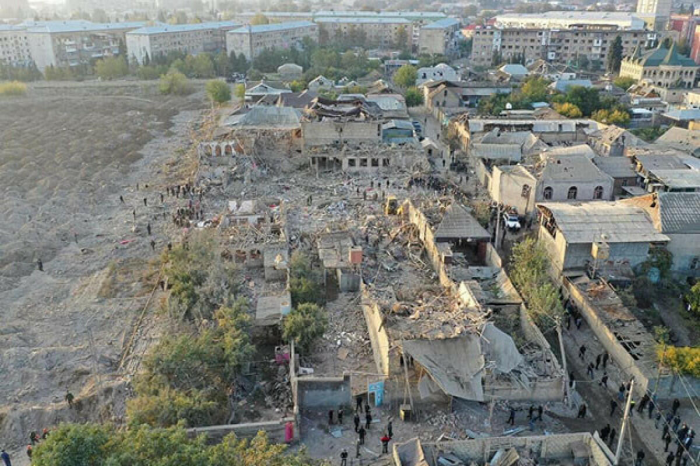
Against this backdrop, it is unsurprising that the report once again overlooks the mass expulsions and persecutions of Azerbaijanis who were deprived of their rights and forced to flee Armenia. Why does Freedom House prefer to ignore the thirty-year occupation of Azerbaijani territories? Why are its reports silent on how peaceful Azerbaijani cities like Ganja, Barda, and Tartar were subjected to missile and artillery strikes by Armenian forces during the 44-day war, resulting in civilian casualties and destruction of infrastructure?
Freedom House, while citing “violations of cultural rights” of the Armenian population in Karabakh, mentions the destruction of Armenian churches and other monuments, yet omits the fact of vandalism and desecration of Azerbaijani holy sites and cultural landmarks during the Armenian occupation. For decades, Azerbaijani mosques, museums, historical buildings were pillaged, and cemeteries leveled. Remarkably, it seems that the protection of cultural heritage becomes a relevant topic for Freedom House only when it concerns Armenian structures, while the fate of Azerbaijani heritage throughout the conflict remains unnoticed by the organization.
The Freedom House report claims that Azerbaijan is pursuing a “systematic policy to cleanse Karabakh of Armenian residents and historical heritage.” However, none of Freedom House's reports have highlighted the instances in which Armenian forces deliberately destroyed Azerbaijani cultural heritage. Such selective omission does not align with the standards of objective analysis that the organization claims to uphold. Moreover, it’s clear that Freedom House sees no need to present facts that might cast a shadow on the Armenian side of the conflict, making its conclusions neither impartial nor complete.
It is also worth noting the funding model of Freedom House. Nearly 80% of this organization’s budget is sourced from the U.S. government, making it less an independent human rights structure than an informal tool of American “soft power.” Although the organization claims to use international platforms and a mandate to promote democracy, it often serves the interests of its sponsors rather than the global community. It’s no secret that U.S. politicians regularly use such rights organizations as levers of pressure on countries whose foreign policy or positions on the international stage do not always align with Washington’s interests. Azerbaijan, a critical energy partner for Europe and strengthening ties with global leaders, has become a convenient target for such reports. In turn, these slanderous statements create an illusion of independent criticism but are, in fact, a well-crafted tactic aimed at discreditation.
Freedom House portrays itself as a defender of human rights, yet its actions call into question its true motives. Instead of providing an objective analysis, its reports offer the same repeated narratives and selective criticism, devoid of a comprehensive view of the context. By expecting the global public to accept this as truth, the organization, unfortunately, undermines trust in itself and the human rights agenda as a whole. Azerbaijan, facing labels and historical distortions, deserves at least a minimum respect for its right to defend historical truth and restore territorial integrity.
For Freedom House to genuinely call itself a defender of rights and freedoms, it must abandon the policy of double standards and hypocrisy that are so clearly reflected in its reports today. When an organization suppresses facts of aggression, violations, and Azerbaijani suffering while amplifying and even fabricating accusations against Azerbaijan, it exposes a glaring hypocrisy masked by human rights rhetoric. Such approaches discredit not only the organization itself but also the very concept of human rights, turning it into a tool for political maneuvering. If Freedom House is serious about being an independent defender of freedoms, it should start by revising its methods and cease serving a political agenda that substitutes human rights with cynical propaganda in the interests of its sponsors.


Similar news