Iran–U.S.: Negotiations or war?




Editor's note: Moses Becker is a special commentator on political issues for News.Az, a PhD in political science and an expert on interethnic and interreligious relations. The article expresses the personal opinion of the author and may not coincide with the view of News.Az.
Today, three key developments dominate the global agenda: tariffs imposed by President Donald Trump, negotiations to end the war in Ukraine, and a potential confrontation between Iran and the United States. The intensified bombardment of Yemen’s Houthi forces starkly illustrates what may await Tehran should it reject the deal proposed by the United States regarding its nuclear and missile programs. In addition, President Trump demands an end to Iran’s support for Hezbollah, Hamas, and Ansar Allah. In essence, the United States expects the Islamic regime to sign an unconditional act of surrender.
For Ayatollah Ali Khamenei, acquiescing to such demands would be immensely difficult, as doing so would nullify the very essence of the 1979 Islamic Revolution—built upon two foundational pillars: the destruction of the State of Israel and the creation of a Shiite empire. To derail the ambitions of the ayatollahs—who have already lost nearly everything—and to prevent Iran’s resurgence, the U.S. Navy has been steadily increasing its carrier presence off the shores of the Middle East. Currently, the region hosts the aircraft carrier USS Carl Vinson (CVN-70) and the USS Harry S. Truman (CVN-75).
Insiders report a notable increase in the presence of U.S. strategic B-2 Spirit stealth bombers, C-17 Globemaster III military transport aircraft, and KC-135 Stratotanker refueling aircraft on one of the islands in the Middle East. These developments signal President Trump’s firm resolve to achieve his objectives. Simultaneously, U.S. strikes on the Houthis in Yemen have intensified, delivering a staggering impact. It appears Yemen is being used as a demonstration to intimidate Iran’s leadership. The message to the ayatollahs is clear: this is what awaits if they refuse to comply with U.S. conditions.
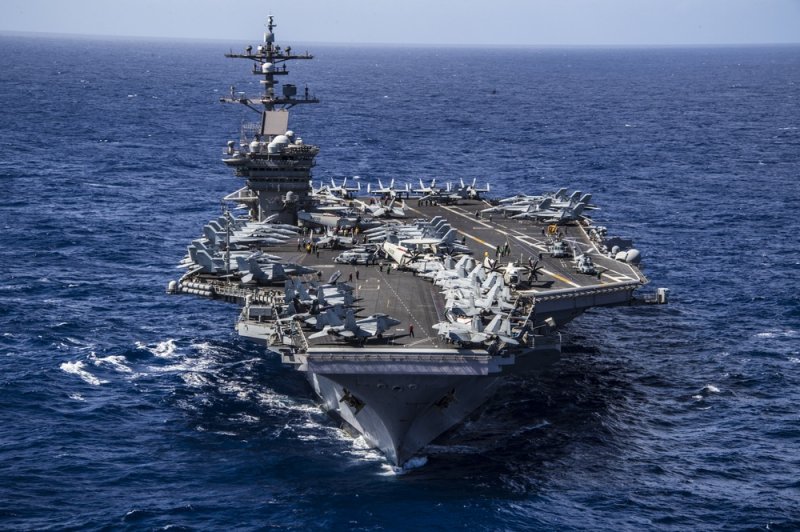 Aircraft carrier USS Carl Vinson (US Navy)
Recently, the Pentagon also deployed several A-10 attack aircraft to the region. An unprecedented build-up of aviation and military hardware is underway—while Iran’s air defense system is nearly in ruins, raising the likelihood of catastrophic consequences in the event of a U.S. strike. Moreover, six B-2 Spirit stealth bombers—amounting to 30% of the U.S. fleet of such aircraft—have been relocated to Diego Garcia. Capable of carrying both nuclear warheads and the most powerful American bunker-busting bombs, these aircraft, according to media reports, could destroy Iran’s underground nuclear facilities.
As noted by aviation expert Peter Layton, deploying six B-2 bombers is excessive for operations against the Houthis in Yemen. The only logical target remains Iran. The B-2s have already been used to strike Houthi underground bunkers, confirming their key role in the campaign. According to the British newspaper Daily Express, citing sources within President Trump’s administration, Iran “will disappear by September” unless it agrees to a nuclear deal.
The United States and Israel are convinced that Iran now lacks allies capable of coming to its aid. The American military operation against the Houthis has been more than successful. The Syrian regime has collapsed. Iran’s attempts to intimidate the U.S. and Israel with its might elicit little more than a wry smile. For instance, Defra Press reported that Iran could launch a devastating attack on U.S. military assets using its advanced Shahed-136 drones, which have a range of 4,000 km—enough to potentially reach the Diego Garcia base, if not intercepted en route. These drones are equipped with explosive warheads and can loiter over targets for hours before striking enemy personnel, vehicles, and buildings. However, their speed is only 185 km/h, meaning the journey would take nearly 20 hours—making interception relatively easy.
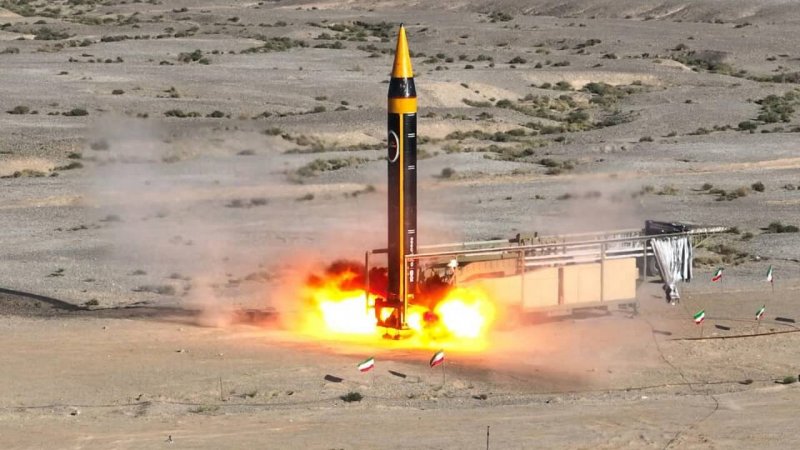 The testing of Iran's fourth generation Khorramshahr ballistic missile, named Khaibar, at an undisclosed location. Photo: AFP
Tehran also threatens to deploy its Khorramshahr ballistic missiles. Yet, its 2024 confrontation with Israel demonstrated that a well-coordinated missile defense system, combined with cutting-edge technologies, neutralizes the supposed advantages of Iran’s military industry. Consequently, Iran has ordered the withdrawal of its mission in Yemen to avoid a direct clash with the U.S. Furthermore, facing crushing sanctions and depleted financial resources, the Islamic Republic has decided to cease all assistance to its proxy forces and reallocate its resources to bolster its own defense.
As a result, Lebanon’s Hezbollah announced its intention to disarm, while Hamas, in panic, urged Israel to end the war in Gaza and seek a compromise to release hostages. As for Ansar Allah, Iranian analysts believe that without material and technical support from Tehran, the Houthis will not survive and are now in their final months—or even days. Perhaps for this reason, many Ansar Allah fighters have begun relocating to Somalia and Eritrea.
In light of these developments, the leadership of the Islamic Republic has agreed to enter into indirect talks with the United States. These negotiations are scheduled to officially begin on April 12, 2025, in Muscat, the capital of the Sultanate of Oman. The talks will involve U.S. presidential envoy Whitko and Iranian Foreign Minister Araghchi.
Thus, the era of the Shiite empire is gradually drawing to a close. A regime founded on expansionism and a medieval ideology has suffered a total collapse. President Donald Trump has demonstrated unequivocally how one should deal with terrorists and their enablers. Simultaneously, news emerged that Indonesia intends to begin accepting residents from Gaza. It appears that Jakarta was offered substantial financial incentives for the resettlement and integration of Gazans—especially as others have also expressed interest in improving their economic position with U.S. support.
In the end, the world has witnessed how the personal resolve of a single leader can change the course of history.
(If you possess specialized knowledge and wish to contribute, please reach out to us at opinions@news.az).


Similar news