The Saudi Crown Prince’s visit to the U.S. and its outcomes


Editor’s note: Moses Becker is a special political commentator for News.Az, a PhD in political science, and an expert on interethnic and interreligious relations. The article reflects the author’s personal views and does not necessarily represent the position of News.Az.
Even during his first term, U.S. President Donald Trump built his Middle East policy primarily around Israel and Saudi Arabia. Although the two states are not bound by a deep friendship, Washington nevertheless considers them its key regional allies. It is noteworthy that the Kingdom of Saudi Arabia has never gone to war with Israel and, in principle, recognizes its right to exist. For this reason, there is cautious optimism that Riyadh may eventually join the Abraham Accords, a topic that was very likely discussed extensively behind the scenes.
Trump’s insistence on this issue stems from the enormous authority the Saudi Crown Prince holds in the Muslim world. Saudi Arabia is home to Islam’s holiest sites, which attract millions of pilgrims each year. Attempts by other states to portray themselves as guardians of the true faith are met with concern in both Washington and Riyadh. The U.S., for its part, is doing everything possible to reinforce Saudi Arabia’s position. Beyond ideological considerations, the kingdom’s immense hydrocarbon reserves and financial power also play a significant role.
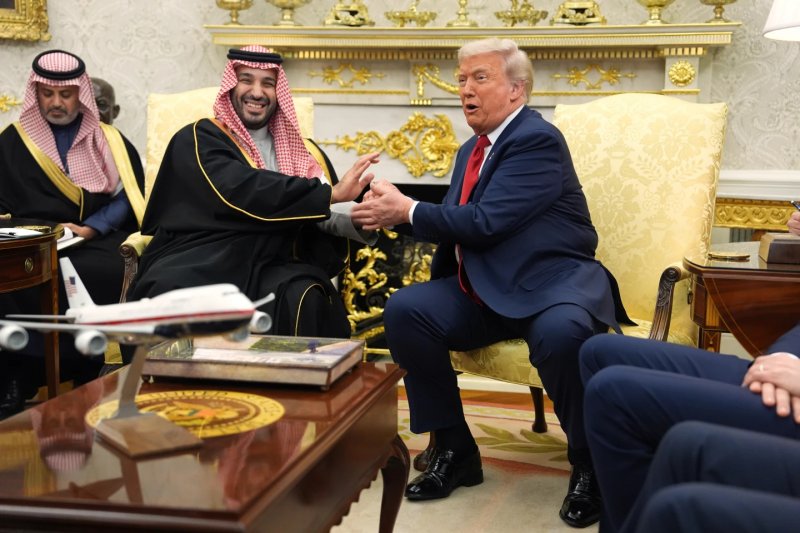
On November 18, 2025, President Trump hosted Crown Prince Mohammed bin Salman at the White House. The event reportedly featured a reception “grander than a standard diplomatic ceremony.” Investment cooperation was a focal point of the discussions.
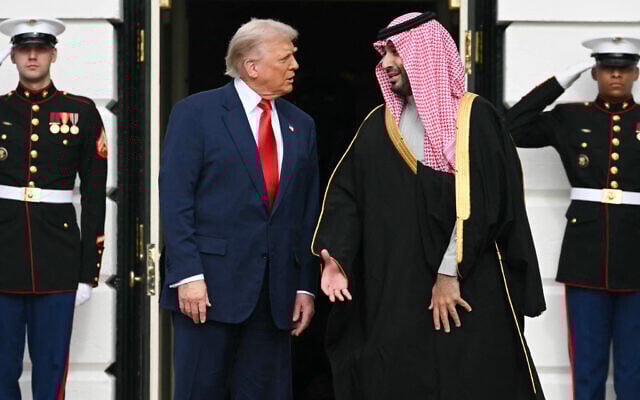 Photo: AFP
Trump stated that the American economy could expect around $600 billion in Saudi investment. The Crown Prince, for his part, said that “Saudi Arabia believes in America’s future,” pledging to increase the investment package to nearly $1 trillion, an amount comparable to the kingdom’s annual GDP.
When asked about potential conflicts of interest involving the Trump family’s business dealings in Saudi Arabia, the president gave an evasive answer, claiming he had no involvement in family affairs. The New York Times noted that just days earlier, the Trump Organization and Saudi partner Dar Al Arkan had announced a new project enabling cryptocurrency investors to buy stakes in Trump-branded real estate.
Meanwhile, Trump’s son-in-law Jared Kushner manages an investment fund that received $2 billion from a foundation overseen by the Crown Prince.
During the meeting, Trump also announced his readiness to sell Saudi Arabia 48 F-35 fighter jets and 300 tanks. It was emphasized that the deal would require Congressional approval and could draw criticism from Israel. There are also concerns that advanced U.S. technology might eventually reach China. These and other factors will reportedly be considered in the final negotiations.
In discussing the Israeli-Palestinian conflict, Mohammed bin Salman hinted that Saudi Arabia might join the Abraham Accords, but only if there is a “clear path” toward establishing a Palestinian state.
It is significant that, parallel to Trump’s engagement with Riyadh, Saudi Arabia was holding talks with China on joint investment ventures and enhanced trade, economic, and military cooperation — developments that Washington viewed with displeasure. Sensing a direct challenge to its strategic interests, the White House became more attentive to Riyadh’s demands. It was the U.S. that helped Saudi private capital re-enter the Syrian market, effectively sidelining Türkiye. Trump’s proposal to sell F-35 aircraft to Saudi Arabia is also linked to these dynamics and has provoked discontent in Ankara, which has spent years seeking its own contract for upgrading its air fleet.
Unable to secure American aircraft, Türkiye moved to purchase 20 Eurofighter jets from the United Kingdom to compensate for the shortfall in its defenses. Washington’s growing rapprochement with Riyadh may therefore lead to a cooling of ties with Ankara. Trump, however, downplays such concerns, viewing warnings about potential fallout as exaggerated. Moreover, the extensive protocol events surrounding the Crown Prince’s visit elevated it to the level of a full state visit, allowing Riyadh to act as an equal interlocutor — unlike many other Arab monarchies historically treated as junior partners.
For a country striving for regional leadership and enjoying explicit support from Trump, such a welcome served as powerful validation of Saudi Arabia’s ambitions. The promised delivery of F-35 aircraft has also elevated Riyadh’s status to a new level. Saudi Arabia will become the first Arab state to acquire the advanced fighter jets and only the second in the Middle East after Israel.
As a result, Saudi Arabia and the Gulf states are solidifying their position as Washington’s main partners in countering Iran and other states seeking regional leadership in the Islamic world.
“Gulf countries, including Saudi Arabia, want Washington to grant strong security guarantees. Qatar has already secured them. Now Mohammed bin Salman wants the same. He also hopes to obtain U.S. support for developing Saudi Arabia’s civilian nuclear program,” reported BBC State Department correspondent Tom Bateman.
Following the visit, Washington officially recognized Riyadh as a “major non-NATO ally,” granting the kingdom expedited access to American military equipment, preferential arms purchases, and expanded cooperation without many of the usual licensing barriers. Saudi Arabia joins 19 other states with this status, including Argentina, Australia, Bahrain, Brazil, Colombia, Egypt, Israel, Japan, Jordan, Kenya, Kuwait, Morocco, New Zealand, Pakistan, the Philippines, Qatar, South Korea, Thailand, and Tunisia.
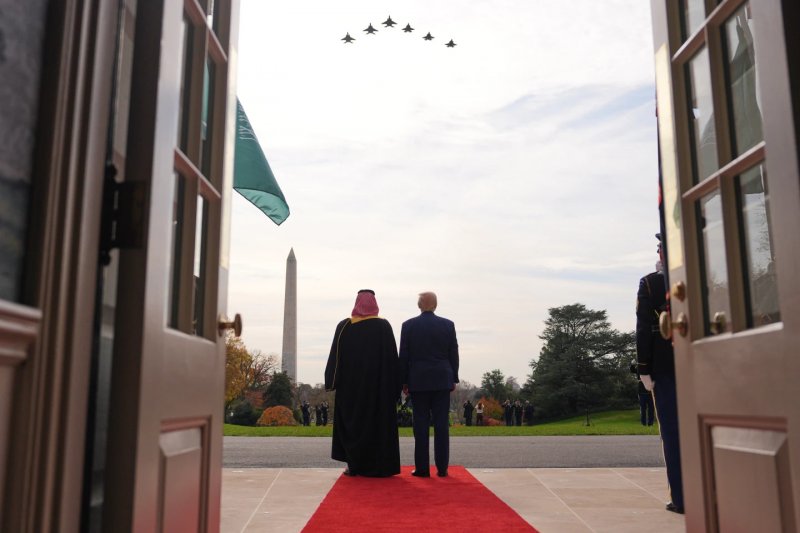 Photo: AP
Trump and the Crown Prince also signed a strategic defense agreement. Both leaders signaled that progress toward establishing diplomatic relations between Saudi Arabia and Israel was possible.
“We discussed a lot. We will continue this dialogue in the near future,” the U.S. president stated.
The Crown Prince confirmed that achieving lasting regional peace was a shared priority.
“We believe that good relations with all Middle Eastern countries are a positive thing, and we want to be part of the Abraham Accords,” Mohammed bin Salman said. “Today, we had a constructive conversation with the U.S. president about what steps we should take.”
U.S.-Iran relations were also addressed during the talks.
“We will do everything possible to help achieve an agreement between the U.S. and Iran,” the Crown Prince told reporters.
“We believe that a mutually beneficial agreement would be good for Iran’s future and for our region,” he emphasized.
Thus, thanks to Trump’s proactive Middle East policy, the U.S. is once again becoming a key player in this strategically and economically important region, where virtually all logistics chains and transportation arteries are located.


Similar news