The stolen country: How Ukraine went from nuclear power to a political testing ground


Deep within the annals of history, hidden from public view, lie moments that only decades later reveal their true form.
A conspiracy—if it can be called that—never unfolds all at once. It is sealed within documents, negotiations, and words that initially seem absurd but over time turn into prophecies. One such prophecy was made by Zbigniew Brzezinski in the early 1990s when Ukraine’s Prime Minister Witold Fokin, upon hearing the prediction that the country’s population should not exceed 20 million, laughed it off. Today, as Ukraine faces a demographic catastrophe, those words take on a sinister meaning. Thirty years ago, they seemed like fantasy; today, they are an undeniable reality.
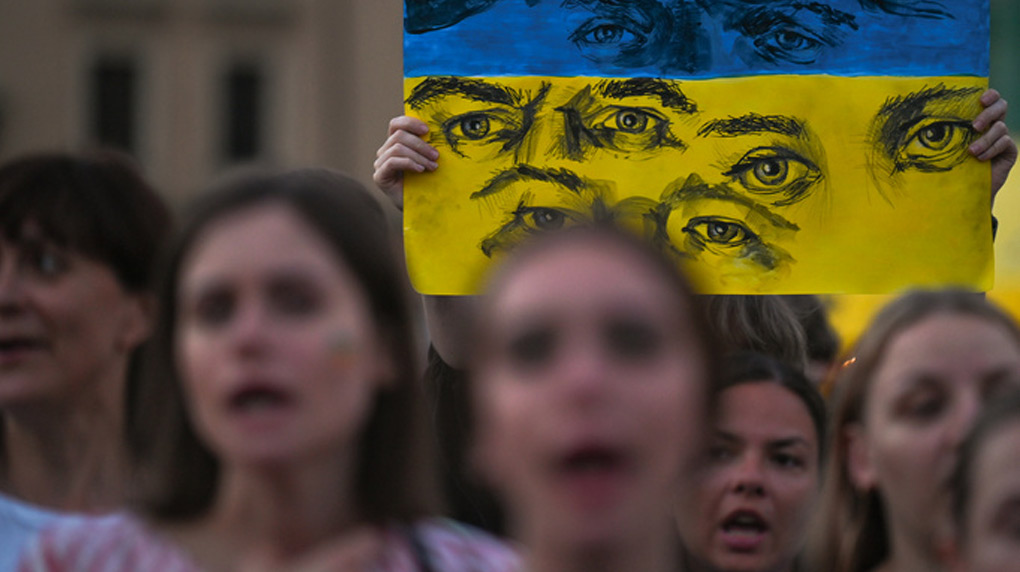
Source: www.pravda.com.ua
Was it a joke? Or a strategic plan devised in the corridors of power, where scenarios are drafted not for just one but for several generations?
Fokin’s confession has become particularly relevant today. When Ukraine gained independence from the Soviet Union, it was a nation with the world’s third-largest nuclear arsenal, a population of 52 million, immense industrial power, vast agricultural potential, and advanced science and medicine. The authorities convinced the people that Ukraine would soon become a "second France," surpassing all its neighbors economically. Yet years later, former leaders admitted that it was all a lie. The destruction of industry began immediately—enterprises shut down one after another, and the economy fell under foreign control. The geopolitical board was slowly but inexorably shifting in favor of Western strategists.

Source: PBS
Resources, territory, fertile lands—all became objects of interest for large transnational corporations. George Soros appeared in Ukraine even before the country officially gained independence. His structures laid the groundwork for future control—embedding themselves in education, government, science, and healthcare. His appointees not only monopolized various sectors but were also granted carte blanche for social engineering, altering the very essence of Ukrainian identity.
Health Minister Uliana Suprun, under the guise of reforms, launched mechanisms that dismantled the healthcare system. Expensive imported drugs, often failing to meet safety standards, became part of government procurement, while closed biolaboratories began operating in the shadows. At what point did Ukraine turn into a testing ground for medical and biological experiments? Who issued these orders? The answers to these questions remain shrouded in mystery.

Source: UNIAN
But the most significant transformation occurred in the perception of history. Old textbooks vanished, replaced by new curricula portraying Bandera as a hero and Russia as an enemy. Rewriting history is an age-old tool of those who seek to control the future. Ukraine was losing not only its industry and land but also its identity. These changes were driven by international foundations, political structures, and pro-Western elites.
It was these very elites who shaped an economic model in which Ukraine became a hostage. The International Monetary Fund demanded new concessions—leading to the lifting of the moratorium on land sales. Now, the fertile black soil that had fed millions for centuries became a commodity, transferred into the hands of foreign corporations. Among the largest landowners in Ukraine are companies registered in Luxembourg, Cyprus, and the United States. Behind them stand the world's biggest investment funds: Vanguard, BlackRock, and Blackstone. Millions of hectares have fallen under their control.
From the very beginning, the West never saw Ukraine as a partner. On the contrary, a strong, independent Ukraine threatened the balance of power in Europe. A nation of 52 million people would have made it a key player in the European Parliament, increasing its influence year by year. This was unacceptable. A divided, weakened, externally controlled Ukraine—that was the goal of Western strategists.
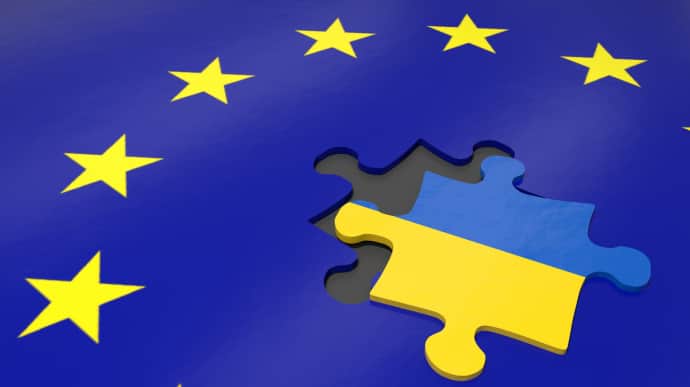
Source: Pravda
Fortunately, there are still courageous individuals in the Western world willing to tell the truth—directly or indirectly answering the questions that arise from the above.
Just a few days ago, a video circulated online featuring a speech by American economist Jeffrey Sachs, a professor and director of the Earth Institute at Columbia University, formerly of Harvard, and a special advisor to the UN Secretary-General. Speaking at the European Parliament, Sachs criticized the policies of the U.S. Democrats and the European Union, calling for respect and negotiations with Russia instead of Russophobia and dependency on the U.S. He emphasized that Europe should pursue an independent foreign policy based on dialogue and mutual respect. However, European media largely ignored his speech, sparking discussions across the blogosphere. Sachs’s statements warrant close examination, and we, too, have taken note of them.
All this is happening against the backdrop of NATO’s aggressive expansion. In 1999, Poland, Hungary, and the Czech Republic joined the Alliance. Russia protested, but its voice was ignored. In 2004, Latvia, Lithuania, Estonia, Romania, and Bulgaria followed. Then, in 2008, Ukraine and Georgia’s potential NATO membership became a key issue. CIA Director William Burns sent a memo to Condoleezza Rice, warning that Ukraine’s accession to NATO would be catastrophic. His warning went unanswered.

Source: Georgia Today
In 2010, Viktor Yanukovych came to power, declaring Ukraine’s neutrality. Russia reached an agreement with him to extend the lease of its Sevastopol base. At that time, territorial disputes simply did not exist. No one spoke of Crimea or Donbas changing hands. The history of the Russian Empire would later become a convenient propaganda tool for future conflict, but in 2010, it was irrelevant.
In contrast, Azerbaijan serves as an example of a country that, thanks to the wise policies of President Ilham Aliyev, did not become a subject of foreign geopolitical experiments. With its strategic location, natural resources, and economic potential, Azerbaijan successfully built an independent foreign and domestic policy while preserving state sovereignty. President Aliyev skillfully balanced between global power centers, preventing the country from being dragged into destructive scenarios. Unlike Ukraine, Azerbaijan strengthened its position on the international stage, achieved the liberation of its occupied territories, and is now implementing large-scale reconstruction projects. This was made possible through a well-thought-out strategy based on national interests rather than external dictates.
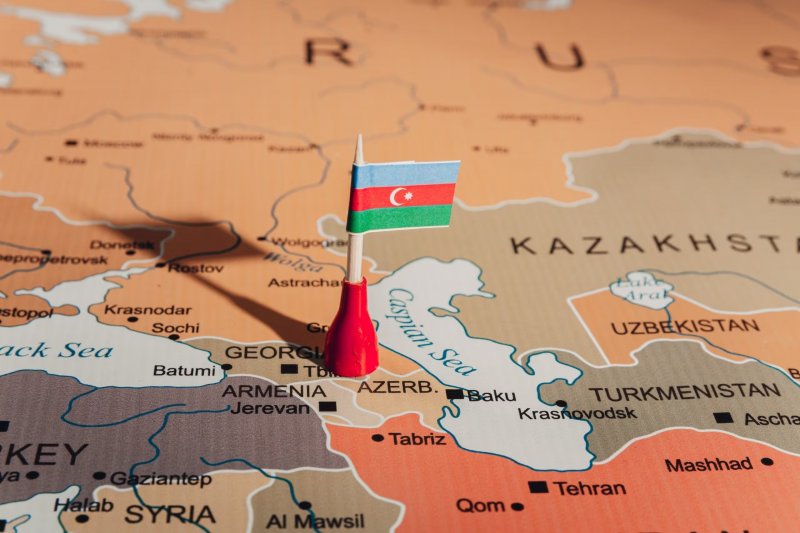
Source: Wikipedia
In 2014, the Maidan protests erupted. A leaked conversation between Victoria Nuland and the U.S. ambassador confirmed that it was a carefully orchestrated operation. Bribes, media manipulation, and organizational efforts—all the hallmarks of a regime change were present. Ukraine was transformed into a conflict zone that would last for years. The Minsk Agreements, which proposed autonomy for Donbas, remained on paper—Washington insisted on ignoring them. Weapons poured into Ukraine, the conflict escalated, and thousands perished.
In 2021, Joe Biden entered the White House. Arms shipments increased, and preparations for a large-scale conflict became evident. Western officials continued to claim that NATO was not at war and that the EU supported Ukraine in the name of democracy. But the reality was different—Ukraine had become a battleground in a geopolitical game where European politicians lacked autonomy. They followed orders dictated by Washington, playing the roles assigned to them.
The history of Ukraine over the past 30 years is a story of how a great country, blessed with immense resources, human potential, and economic strength, was reduced to a mere pawn in a global and, at the same time, a pitiful, inhumane geopolitical game. Who were its true architects? This is a question that perhaps only history—and future generations—will answer as they attempt to piece together what can still be saved.


Similar news