Who will protect Venezuela from enslavement?


Editor's note: Vladimir Bekish is a Russian military-political analyst and an expert in strategic security, with a focus on the Middle East and Africa. The article reflects the author’s personal views and may not represent the position of News.Az.
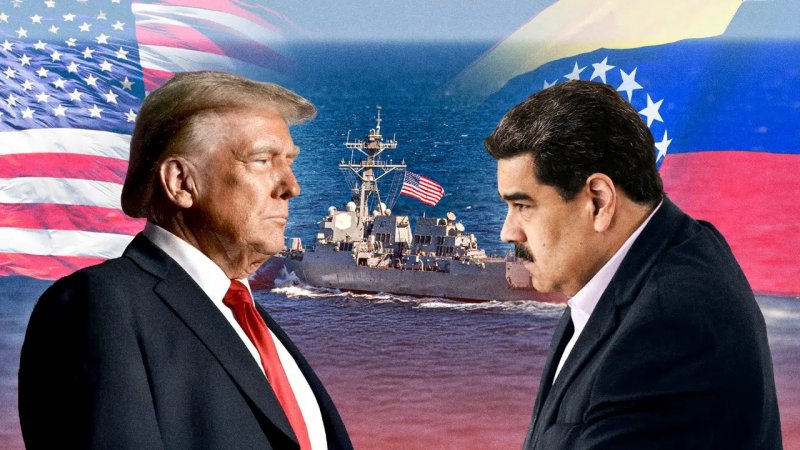
So, in the Latin American backyard, the stubborn Venezuelan boy still refuses to obey the main tough guy of this yard from the “coolest” North America.
This very stubborn Venezuelan, Nicolás Maduro, although he communicates with the American master of all the Americas, Donald Trump, and is even willing to make concessions and step down, nevertheless continues to resist, mobilize his people, and prepare to confront America. The United States, for its part, is ready to fight and speaks openly about the imminent start of a war against Venezuela.
We have already analyzed and described what is happening around Venezuela, but events continue to develop in a negative direction.
In preparing to strike Venezuelan territory, Trump cites the fight against drug trafficking — the production and supply of drugs, especially their shipment to the United States — as the main justification for such strikes and all related U.S. actions.

Source: Reuters
U.S. Navy ships are currently stationed off the coast of Venezuela, while American military aircraft patrol near the country’s borders. In addition, Trump has imposed a blockade on Venezuelan airspace, halting flights by all airlines over the nation. These measures continue despite direct communications between Trump and Maduro.
In response to Trump’s ultimatum to resign, Maduro agreed to step down, but not immediately, as the U.S. president demands, instead proposing a timeline of several years.
At the same time, Trump has repeatedly stated that the United States will target Venezuela, its drug lords, and drug cartels — not just remotely, but potentially by sending troops onto Venezuelan soil. Yet, as is often the case with Trump, no American forces have actually entered the country.
Nonetheless, U.S. forces have conducted strikes against boats and small vessels near Venezuelan waters, claiming the ships were transporting drugs, including shipments destined for the United States — something Trump says he will not tolerate. Many questions remain about these attacks. Venezuelan authorities insist that the targeted vessels were not carrying drugs and that those killed were ordinary fishermen and sailors. In some cases, it is unclear whether the boats were even Venezuelan or if the victims were Venezuelan citizens.
Despite these objections, the Trump administration appears unconcerned. From the U.S. perspective, Venezuela is a defiant country led by a defiant leader, and a country of significant strategic value. All issues must therefore be resolved in America’s favor, with particular attention to Venezuela’s natural resources, especially its oil.
Source: Independent
Recently, the United States imposed a blockade on all sanctioned tankers traveling to or from Venezuela. U.S. naval forces have already seized two vessels at sea near the country, one of which was not even a tanker. Venezuela and President Nicolás Maduro have strongly condemned these actions, accusing the United States of piracy and violations of international law. Caracas has also requested a meeting of the UN Security Council to address the issue. In response, Maduro announced that all ships departing from Venezuelan ports will now be escorted by Venezuelan military forces to protect them from U.S. interference.
Amid this oil-related tension, President Donald Trump made another striking statement, claiming that Venezuela and its current regime had “stolen” oil from the United States — oil located beneath Venezuelan soil. Many were taken aback by the claim, given that Venezuela is not a U.S. territory. Trump later clarified that American oil companies had explored, discovered, and organized the extraction of Venezuelan oil, including for use by the Venezuelan population. In other words, he implied that without U.S. involvement, Venezuela would supposedly have no oil at all — despite holding the largest oil reserves in the world. This statement fits into Trump’s broader narrative of “making America great again” by reclaiming resources he considers rightfully American.
The escalating tensions between the United States and Venezuela are causing serious concern worldwide, particularly in Latin America, where Venezuela has partners and allies with significant military capabilities, including Russia, China, and Iran.
On December 18, Russia’s Foreign Ministry urged the United States to avoid escalating the situation, warning that any conflict could threaten the entire Western Hemisphere. Moscow reaffirmed its status as a friendly nation to Venezuela and expressed concern over the “continuous and deliberate” escalation of tensions. The Russian Foreign Ministry also confirmed that it is providing Venezuela with political support amid the growing conflict with the United States and is seeking a “correct decision” regarding its mediation efforts.
Meanwhile, the U.S. response to Russia’s stance and its view of a potential conflict remains measured. Washington does not appear to fear Russian intervention in support of Venezuela if hostilities begin. This was underscored by a recent statement from U.S. Secretary of State Marco Rubio during a briefing: “We are not concerned about the possibility of escalation with Russia over Venezuela. I mean, we always expected rhetorical support from them,” Rubio said, noting that Moscow already has “its hands full in Ukraine.”
In other words, the United States expects Russia’s support for Venezuela to be largely rhetorical. Despite Maduro’s active communication with Russian leadership, including phone calls with President Putin, reports of mysterious Russian cargo planes arriving in Venezuela with unknown shipments, and Belarusian President Lukashenko’s statement that Belarus is ready to host Maduro, any direct military assistance from Russia in the event of U.S. hostilities would likely be limited to providing satellite intelligence.
Source: Xinhua
It is also possible that North Korean military personnel could suddenly appear on Venezuelan soil or along its coast. While Venezuela has no formal ties with North Korea, Russia maintains a relationship with both countries, creating a potential indirect connection.
Another significant development occurred on December 21, when the U.S. Navy seized a tanker off the coast of Venezuela. The vessel was not on any sanctions list, sailed under the Panamanian flag, and was transporting oil for a major Chinese company. This action could have serious repercussions, as roughly 80 percent of Venezuela’s oil exports are destined for China.
There is little doubt that China will resist any interference by the United States in its energy interests, particularly given the already complex nature of U.S.–China relations. How China will respond remains to be seen.
(If you possess specialized knowledge and wish to contribute, please reach out to us at opinions@news.az).


Similar news