Will Indian workers change Russia more than Moscow expects?


Editor’s note: Ruslan Shevchenko is a Moldovan political analyst and Doctor of Historical Sciences, serving as a special political commentator for News.Az. The opinions expressed in this article are solely those of the author and do not necessarily represent the views of News.Az.
Russia’s renewed interest in Indian labor migration is not merely an economic story about workforce shortages. It is a deeper narrative about identity, demographic engineering, political calculations and an uncertain future where the country must choose which social conflicts it is willing to tolerate — and which it hopes to postpone. While Central Asian migrants have long been the backbone of low-wage labor in Russia, the Kremlin appears to be rethinking the model. The logic behind this shift tells us far more about Russia’s internal anxieties than any official statement ever will.
For decades, millions of workers from Uzbekistan, Kyrgyzstan and Tajikistan sustained Russian construction sites, municipal cleaning sectors, service industries and logistics. They were cheap, available and abundant — a practical answer to a shrinking workforce. Yet their presence has created a reality Moscow can no longer comfortably manage. Ethnic tensions have multiplied. Migrant districts have evolved into culturally isolated enclaves where Russian authority — legal, social, even police — is often unwelcome. Integration did not happen; instead, parallel societies formed, governed more by diaspora leaders than the state.
The cultural friction is visible: many Central Asian migrants show little interest in integrating into Russia’s civic or cultural space, often reacting negatively to established social norms, especially to the liberal behavior and dress of Russian women. They work for wages below those acceptable to native workers, fueling resentment among Russians whose livelihoods are undercut. They cluster in compact communities, build self-contained ecosystems, and local authorities sometimes avoid entering these zones. As friction increases, the Ministry of Internal Affairs and the Federal Security Service are already forecasting the possibility of large-scale confrontations between locals and migrants by 2035–2040. Analysts even warn that these conflicts could evolve into separatist tendencies, given the religious and ethnic composition of regions such as Tatarstan and Bashkortostan, where Islamic identity competes with Russian cultural dominance.
This is where the concept of the “Turkic arc” emerges — a hypothetical demographic belt stretching from Tatarstan through Central Asian states and northeast toward Yakutia, where a Muslim demographic base could eventually contribute to centrifugal tendencies. It is precisely against this backdrop that Indian workers are beginning to appear more attractive to Moscow. Unlike Central Asians, most Indian migrants are not Muslim. They are perceived as less confrontational, less culturally assertive, and more removed from the tension-laden religious landscape that already strains Russia’s internal stability. Historical Soviet–Indian friendship also plays a convenient psychological role: India, unlike the post-Soviet Muslim world, carries no secessionist implications in Russia’s imagination.
But if the choice seems rational, the underlying economic motive is far cruder. Raising wages and improving labor conditions for Russian citizens would cost businesses money, reduce profits, require regulation and expand social obligations. Employers are far less interested in paying higher salaries, offering insurance, honoring overtime, or improving working environments. Their position is simple: if Russians refuse such conditions, they can be replaced with cheaper foreign labor. This logic hardened during COVID-19, which strained budgets and reduced appetite for social spending. After the war in Ukraine began, the government diverted resources to military expenditures, and sanctions constrained the economy further. Even under an optimistic scenario, it will take more than a decade for Russia to recover economic stability. Under a less optimistic one — especially if confrontation with NATO intensifies — wage arrears, factory closures and social cuts will become routine. Employers will continue choosing foreign labor not out of preference, but out of survival.
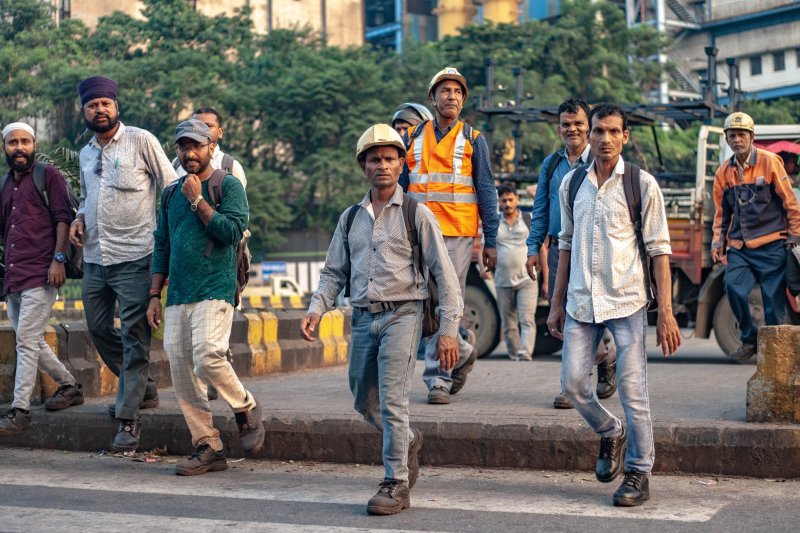
Workers pass by Tata Steel Ltd. plant in Jamshedpur, highlighting daily operations at one of the company's key production sites. (Source: Getty Images)
In this climate, the state prefers silence. The migrant issue is explosive. Public irritation is high, and official rhetoric avoids touching it directly. Yet decisions unfold quietly, strategically, and with long-term consequences. The arrival of Indian workers is already reshaping the migrant hierarchy, provoking an entirely new kind of rivalry — migrant versus migrant. Central Asian communities, having built strong positions in taxi networks, municipal services, markets and construction, see Indians not as colleagues, but as competitors threatening their economic base. Their leaders have begun defensive campaigns: paid bloggers and commentators increasingly frame Indians as “strange,” “dangerous,” “incompatible.” The message is subtle but calculated — Central Asians are now “familiar,” “integrated,” even “part of society,” whereas Indians are alien. This narrative seeks to protect influence and economic territory rather than integration.
With the first tens of thousands of Indian workers already arriving, Russia may soon face not only native–migrant tensions, but full-scale clashes between migrant groups themselves. When that moment arrives, the state will have to choose sides. Any choice carries a cost: support for Indians risks destabilizing Central Asian labor networks, while support for Central Asians undermines the very policy shift Moscow is now pursuing. Such conflicts could disrupt essential services — taxis, food supply chains, municipal systems, retail and low-cost dining — sectors so dependent on migrants that even short strikes could paralyze cities.
At the same time, Indian migration is not only risk. It carries certain advantages that explain why Russia is willing to attempt this demographic experiment. Unlike most Central Asian workers, many Indians arrive with vocational training, higher education or technical proficiency. They often speak English, are more comfortable with flexible work schedules, maintain lower turnover and demonstrate stronger discipline on industrial sites. Russia is attractive to them because the competition is weaker than in the West, particularly in highly technical fields — medicine, engineering, IT, and manufacturing. Indian workers are more willing to relocate to the Far East and Siberia, where domestic and Central Asian labor is less enthusiastic to go. For Russia’s aging industrial infrastructure, this is a valuable resource.
Still, even these advantages are not without complications. The generation of Indians educated in Soviet universities — fluent in Russian, culturally familiar, ideologically connected — is gone. Most modern Indian workers do not speak Russian at all, and language differences will deepen social distance. Workers from southern India will struggle with harsh climate adaptation. Muslims within the Indian flow will encounter similar cultural frictions Central Asian migrants faced. And crucially, as Russia’s economic crisis deepens, salary delays and wage non-payments — already common — will spark frustration more quickly among Indian workers, who tend to have higher expectations of contract integrity. Cultural preferences will create separate food markets, separate religious spaces, separate social clusters. Russia has few Indian restaurants or community infrastructures; new arrivals will build their own. The result could be another large diaspora — educated, organized, culturally distinct and ultimately no more integrated than its Central Asian predecessors.
Russia risks reproducing the same problem with a different demographic. Instead of Central Asian enclaves, the country may eventually host Indian enclaves — new cultural planets orbiting Moscow but rarely merging with it. Integration may become even harder, not easier. And while Indian migrants appear less politically sensitive today due to absence of Turkic identity or Islamic geopolitical implications, no one can predict how identity evolves once numbers grow large enough to sustain a community mindset.
In the long term, Russia’s decision looks less like a solution and more like a postponement. The state is choosing a cheaper workforce instead of investing in its own citizens. It is hoping demographic substitution will cover structural economic decay. But migration is not a plug-and-play mechanism. It changes cities, language, social order and internal cohesion. Demography is policy. Policy is destiny.
If Moscow believes it can control this process, it may discover that the process ultimately controls Moscow instead. Indian workers may be less confrontational today, but their arrival redistributes power among migrant groups, weakens the established Central Asian influence pyramid, introduces new cultural layers and accelerates the fragmentation of Russian urban identity. Economic need is forcing the state to gamble with the composition of its society — a gamble with effects that will last generations beyond this political moment.
Russia is not simply importing workers. It is importing future citizens, future districts, future enclaves, future conflicts. The real question is not why Moscow wants Indians — but whether it understands what comes after.
Migration is no longer just an economic tool for Russia. It is the architecture of its future — fragile, layered, combustible. And as history shows, demographic experiments rarely end the way governments expect.
(If you possess specialized knowledge and wish to contribute, please reach out to us at opinions@news.az).


Similar news