300 robots to race in China’s half-marathon - VIDEO


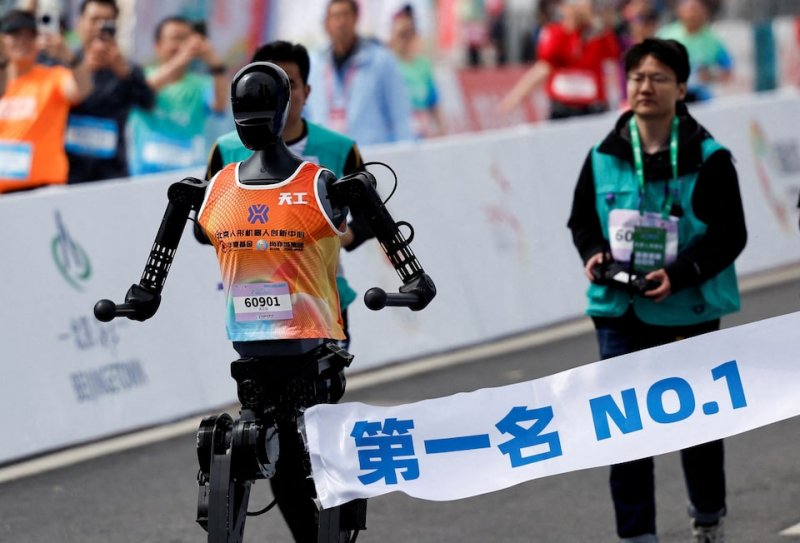
Beijing is set to host a striking display of next-generation robotics as more than 300 humanoid machines prepare to run a half-marathon—offering a glimpse into how far the technology has come, and how far it still has to go.
The 21-kilometre race, part of China’s push to build a world-leading robotics industry, will feature over 70 teams—nearly five times more than last year. Unlike the smoother course in 2025, this year’s route includes slopes, uneven parkland, and more complex terrain designed to push robots to their limits, News.Az reports, citing Reuters.
A major shift from last year: nearly 40% of the robots are expected to navigate the course autonomously. In 2025, every participant was remotely controlled, highlighting just how quickly the technology is evolving.
RECOMMENDED STORIES
One standout contender is Tiangong Ultra, developed by the Beijing Innovation Center of Humanoid Robotics in collaboration with UBTech. After winning last year’s race, the robot is now set to run fully on its own—relying on sensors, algorithms, and real-time decision-making to avoid obstacles and maintain balance.
🔴 INFO - #Chine : Lors d’un marathon de robots à #Pékin, des programmeurs ont été aperçus en train de courir ordinateur à la main derrière les machines. Une scène aussi improbable que symbolique de l’ère technologique actuelle. pic.twitter.com/9vUOA1ufax
— FranceNews24 (@FranceNews24) April 18, 2026
Still, the challenge is steep. At higher speeds, robots must process information and react in fractions of a second, placing intense demands on computing power and battery performance. Training footage from Beijing shows mixed results: some robots run smoothly at speeds up to 14 km/h, while others stumble, fall, or crash into barriers.
China currently dominates the global humanoid robotics market, accounting for more than 80% of installations worldwide, according to industry data. Domestic leaders like Unitree and AgiBot have shipped thousands of units, with Unitree aiming to scale production to 75,000 robots annually.
Yet experts caution against overestimating progress. While a robot finishing a half-marathon is impressive, it does not necessarily translate into real-world usefulness. Many humanoid robots today are still limited to controlled environments—used in research labs, performances, or as interactive service assistants.
Critics argue the industry remains in its early stages, with major gaps in artificial intelligence, dexterity, and reliability. Some even describe current demonstrations as “dancing disguised as working,” pointing to the difficulty of replicating human-level performance in complex, unpredictable settings.
Despite these challenges, China is betting heavily on robotics and “physical AI” as a future engine of economic growth. Companies are rapidly expanding real-world testing and data collection, with thousands of humanoid robots already being deployed in factories to improve learning and performance.
The upcoming race may not prove that robots are ready to replace humans—but it will clearly show how fast they are catching up.
By Aysel Mammadzada


Similar news