Baku: Armenia's aggression remains a major threat to security of Azerbaijan


"Aggression of Armenia against Azerbaijan and continuation of Azerbaijan’s territories occupation by Armenia remains a major threat to the security of Azerbaija
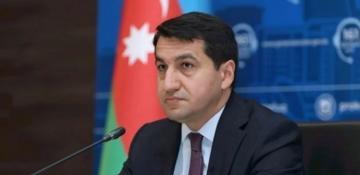
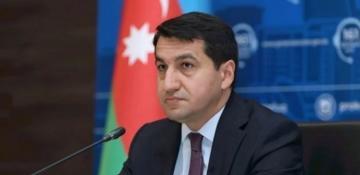
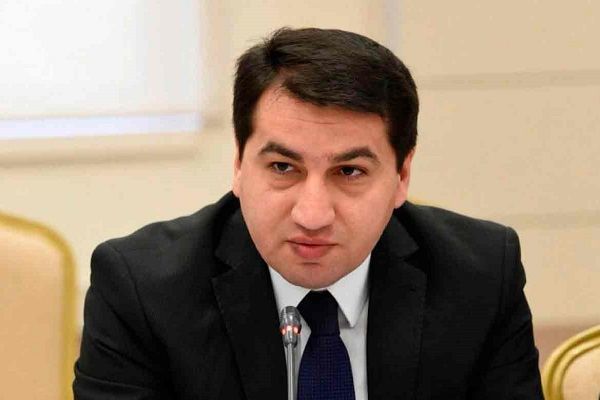
As a result of Armenia's destructive policy of undermining the negotiating process through political and military provocations, setting a precondition for participation in the negotiations and, maintaining the existing status quo of occupation of Azerbaijan’s territories, it was not possible to achieve progress in the political settlement of Armenia-Azerbaijan Nagorno-Karabakh conflict, said spokesman for Azerbaijan's Foreign Ministry Hikmat Hajiyev.
He noted that for the purposes of political sabotage, holding of so-called “referendum on constitutional changes” in the illegal regime created by Armenia in the temporarily occupied territories of Azerbaijan on February 20, 2017 has been rejected by the international community, once again support to territorial integrity and sovereignty of Azerbaijan within its internationally recognized borders was reiterated. Statements by the Ministry of Foreign Affairs on the so-called referendum, Khojaly genocide, the April events, the 25th anniversary of the occupation of Shusha served to disclose real reluctance of Armenia to find political solution to the armed conflict, and to strengthen firm and unequivocal support of the international community to the fair position of Azerbaijan in the conflict settlement.
"In June and July, against the background of increased efforts of Azerbaijan together with the Co-Chairs of the OSCE Minsk Group, the visits of the Co-Chairs to the region and the serious calls of the international community to substantive negotiations, Armenia attempted to escalate the situation along the line of contact by military provocations. As a result of the shelling by armed forces of Armenia on July 4, Alkhanli village of Fuzuli region of Azerbaijan 51-year-old Allahverdiyeva Sahiba and her two-year-old granddaughter Guliyeva Zahra were killed and 52-year-old Guliyeva Sarvinaz was seriously injured.
"Intentional targeting of civilians and civilian objects and their physical annihilation policy pursued by Armenia were strongly condemned by the international community. The international community has once again witnessed that Armenia is not interested in the political settlement of the conflict; instead, by means of such provocations it pursues a policy of derailing the negotiations and continuing the occupation of Azerbaijani territories. Armenia’s impunity encourages it to new military adventures," he said.
According to Hikmat Hajiyev, as a result of consistent measures and political-diplomatic pressures exerted by the OSCE Minsk Group Co-Chairs and the international community jointly with Azerbaijan, Armenia's attempts to undermine the negotiation process and to set preconditions for the negotiation have been evaded, and Armenia has been urged to return to the negotiation table.
"On October 16, Presidents of Azerbaijan and Armenia held a meeting in Geneva mediated by the OSCE Minsk Group Co-Chairs. As a result of the meeting, the Joint Statement by the Foreign Ministers of Armenia and Azerbaijan and the OSCE Minsk Group Co-Chairs noted that the negotiations were held in a positive atmosphere and the Foreign Ministers were instructed to continue negotiations on an intensive and substantive basis. In this regard, on November 14 and 16, respectively Foreign Ministers of Armenia and Azerbaijan met in Moscow with the OSCE Minsk Group co-chairs. Also, on December 6, a meeting of Foreign Ministers of Azerbaijan and Armenia took place on the margins of the OSCE Ministerial Council in Vienna," the spokesman said.
"After the Geneva meeting of Heads of State on October 16th, Azerbaijan supports the intensified, substantial and concrete negotiations. Substantive and logical discussions have been held on all the proposals on the negotiation table at the Moscow meeting in November and Vienna meeting in December. Azerbaijan, together with the OSCE Minsk Group co-chairs will continue efforts for the soonest settlement of the conflict based on norms and principles of international law, relevant UN Security Council resolutions, the Helsinki Final Act which also constitute the mandate of Minsk Group Co-Chairs and for the change of status quo, which was declared on numerous occasions as unacceptable and unsustainable by the Heads of State of OSCE Minsk Group Co-Chair countries.
"The UN Secretary-General made a statement on several times within a year and called for substantial negotiations on the settlement of Armenia-Azerbaijan Nagorno-Karabakh conflict.
"The political-legal bases of the “stage by stage” settlement of the conflict are already known to everyone. The UN Security Council resolutions 822 (1993), 853 (1993), 874 (1993), 884 (1993) on Armenia-Azerbaijan Nagorno-Karabakh conflict has defined the legal framework for the political process on conflict settlement based on international law, as well as the relevant principles of international humanitarian law.
"The UNSC resolutions condemn the occupation of territories of Azerbaijan, emphasize the inadmissibility of land acquisition by use of force, and reaffirm territorial integrity, sovereignty and inviolability of Azerbaijan's borders and demand immediate, full and unconditional withdrawal of occupying forces from all occupied territories of Azerbaijan. UN Security Council resolutions have no time limit. These resolutions are up to date until implementation and are on the agenda.
"Under the document of March 23, 1995 on the mandate of the OSCE Minsk Group co-chairs, in running their activities Co-Chairs should base on the relevant resolutions of the UNSC, decisions of OSCE Budapest Summit and the Helsinki Final Act.
"During the year, Azerbaijan continued its efforts to bring into the international agenda the fact of occupation of Azerbaijan’s territories by Armenia, the serious social and humanitarian consequences of the aggression of Armenia against Azerbaijan and illegal activities of Armenia in the occupied territories.
:The statement adopted by the Economic Cooperation Organization (ECO) at the 13th Summit of the Organization of Economic Cooperation (ECO) in Islamabad in March this year, express concern about the existing unresolved conflicts in the ECO region, including Armenia-Azerbaijan conflict, which hinder the economic growth and realization of the full economic potential of the region and impede the development of economic cooperation on regional as well as broader level, and stress the importance of making increased efforts for the earliest resolution of these conflicts based on the norms and principles of international law, in particular the principles of respect to sovereignty and territorial integrity," Hikmat Hajiyev said.
Accordijng to him, the Joint Statement adopted at the meeting of the Heads of the Government of Organization for Democracy and Economic Development-GUAM held on March 27, 2017 reaffirm member states’ aspirations for the soonest settlement of the continuing conflicts in the territories of the GUAM Member States on the basis of sovereignty, territorial integrity and inviolability of internationally recognized borders of States with the understanding that the territory of a State cannot be the object of acquisition by another State resulting from the threat or use of force.
"Joint Communiqué of the Special Meeting of the Council of Ministers of Foreign Affairs of the Organization for Democracy and Economic Development – GUAM Member States on the occasion of the 20th Anniversary of the Establishment of GUAM, as well as GUAM-USA Joint Statement and Joint Press Release of the 5th GUAM-Japan Ministerial Meeting reaffirm respect to universal norms and principles of international law, particularly respect for sovereignty, territorial integrity and inviolability of internationally recognized borders of States," the spokesman said.
News.Az


Similar news