Blue whale-sized asteroid set for close Earth flyby today


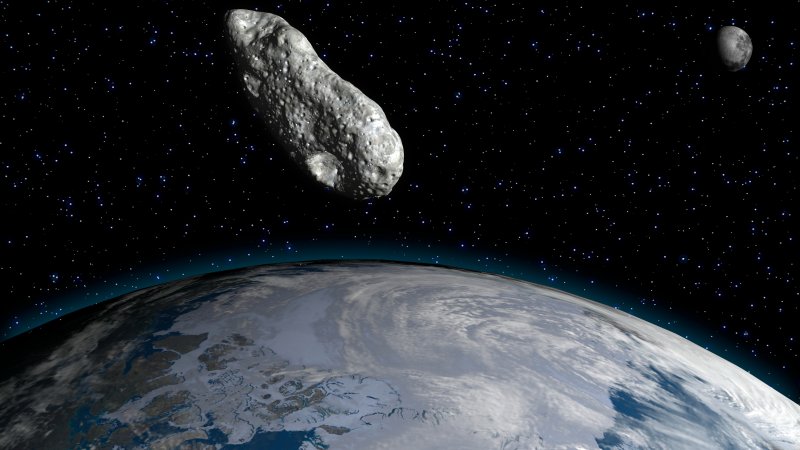
A newly discovered asteroid, comparable in size to an adult blue whale, is set to pass close to Earth today (May 18), at about 24% of the average Earth–Moon distance.
The event can be watched live from home via a Virtual Telescope Project livestream, News.Az reports, citing Space.com.
The near-Earth asteroid, designated 2026 JH2, was first detected on May 10 by the Mount Lemmon Survey in Arizona. Follow-up observations suggest it measures between 52 and 114 feet (16–35 meters) across, based on its brightness, according to the European Space Agency (ESA).
RECOMMENDED STORIES
2026 JH2 will make its closest approach to Earth at 5:23 p.m. (2123 GMT) on May 18, passing at a distance of 56,628 miles (91,135 kilometers) while traveling at 19,417 mph (31,248 km/h) relative to Earth.
The Virtual Telescope Project will stream the event live on YouTube starting at 3:45 p.m. EDT (19:45 GMT) on May 18, weather permitting.
“At the time of the observation, the object will be moving pretty fast against the stars, but our advanced telescopes will precisely track 2026 JH2 while it will be almost at its minimum distance from us, peaking in brightness, around magnitude 11.5, before it will set below our horizon,” Virtual Telescope Project founder Gianluca Masi told Space.com.
Although the asteroid will pass relatively close in astronomical terms, 2026 JH2 poses no threat to Earth or the Moon during its flyby. It is expected to be visible only through telescopes operated by the project in Manciano, Italy.
“We will see it like a sharp dot of light, moving against the starry background, with stars leaving long streaks, as we will be tracking the asteroid,” Masi explained.
After its flyby, 2026 JH2 will continue on a 3.8-year orbit that takes it near Jupiter’s path before returning toward the inner solar system. Its next close approach to Earth is expected in 2060, when it will pass at about 17 times the Earth–Moon distance.
By Nijat Babayev


Similar news