British Airways flight catches fire due to pilot error


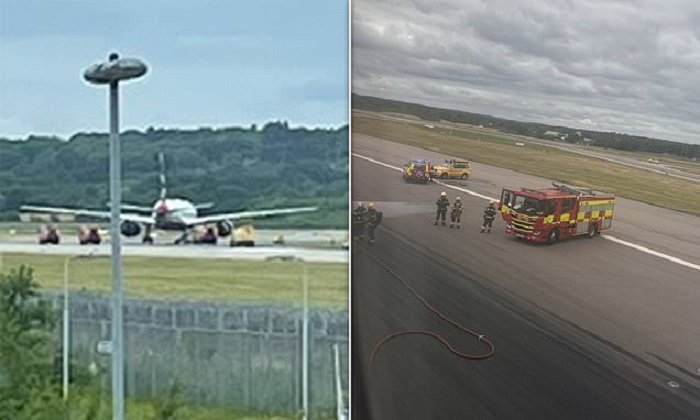
A British Airways flight caught fire after a pilot mixed up left and right during take-off, a report has revealed.
None of the 347 people on the Boeing 777 airliner were injured, although it was serious enough for a formal investigation and report by the safety agency.
Airliner co-pilots use their left hands to operate the aircraft’s thrust levers, which control its engines, and their right hands on the control column.
At take-off, the pilot must pull back on the control column, raising the airliner’s nose so it lifts into the sky.
Instead, the co-pilot of BA2279, an experienced airman with more than 6,000 flying hours under his belt, throttled back right at the point where the aircraft needed maximal thrust to get airborne.
Although he “momentarily” pushed the levers forward again, his training kicked in. Two seconds after the “action slip”, the co-pilot cut the power and applied the brakes from a speed of 186mph.
Momentum meant the Boeing reached a maximum speed of 167 knots (192mph) before it began slowing down.
Airline pilots typically take it in turns to handle take-off and landing. The captain helped the co-pilot “calmly and methodically” complete the rejected take-off procedure, which includes stopping on the runway with full brakes and reverse thrust before radioing air traffic control to ask for an external check of the aircraft.
“The airport rescue and firefighting service attended the aircraft and extinguished a fire from hot brakes on the right main landing gear,” the AAIB report noted. Such fires, while unusual, are not unheard of after a high-speed rejected take-off.
AAIB investigators described what happened in the flight deck as an “action slip”, something that “occurs when an action is not performed as intended, arising in routine or highly learnt motor action sequences”.
They said: “The resulting ‘action sequence’ resembled the RTO [rejected take-off] or landing manoeuvres, rather than a normal take-off.
“There was no obvious reason for [the co-pilot] being primed to do that – for example, he had not recently changed aircraft seat or type, or practised landings or RTOs in a simulator – and he could not identify a reason for it on the day.”
Cancelling just one long-haul flight costs airlines more than £72,000 on average, according to estimates by Eurocontrol, an organisation that promotes safety, efficiency and sustainability in the European airspace.


Similar news